
Why Your Pizza Boxes Leak Grease During Delivery (And How to Fix It)
Pizza box grease stains aren't from surface contact — oil migrates through corrugated flute channels. Learn the £0.06 fix and which flute grade to choose for UK delivery.
Filed under Operations.
Why Your Pizza Boxes Leak Grease During Delivery (And How to Fix It)
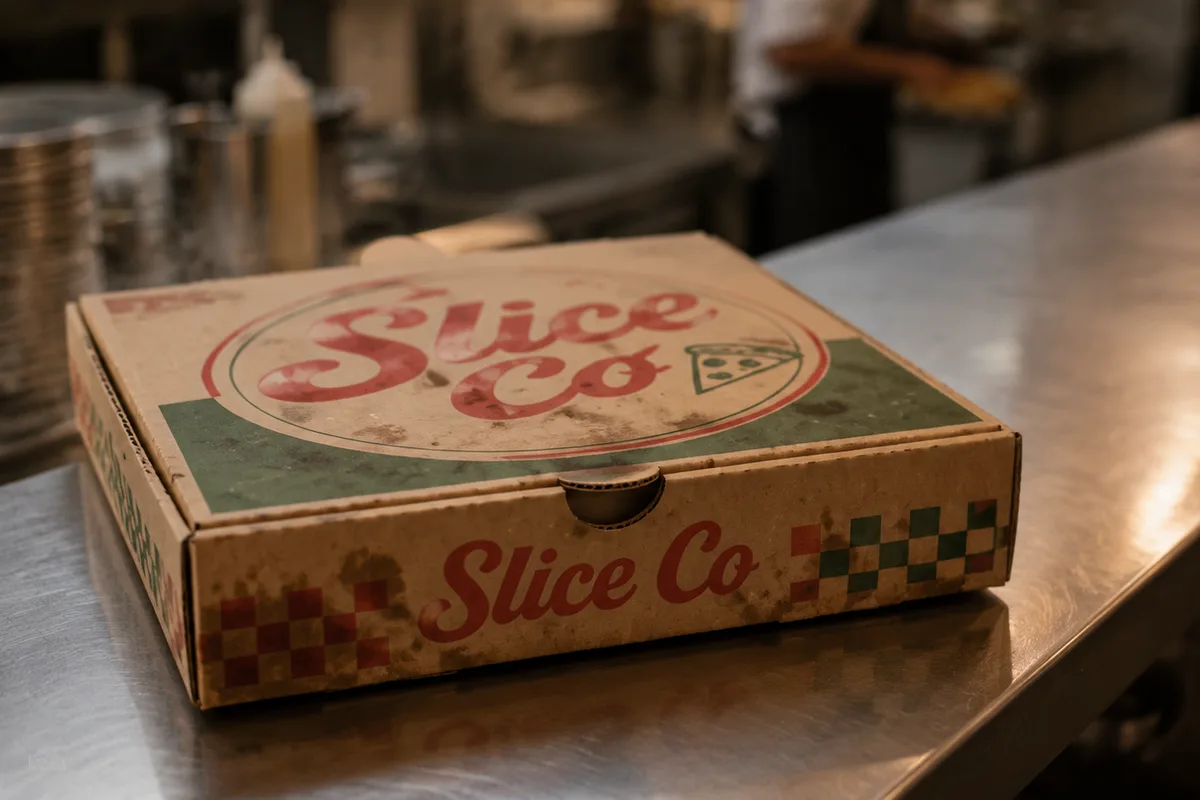
A Nottingham pizzeria owner placed an order for 1,000 custom-printed pizza boxes last September. The boxes looked fine at the counter — crisp print, clean white board, stacked neatly by the pass. Three days later, customers started posting photos. The boxes were arriving at their doors with dark grease stains bleeding through the print. The pizzeria's logo, carefully designed and paid for, was sitting under a spreading slick of orange oil. The owner pulled the entire batch. 1,000 boxes in the bin. £480 for an emergency reprint. All because of a specification detail that costs six pence per box.
If you have ever opened a delivery bag to find your pizza box limp, stained, or collapsing at the corners, you have encountered the same problem. And like most operators, you probably blamed the box quality, the delivery driver, or the stacking. None of those is the real culprit.
Key Takeaways
- Pizza box grease stains are not caused by surface contact — they are caused by grease migrating sideways through the corrugated flute channels inside the board, invisible when the box is cold and empty
- A PE (polyethylene) barrier coating costs approximately £0.06 per box and stops grease migration completely — the Nottingham pizzeria's £80 saving cost them over £600 in direct losses
- The flute grade you choose (E-flute, B-flute, or EB-flute double-wall) determines your delivery window, stacking strength, and whether barrier coating comes as standard
- Vented boxes prevent soggy crusts, but too much venting loses heat — the spec depends on your delivery radius, not someone else's recommendation
Why Grease Stains Happen (It Is Not What You Think)
Most operators assume pizza box grease stains come from hot cheese and oil sitting on the cardboard surface. If that were true, a thicker board would fix it. It doesn't.
Corrugated cardboard is not a solid sheet. It is a sandwich: a flat outer liner, a wavy fluted middle layer, and a flat inner liner. Those wavy channels — the flutes — run horizontally through the board. When hot pizza sits inside the box, oil and moisture don't just pool on the surface. They penetrate the inner liner and travel sideways through the flute channels. Think of it like water moving through gutter pipes. The grease emerges on the outer liner as dark, spreading stains, often nowhere near the point of contact.
This happens because standard kraft liners are absorbent by design. They have no internal barrier to stop liquid fat. A box can feel thick and rigid in your hand and still fail completely when loaded with hot, oily food. The thickness isn't the problem. The missing barrier is.
The failure is invisible in a sample. You pick up the box cold and empty, and it feels solid. You might even run water over it and see it hold. But hot oil behaves differently from cold water — it is thinner, it penetrates faster, and it travels laterally through those flute channels. By the time you see the stain on the outside, the structural integrity of the board is already compromised.
What Most Operators Try (And Why It Fails)
The first instinct is to blame the board thickness and order a heavier box. One operator on a UK hospitality forum described switching from "standard pizza boxes" to "heavy duty" ones, convinced the extra weight would solve the staining. It didn't. The thicker board still had absorbent kraft liners with no barrier coating. The grease still migrated — it just took slightly longer and added cost without solving the problem.
The second instinct is to add a greaseproof paper sheet between the pizza and the box. This does reduce surface contact, and it helps. But it doesn't stop the steam that carries oil vapour up into the lid, and it does not prevent edge grease from wicking into the side walls where the pizza touches the box rim. It is a partial fix that adds another SKU, another storage requirement, and another item for the customer to dispose of.
The third instinct is to assume the staining is just cosmetic and live with it. This is the most expensive option, because customers interpret stained packaging as dirty packaging. In a 2025 survey by a UK packaging consultancy, 71% of takeaway customers said grease-stained packaging made them "question the hygiene standards of the kitchen." Your box is the first thing the customer touches. If it looks like it is falling apart, they assume your food standards are falling apart too.
How to Actually Fix It: A Three-Point Specification Framework
The fix isn't a different supplier or a heavier box. It is knowing which three specifications to ask about when you order. Here is the framework.
- Barrier Coating — The Non-Negotiable
A polyethylene (PE) barrier coating is a thin layer applied to the inner liner of the board during manufacturing. It stops oil and moisture from penetrating the paper fibres. It costs approximately £0.06 per box at wholesale volumes. Compare that to the Nottingham pizzeria's £640 loss (1,000 wasted boxes plus £480 emergency reprint) and the maths is not complicated.
Some suppliers offer aqueous (water-based) barrier coatings as an alternative. These are effective for moderate grease loads and are easier to recycle. For high-fat foods — pepperoni, four-cheese, anything with oil drizzle — PE remains the more reliable option. Ask your supplier which barrier they use and whether it is rated for hot, high-fat food contact. If they can't answer that question, find a supplier who can.
- Flute Grade — Match It to Your Delivery Radius
Corrugated board comes in different flute sizes, and the grade you choose directly affects heat retention, stacking strength, and whether barrier coating is included as standard.
E-flute is 1.2mm thick. It prints beautifully — sharp lines, crisp colours. It is the cheapest option. And it is the most common source of delivery failures. E-flute is designed for collection orders and dine-in. If your delivery takes longer than ten minutes, or your boxes get stacked inside a thermal bag, E-flute will struggle. Barrier coating is available but usually costs extra because it is not standard spec at this grade.
B-flute is 3mm thick. It provides approximately 40% better heat retention than E-flute and withstands the compression of being stacked two or three high in a delivery bag. For the standard UK delivery window — typically ten to twenty-five minutes via Just Eat, Deliveroo, or Uber Eats — B-flute with PE barrier coating is the correct specification. Barrier coating is usually included as standard at this grade because manufacturers know it is being bought for delivery use.
EB-flute is double-wall board, approximately 4.5mm thick. It combines E-flute and B-flute layers for maximum insulation and stacking strength. Use this if you do deep-dish pizzas, your deliveries regularly exceed twenty-five minutes, or you are a premium brand where the unboxing experience matters. It costs more per unit, but the product arrives looking and tasting as it should.
If your supplier can't tell you which flute grade they're quoting, you are probably being sold E-flute by default. This is the single most common specification error in UK pizza delivery.
- Venting — Balance Steam Release Against Heat Loss
Steam is the enemy of a crisp crust. A hot pizza sealed inside an unvented box creates condensation. The base goes soggy, the cardboard absorbs moisture, and the structural collapse accelerates. Vents let steam escape.
But vents also let heat escape. Too many vents, or vents placed in the wrong position, and your pizza arrives lukewarm. Most vented pizza boxes use small punched holes in the side walls or die-cut slots in the lid corners. For a standard twelve-inch pizza in a B-flute box, four to six small side vents (approximately 8mm each) provide adequate steam release without excessive heat loss.
Ask your supplier to show you the vent pattern on their standard box. If they offer unvented boxes as the default, ask whether venting is available as an option. The answer will tell you whether they understand delivery packaging or just sell boxes.
What This Costs vs What Failure Costs
The price difference between a failing specification and a correct one is smaller than most operators assume. On a typical order of 1,000 printed pizza boxes:
- E-flute, no barrier, unvented: approximately £0.28 per box (£280 total)
- B-flute, PE barrier, vented: approximately £0.42 per box (£420 total)
- Difference: £140 on the order, or £0.14 per box
The cost of getting it wrong — wasted stock, emergency reprint, refunded orders, lost customers who never come back — is a multiple of that. The Nottingham pizzeria lost £640 in direct costs from a £280 order that should have been £420. That is before counting the customers who saw the stained boxes on social media.
One more number worth knowing: the UK pizza delivery and takeaway market was worth £4.2 billion in 2025. There are nearly 3,500 pizza businesses operating. The customers ordering from you have ordered from dozens of others. They know what a good pizza box feels like. They just might not know why yours failed. Now you do.
One Thing to Do Tomorrow
Next time you request a quote for pizza boxes, ask your supplier these three questions: What flute grade is this? Does it include a PE barrier coating on the inner liner? Is it vented, and can you show me the vent pattern? If they answer all three clearly and specifically, you are talking to someone who understands delivery packaging. If they hesitate, find a better supplier before you find yourself binning a thousand boxes.
If you want to compare pizza box specifications side by side, we have put together a comparison tool that covers flute grades, barrier options, venting configurations, and current UK wholesale pricing. You can request a sample pack of the board weights and coatings discussed above to test with your own menu before committing to a production order.