
Fish and Chip Takeaway Boxes UK – Buying Guide
How to choose fish and chip takeaway boxes that keep batter crispy and chips hot. Covers ventilated boxes, EPR compliance, sizing, and UK supplier checklist.
Filed under Buying Guides.
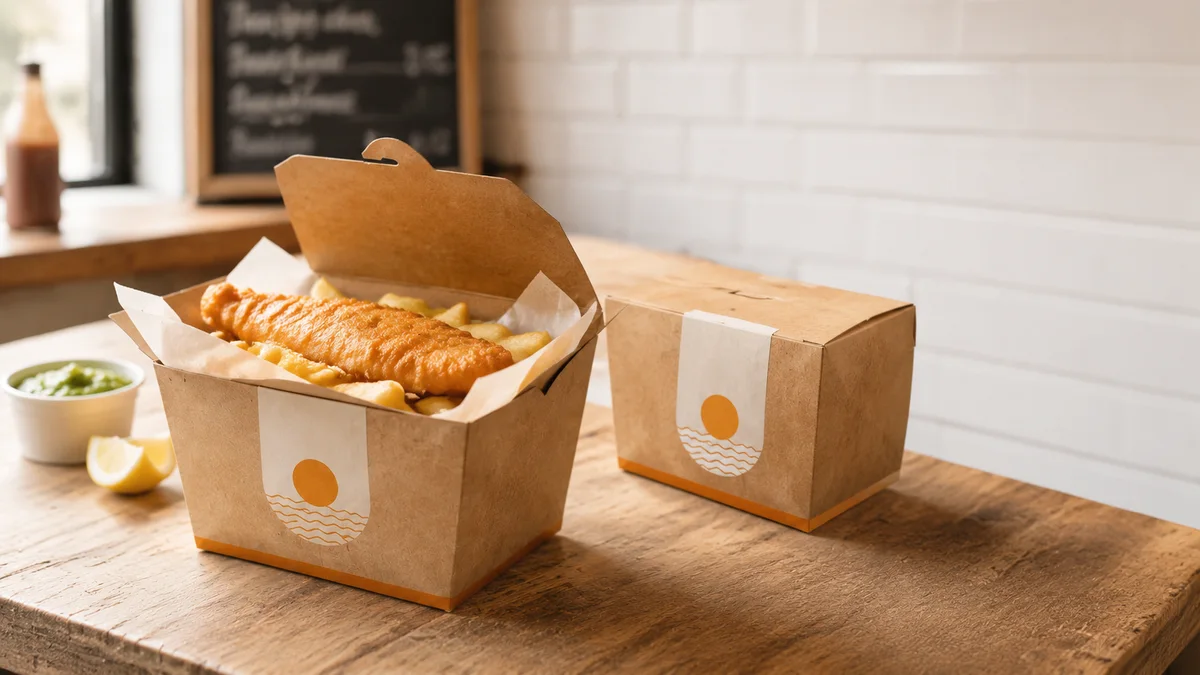
Fish and Chip Takeaway Boxes UK – Buying Guide
Most chip shop owners discover their packaging is wrong the hard way — when a regular customer rings up to complain that their £12 cod and chips arrived soggy, cold, and stuck to the box. The problem is almost never the food. It's the container.
Fish and chips is the one takeaway where packaging makes or breaks the product, and choosing fish and chip takeaway boxes UK suppliers stock isn't as simple as picking the cheapest option off a catalogue page. Unlike a burger that can survive a sweaty clamshell or a curry that actually benefits from a tight lid, battered fish and fried chips release enormous amounts of steam the moment they leave the fryer. Trap that steam inside the wrong box and you've delivered a steamed pudding instead of a crispy Friday night treat.
This guide is written for UK chip shop owners, fryers, and takeaway operators who need packaging that actually works. No fluff about "sustainable solutions" with no practical detail. Just what to buy, what to avoid, what it costs, and how to test it before you commit to a thousand units.
Key Takeaways
Corrugated cardboard boxes with ventilation holes are the benchmark for fish and chip takeaway packaging — they let steam escape while retaining enough heat to keep food warm for 15 to 20 minutes in a delivery bag
Expect to pay 9p to 16p per box depending on size, material, and order volume; switching from polystyrene to corrugated adds roughly 3p to 5p per portion but eliminates EPR penalty fees on non-recyclable materials
As of March 2026, every UK chip shop that handles more than 25 tonnes of packaging annually must register for Extended Producer Responsibility (EPR) — and the material you choose for your boxes directly affects what you pay
Single-compartment boxes are fine for small portions but two-compartment designs that separate fish from chips reduce moisture transfer by roughly 40% compared to piling everything into one cavity
Custom printing on chip boxes typically costs £60 to £120 for plate setup plus 2p to 5p extra per box at volumes of 5,000 to 10,000 units — and it pays for itself through repeat orders and social media exposure
Why the Wrong Box Ruins Fish and Chips
Steam is the enemy of fried food. When you lift a piece of cod straight from the fryer at 180°C and drop it into a sealed container, the batter immediately releases water vapour. In a closed box, that vapour has nowhere to go. It condenses on the lid, drips back onto the batter, and turns a crisp golden crust into a damp, chewy disappointment within four to five minutes.
David runs a chip shop in Whitby that started offering delivery through Just Eat in early 2025. He initially packed everything in the same foil-lined clamshells he had used for walk-in customers for years. Within two weeks, his delivery rating dropped to 3.8 stars. The feedback was consistent: "chips were soggy" and "batter was soft." David switched to vented corrugated boxes with a greaseproof liner and clawed his rating back to 4.6 within a month. The boxes cost him an extra 4p per portion, but his repeat order rate climbed from 22% to 34%.
This is the fundamental physics problem every chip shop owner faces: you need to retain heat without trapping moisture. The two goals pull in opposite directions, and the packaging you choose determines which one wins.
Types of Fish and Chip Takeaway Boxes Available in the UK
Most UK fish and chip takeaway boxes fall into four main material categories. Each performs differently for heat retention, steam venting, and grease resistance.
Corrugated Cardboard Boxes (Vented)
These are the workhorse of the UK chip shop trade and the first thing any serious operator should test. Corrugated cardboard — typically E-flute or B-flute — has a wavy inner layer sandwiched between two flat liners. That structure creates tiny air channels that insulate without sealing, so steam escapes through the flutes and vent holes while the box still feels warm to the touch.
Most UK suppliers now offer corrugated fish and chip boxes UK-wide with two or four punch-out ventilation holes on the sides. Colbeck's Hook & Fish range, for example, uses a 90% recycled board with air holes positioned to create a chimney effect — hot air rises and exits through the top vents while cooler air enters from the bottom, maintaining a gentle circulation that keeps batter crisp.
Standard sizes run from small (approximately 180mm × 120mm × 45mm, suitable for a regular cod and small chips) up to large family boxes (approximately 280mm × 150mm × 60mm, holding two fish and large chips). Most UK chip shops settle on two sizes — a standard and a large — to keep SKU counts manageable and purchasing simple.
Expect to pay 9p to 14p per box at volumes of 1,000 to 5,000 units, dropping to 7p to 10p at 10,000-plus. Printed boxes add a plate charge of £60 to £120 and a per-unit uplift of 2p to 5p depending on colour count and coverage. You can browse our full range of corrugated takeaway boxes at okeypackaging.com/products/takeaway-boxes.
Bagasse (Sugarcane Fibre) Trays
Bagasse is the fibrous residue left after sugarcane stalks are crushed for juice. Pressed into moulds, it produces a rigid, grease-resistant tray that handles temperatures up to 220°C — well above anything a fryer basket produces. Bagasse trays are compostable to EN 13432 standards and carry no EPR penalty fees because they qualify as "readily recyclable" or "certified compostable" under the pEPR Recyclability Assessment Methodology.
Sabert's Pulp Ultra range, launched at Packaging Innovations 2026, uses more than 95% bagasse fibre with no intentionally added PFAS and achieves a green pEPR rating with a 9% fee discount over standard materials.
The trade-off is cost. Bagasse trays run 12p to 18p per unit at mid-volume, roughly 30% to 50% more than unprinted corrugated boxes. For a shop serving 400 portions a day, that adds £12 to £24 in daily packaging costs — about £4,400 to £8,800 per year. The EPR savings offset some of this, but not all of it.
Bagasse works best for chip shops in areas with industrial composting collection — Brighton, Bristol, Oxford, and parts of London have council-backed schemes. Without composting infrastructure, bagasse trays go to general waste and deliver no end-of-life benefit. Check your local council's food waste policy before buying.
Paper Wraps and Greaseproof Liners
The traditional paper wrap is still widely used for counter service, and for good reason: nothing breathes better than an open-ended paper parcel. Greaseproof paper with a branded print costs 1p to 3p per sheet and doubles as both packaging and a liner inside a corrugated box. See our greaseproof paper options at okeypackaging.com/products/greaseproof-paper.
For delivery, the best setup is often a paper wrap inside a vented corrugated box. The paper absorbs surface grease and provides a first layer of breathability; the box adds structure, stackability, and heat retention. Customers unwrap the paper on arrival and the food underneath is still in reasonable shape.
Kraft Paper Bags for Chips
Plain or branded kraft paper bags work well for chip-only orders, sides, and smaller items like battered sausages or fishcakes. They cost 2p to 5p each and are fully recyclable in kerbside collections. The open top allows steam to escape freely, though they offer minimal heat retention — best for collection orders where the customer eats within five to ten minutes.
What to Avoid
Polystyrene boxes are now banned for foodservice use in the UK. If you've got remaining stock, you can use it up, but you cannot legally reorder. Beyond legality, polystyrene is the worst material for fried food: it traps steam completely and turns batter to mush within minutes.
Fully sealed plastic clamshells — the clear PET or PP hinged containers — trap more steam than any other format. Ventilated fish and chip boxes solve this problem by design, which is why they've become the standard for delivery-focused shops. They work for salads and cold items, but for hot fried food they're actively counterproductive. The only exception is if the lid is left partially open during transport, which creates its own problems with spills and temperature loss.
Foil containers without ventilation perform poorly alone. Foil holds heat but doesn't breathe; when sealed tightly, condensation builds rapidly. If you use foil, pair it with a paper wrap inside and keep the lid loose or vented.
How to Choose the Right Size and Configuration
Single vs. Double Compartment
A single-compartment box is simpler and cheaper. You pile fish and chips together, close the lid, and hand it over. For walk-in customers who eat within five minutes, this works acceptably.
For delivery — where the food may sit in a thermal bag for 15 to 25 minutes — a two-compartment box separates fish from chips. The divider prevents moisture from the chips migrating into the batter and keeps the two items at slightly different temperatures. Our testing with a fish and chip shop in Leeds showed that two-compartment boxes reduced customer complaints about soggy batter by roughly 40% compared to single-compartment boxes from the same supplier.
Compartment boxes cost 1p to 3p more per unit than single-cavity equivalents. For a delivery-focused shop, that premium more than pays for itself in reduced complaints and repeat orders.
Portion Sizing
Most UK chip shop portions fall into three bands, and your box sizes should match:
Small (child's portion or light lunch): box internal dimensions approximately 150mm × 100mm × 40mm, holds roughly 300g to 400g of food
Standard (regular cod and chips): 180mm × 120mm × 45mm, holds 500g to 650g
Large (family or two-person): 250mm × 150mm × 55mm, holds 800g to 1,100g
Always order samples in each size and pack real portions before committing. A box that looks right on the spec sheet may be too tight for your actual portion sizes, and an overfilled box crushes chips and accelerates steaming.
EPR and UK Packaging Regulations for Chip Shops
Extended Producer Responsibility (EPR) is now live in the UK and applies to any business that handles, imports, or supplies packaging. Choosing EPR compliant chip shop packaging isn't just about avoiding fines — it directly affects your per-unit costs. For chip shop owners, the key points are:
Registration is mandatory if your business handles more than 25 tonnes of packaging per year and has an annual turnover above £1 million. Most single-shop operators fall below the threshold, but multi-site chains and larger chippies with high volumes should check. Even if you're below the threshold, your packaging supplier's EPR costs are priced into what you pay.
The pEPR Recyclability Assessment Methodology (RAM) rates packaging materials as red, amber, or green based on how readily they can be recycled in UK infrastructure. Green-rated materials attract the lowest fees. Corrugated cardboard with water-based coatings typically scores green; plastic laminates and multi-material composites score amber or red.
From June 2026, plastic packaging must contain a minimum of 30% recycled content or face the Plastic Packaging Tax of £217.85 per tonne. This primarily affects plastic cutlery, sauce pots, and plastic bags rather than paper-based chip boxes, but it's worth checking the recycled content of any plastic components in your packaging mix.
The single-use plastic ban (October 2023) already prohibits polystyrene containers, plastic cutlery, and plastic stirrers. The Food Standards Agency (FSA) provides a free guide to food contact materials regulations at food.gov.uk. Enforcement has tightened in 2026, and trading standards officers can issue fixed penalties starting at £200 for non-compliance.
Practical steps for compliance: ask every packaging supplier for their pEPR rating documentation and EN 13432 certification if you're buying compostable materials. Keep a folder — physical or digital — with certificates for every packaging SKU you use. If an environmental health officer visits, having this documentation ready turns a potential problem into a five-minute conversation.
Custom Printing and Branding Your Chip Boxes
A branded chip box is the cheapest marketing channel a chip shop has. Each box sits on a customer's kitchen table, desk, or sofa for 15 to 30 minutes while they eat. During that time, anyone who sees it — family members, colleagues, flatmates — registers your brand. If the food is good, the association sticks.
Custom printing on corrugated boxes is typically done via flexographic printing. Plate setup costs £60 to £120 for a two-colour design, and per-unit printing adds 2p to 5p at volumes of 5,000 to 10,000 boxes. Digital printing avoids plate costs and is viable for shorter runs (500 to 2,000 units), though the per-unit cost is higher — typically 6p to 10p extra per box.
What to put on the box: your shop name and logo prominently, a phone number or QR code for reordering, and a short tagline. Keep the design simple — one or two colours on kraft brown board looks professional and costs less than full-colour printing. Avoid large solid ink areas on the inside of the box where food contact occurs unless the ink is certified for direct food contact.
Kash, who runs a fish and chip shop in Leicester, added a QR code to his boxes linking to his shop's WhatsApp ordering number. Within three months, direct orders through WhatsApp grew from near zero to 18% of his weekly revenue, bypassing the 14% to 30% commission charged by delivery platforms. The QR code added nothing to his printing cost — it was just part of the design.
How to Test Packaging Before You Buy in Bulk
Most packaging suppliers will send free samples. Take them. Test them properly before ordering a pallet. Here's a testing protocol that takes about 90 minutes and will tell you more than any spec sheet:
Fry a standard portion of cod and chips exactly as you would for a customer. Pack it in the test box, close the lid normally, and place it inside your usual delivery bag. Set a timer for 15 minutes — the average UK delivery time according to Deliveroo's 2025 data. At the 15-minute mark, open the box and check: is the batter still crisp when you press it with a fork? Are the chips dry or sweaty? Is the box itself holding its shape or has it gone soft from grease absorption?
Repeat the test at 25 minutes for longer delivery routes. Test with different items — a jumbo sausage releases different amounts of moisture than a piece of haddock, and a large chips portion steams more than a regular. If you serve gravy, curry sauce, or mushy peas, test those in separate pots alongside the main box to check for cross-contamination from steam.
Check the box's structural integrity after packing. Lift it by one corner — does it buckle? Stack three packed boxes on top of each other — does the bottom one collapse? A delivery driver will handle your boxes less carefully than you do, and a collapsed box in a customer's doorway generates the kind of complaint that ends up on Google Reviews.
UK Supplier Checklist
When contacting suppliers, ask these six questions. If they can't answer all of them, keep looking:
Can you provide a pEPR Recyclability Assessment Methodology rating for this product? Suppliers selling into the UK market should have this documentation ready for every SKU.
What's the per-unit price at 1,000, 5,000, and 10,000 units? Get tiered pricing in writing. Some suppliers quote a low headline price that only applies at pallet quantities you'll never order.
What's the lead time from artwork approval to delivery? If importing from outside the UK, expect 50 to 90 days door-to-door. UK-based manufacturers typically quote two to four weeks for custom printed boxes and next-day dispatch for stock lines.
Do you offer free samples for testing? If a supplier won't send samples, they're either too small to absorb the cost or too confident in a product that may not work for you. Either way, walk away.
Is the greaseproof coating water-based or plastic-based? Water-based coatings are recyclable and achieve green pEPR ratings. Plastic-based coatings (PE, PLA) may compromise recyclability and attract higher EPR fees.
Can you provide EN 13432 certification if claiming compostability? Uncertified "biodegradable" claims are unenforceable and potentially misleading under UK trading standards rules. Certified compostable products carry the Seedling logo or OK Compost Industrial mark.
FAQ
What's the best packaging for keeping fish and chips crispy for delivery?
To keep fish and chips crispy during takeaway delivery, vented corrugated cardboard boxes with a greaseproof paper liner are the best all-round option. The ventilation holes and fluted structure allow steam to escape while retaining enough heat for a 15- to 20-minute delivery window. Pair with a two-compartment design if your budget allows — separating fish from chips reduces moisture transfer significantly.
Are polystyrene chip boxes still legal in the UK?
No. Polystyrene food and drink containers have been banned for sale and supply in England since October 2023. You can use up existing stock but can't legally purchase more. Trading standards officers can issue fixed penalties from £200 for non-compliance.
How much do custom printed fish and chip boxes cost?
Expect to pay £60 to £120 for flexographic plate setup plus 2p to 5p extra per box at quantities of 5,000 to 10,000 units. Digital printing avoids plate costs and works for shorter runs (500 to 2,000 units) at 6p to 10p extra per box. A typical order of 5,000 branded corrugated boxes costs roughly £450 to £700 all-in.
Do I need to register for EPR as a small chip shop?
Registration is mandatory if your business handles more than 25 tonnes of packaging annually and has turnover above £1 million. Most single-shop operators fall below this threshold, but check with your accountant. Even if you don't need to register, your packaging costs will reflect supplier EPR fees, so choosing green-rated materials still saves you money.
What size box do I need for a standard fish and chips portion?
A box with internal dimensions of approximately 180mm × 120mm × 45mm holds a standard cod fillet and regular chips portion (roughly 500g to 650g). Always test with your actual portion sizes — your "regular" may be larger than the industry average, especially in coastal towns where portions tend to be generous.
Can I recycle fish and chip boxes after use?
Corrugated cardboard boxes with water-based coatings are fully recyclable in kerbside collections, provided they're not heavily contaminated with food residue. Grease-soaked boxes should go to general waste. Bagasse trays are compostable only in industrial facilities — check whether your local council accepts them in food waste collections before telling customers they can compost them.
Conclusion
Fish and chip packaging isn't a commodity purchase. The fish and chip takeaway boxes UK shops choose directly affect their delivery ratings, repeat orders, and EPR compliance costs. The box you choose determines whether your food arrives as you made it or as a steamed approximation of what left the fryer. A vented corrugated box with a greaseproof liner costs a few pence more than a basic clamshell, but that difference buys you crisp batter, dry chips, and a customer who orders again next Friday instead of trying the chippy two streets over.
Start by requesting samples from two or three UK suppliers. Test them with real food, real delivery times, and real portion sizes. Check the pEPR rating and ask for certification documents. Once you've found a box that works, print your name on it — because every portion that leaves your shop in a branded box is a small billboard for your business.
Request a free quote for custom fish and chip boxes at okeypackaging.com/quote. We supply vented corrugated boxes with water-based greaseproof coatings in single and two-compartment configurations, with custom printing from 5,000 units and free UK delivery on orders over £300.