
Paper Coffee Cup Lids Leaking in Your UK Café? Here's What McDonald's Proved the Hard Way
McDonald's pulled its paper coffee cup lids after customer complaints of leaks and burns. Learn why fibre lids fail, how to test them properly, and which lid material suits your UK cafe's service model.
Filed under Operations.
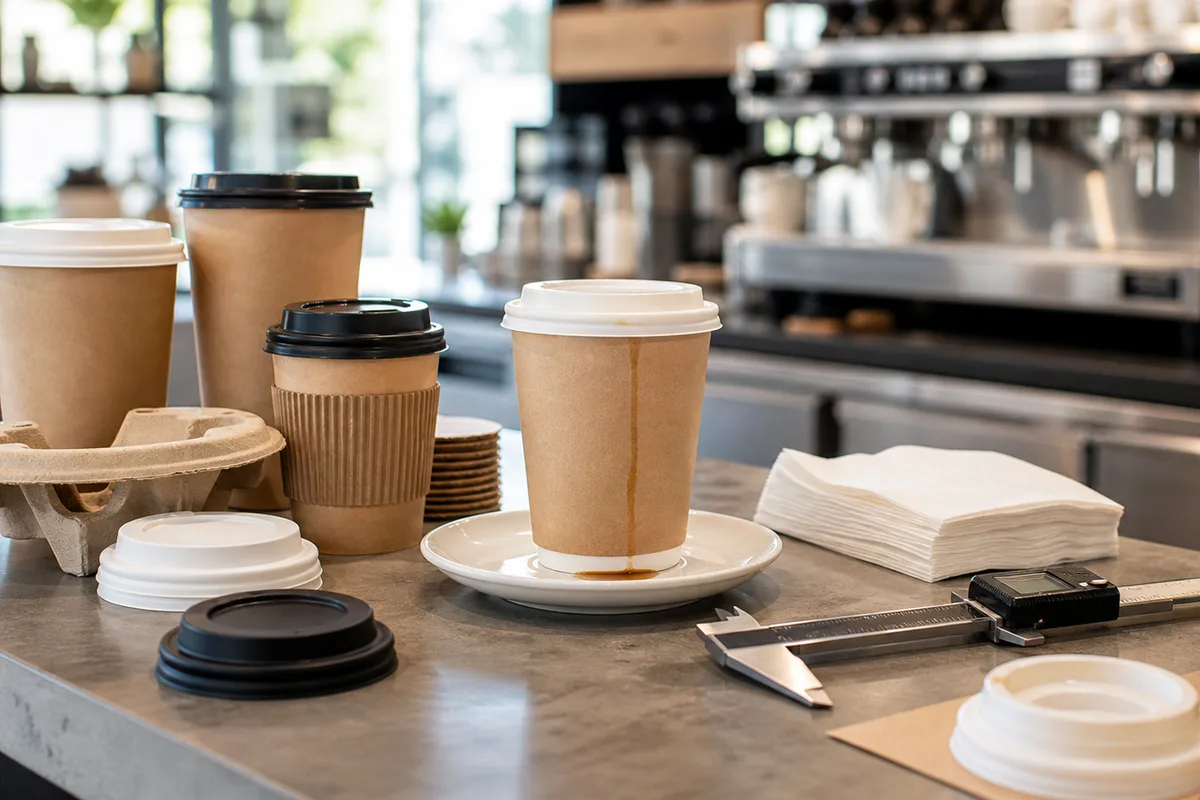
In January 2025, McDonald's UK rolled out moulded fibre coffee cup lids across every restaurant in the country. The idea was simple: swap plastic lids for paper-based ones, cut single-use plastic, and meet the growing demand for sustainable packaging. Less than twelve months later, they reversed the decision and switched back to plastic. Customers had complained of lids going soggy mid-drink, collapsing into their coffee, and in some cases, coming off entirely — dumping hot liquid onto hands, laps, and car seats. One staff member at a Midlands location told the press the quiet part out loud: "One thing we kept hearing was that coffee was leaking out. The paper lids weren't secure enough."
If the largest quick-service chain in the UK, with its vast supplier relationships and testing resources, couldn't make paper lids work, where does that leave an independent café owner trying to make the same decision on a Tuesday afternoon? The answer isn't "give up and stick with plastic." It's understanding why paper lids fail, what the actual alternatives are, and how to test lids properly before you commit to a production order.
Key Takeaways
- Paper and fibre lids fail primarily because of condensation and steam — not because the material is inherently weak. The failure mechanism is predictable and testable.
- McDonald's UK spent millions on a paper lid rollout that lasted under a year. The lesson for independents: run your own real-world tests, not just supplier demo tests.
- Plastic, CPLA, and fibre lids each have a different sweet spot for cost, performance, and environmental claims. No single material wins on all three.
- Testing lids at the counter is not enough. You need to test them after 20 minutes in a delivery bag — that's where most failures happen.
Why Paper Coffee Cup Lids Fail
Most café operators assume a leaking lid means a bad batch or a manufacturing defect. The actual cause is more fundamental — and it explains why McDonald's, with its famously rigorous supplier standards, still couldn't solve it.
Paper and moulded fibre lids absorb moisture. That is not a design flaw; it is a property of the material.
When hot coffee sits under a lid, steam rises and condenses on the underside. Over 10 to 15 minutes — roughly the length of a delivery journey or a leisurely drink — that condensation soaks into the fibre structure. (We have covered the broader condensation problem for takeaway packaging in our guide to stopping condensation ruining takeaway food.) The fibres swell, lose rigidity, and the lid begins to soften. The snap-fit rim that felt secure when the barista pressed it on now flexes under slight pressure. A customer lifts the cup to their mouth, applies a small squeeze to the cup wall, and the lid pops off. This is not a freak accident. It is physics.
The second mechanism is mouth contact. A plastic lid sheds moisture — coffee runs off the surface. A paper lid absorbs saliva and coffee residue at the sip hole. Over the course of a single drink, the area around the opening breaks down. By the last third of the cup, the lid feels unpleasant against the lips and starts losing its structural integrity exactly where it matters most.
McDonald's confirmed both failure modes at scale. Their fibre lids reportedly "made coffee taste different" and felt "uncomfortable in the mouth," according to customer complaints documented by multiple UK news outlets. McDonald's official statement was diplomatic: "The innovation didn't meet expectations and customers told us they weren't satisfied." Translation: the lids failed in ways that affected the drinking experience enough to generate a PR problem.
What UK Café Operators Have Tried — And Where It Goes Wrong
When operators encounter lid problems, the instinct is to try the obvious fixes: order lids from a different supplier, switch to a thicker gauge, or move to a dome lid that sits higher above the coffee surface. These sometimes help for a week. Then the same complaints return.
The supplier-switching trap is the most common. One café group in Manchester told a hospitality forum they had tried three different "compostable" lid suppliers in eighteen months. Every single one performed well on the first order — because the supplier sent their best production run. Orders two and three were from different production batches, with slightly different fibre blends, and the failure rate crept back up. The operator assumed the first batch was the norm. It was the exception.
Then there is the dome lid assumption. A higher lid profile does reduce condensation contact — steam has more volume to disperse before settling. But it does not solve the fundamental moisture absorption problem. The steam is still there. The fibre is still fibre.
A dome lid buys you an extra five to eight minutes before the softening starts. For an eat-in café where drinks are consumed in ten minutes, that might be enough. For delivery, where the journey alone is twenty minutes, it is not.
The third common mistake is conflating "compostable" with "high-performance." The EN 13432 industrial composting standard tests whether a material breaks down in controlled facilities — not whether it holds up under hot, wet conditions for 30 minutes.
A CPLA lid and a bagasse fibre lid can both carry the "compostable" label. Their real-world performance is completely different. CPLA, being a crystallised plant-based plastic, behaves much like conventional PS lids. Bagasse and moulded fibre behave like, well, paper. Operators who buy based on the compostability logo rather than the material spec inevitably end up disappointed.
A Practical Framework for Choosing Coffee Cup Lids That Actually Work
The good news is that lid failures are predictable — and predictable problems are testable. Here is a framework that works regardless of which supplier you end up buying from.
Step one: understand the material trade-offs honestly. There are four lid materials in common UK foodservice use today, and none of them is perfect.
Polystyrene (PS) lids are the industry workhorse. They snap on securely, resist heat without softening, and cost around 1.5p to 2.5p per unit at volume. They are technically recyclable, but very few UK councils accept them in kerbside collections. Under the UK Plastic Packaging Tax, they attract the full £217.85 per tonne charge because they contain zero recycled content. You can check the latest rates and thresholds on the gov.uk Plastic Packaging Tax guidance page.
Polypropylene (PP) lids are slightly more expensive — roughly 2p to 3.5p per unit — but are more heat-resistant and less brittle than PS. They crack less during transport and are accepted by more UK recycling streams, though still not universally. PP lids with 30% or more recycled content are exempt from the Plastic Packaging Tax.
CPLA lids are the plant-based plastic option. They look and perform similarly to PS, handle heat well, and carry the industrial compostability certification. They cost 3p to 5p per unit — roughly double the price of a standard PS lid. The catch is that they only compost in industrial facilities, which are patchy across the UK — WRAP's latest recycling infrastructure report confirms that fewer than half of UK households have access to a food waste collection that accepts compostable packaging. If your customers throw CPLA lids in general waste, the environmental benefit is theoretical.
Fibre and bagasse lids are the category McDonald's tried and abandoned. They cost 3p to 6p per unit, carry strong eco credentials on paper, and look the part in an Instagram post. But they soften with steam, can affect taste, and feel different in the mouth. For short-duration eat-in service, they can work. For delivery, they are a gamble.
So: which lid material should you pick? It depends on your service model. Here is the trade-off in plain terms:
Eat-in café, strong eco brand: Fibre or bagasse lids work. The drink is consumed in under ten minutes, before the steam has time to do real damage. The customer sees the natural material and associates it with your sustainability values. You pay roughly 3p to 5p extra per cup compared to plastic. For a café doing 200 covers a day, that is £6 to £10 in additional daily cost — manageable if your brand positioning supports it.
Eat-in café, cost-conscious: PP lids are the practical choice. They perform well, cost 2p to 3.5p per unit, and are accepted by more UK recycling streams than PS lids ever were. They do not carry the same eco marketing value as fibre, but they also do not generate complaints. If you want to offset the plastic perception, add a line on your menu or cup sleeve explaining the choice.
Delivery-focused kitchen, any volume: CPLA or PP. Do not use fibre lids for delivery. The maths is straightforward: a CPLA lid costs roughly 2p more than a fibre lid. A single refund or remake from a lid failure costs your business £15 to £30 in food cost, delivery fees, platform penalties, and staff time. You would need to save 750 to 1,500 lid purchases to offset one failure. At 200 orders a day, that is less than a week — meaning even a single lid failure per week wipes out any savings from choosing the cheaper material.
Mixed trade (eat-in plus delivery): Run two lid stocks. It sounds like more inventory to manage, but the operational logic is sound. Use fibre lids for your counter trade where they perform well and customers see them. Use CPLA or PP lids for delivery orders where the lid needs to survive 20-plus minutes in a bag. The dual-stock approach costs a bit more in storage space but eliminates the compromise where neither service model gets the right lid.
Step two: test lids under your actual operating conditions, not the supplier's demo conditions. Every lid supplier will happily send you samples and show you how securely they snap onto a cup of room-temperature water. That tells you nothing about how they perform with 88°C coffee after 25 minutes in a delivery rider's bag.
Here is a testing protocol you can run in an afternoon, using your actual cups, your actual coffee, and your actual delivery times:
Pour coffee at your normal serving temperature into six cups. Fit lids from the sample batch. Place three cups upright in a delivery bag and seal it. Leave three cups on the counter as a control. At 10, 20, and 30 minutes, open the bag and check each lid: does the snap-fit still hold when you squeeze the cup gently? Tilt each cup to 45 degrees — any dripping from the rim-lid junction is a fail. Check the sip opening for softening or fibre breakdown. Record the results.
If a lid passes at 20 minutes, it is probably good enough for eat-in and short-distance delivery. If it passes at 30 minutes without any dripping, softening, or taste transfer, you have found a workable lid. If it fails before 15 minutes, do not order it — no matter how good the eco story is, and no matter how persuasive the sales rep.
Step three: match your lid to your service model, not to your aspirations. A specialty coffee shop with 90% eat-in trade and a strong sustainability brand can make fibre lids work — the drink is consumed within ten minutes, the customer sees the eco choice, and the failure window is shorter than the drinking window. A dark kitchen doing 100% delivery with an average journey time of 22 minutes should not touch fibre lids. CPLA or PP is the safer choice, and the cost difference — roughly 2p extra per cup — is far cheaper than the refund requests and one-star reviews that leaking lids generate.
If you are caught between eco pressure and performance reality, the honest move is to choose a recyclable PP lid and communicate clearly with your customers about why. A simple line on your cup or menu — "We chose a recyclable plastic lid because paper lids don't survive delivery yet" — is more credible than a compostable lid that ruins someone's shirt.
Next time you are comparing lid quotes, ask each supplier for a pre-production sample from a standard production run — not a hand-picked demo sample. Run the 30-minute bag test with your own coffee. If the supplier cannot or will not provide that, walk away. If you want to compare spec sheets across materials side by side, we have put together a comparison tool that covers the four main lid types with current UK pricing — you can find it on our paper cups page. If you are ready to test samples, request a sample pack here with the lid types and quantities you want to evaluate.
The McDonald's lid story is not a reason to avoid sustainable packaging. It is a free lesson in why real-world testing matters more than supplier promises. The café owners who learn from it — rather than repeat it — are the ones who will get both the eco credentials and the five-star reviews.