
Aluminium Foil Containers for UK Takeaways: Sizes, Lids & What to Check Before Ordering
UK takeaway guide to aluminium foil containers: smoothwall vs wrinklewall compared, No.1-9 sizes, lid matching, foil thickness, UK 2026 pricing, and recycling rules.
Filed under Buying Guides.
Aluminium Foil Containers for UK Takeaways: Sizes, Lids & What to Check Before Ordering
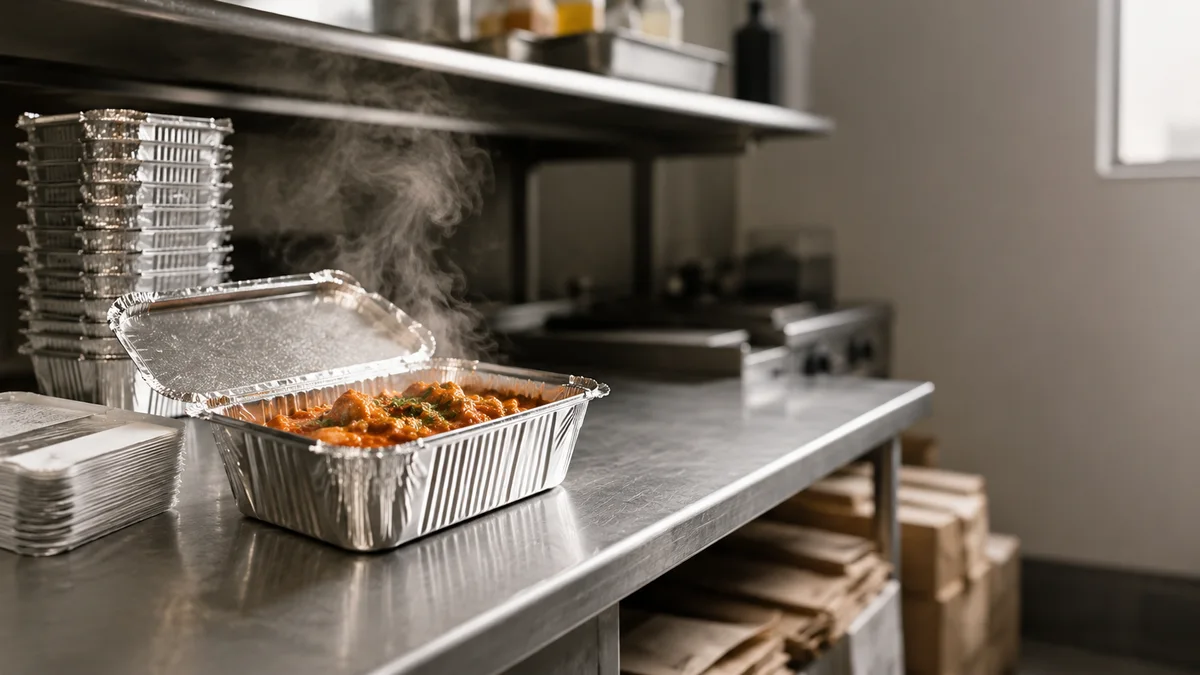
Last Saturday night, three delivery orders arrived at a flat in Leicester within 15 minutes of each other. One order — a chicken tikka masala in a rectangular aluminium container with a crimped foil lid — arrived piping hot, sauce intact, no leaks. Another — a Thai green curry in a plastic tub with a snap-on lid — had spilled into the delivery bag, coating the driver's thermal liner in coconut milk. Same journey. Same distance. The container made the difference.
For UK takeaways sending curries, Chinese dishes, pasta bakes, and any sauce-heavy meal through delivery drivers, aluminium foil containers are the hardest-working option in the packaging cupboard. They hold heat longer than paper or plastic. They do not buckle under wet weight. They go straight from the oven or grill into the delivery bag — no transfer, no second container, no extra labour. But the difference between a foil container that performs and one that fails comes down to four things most operators only learn through trial and error: size, wall type, lid match, and material thickness.
This guide walks through what to look for, what to avoid, and what real UK takeaway owners have learned the hard way about buying aluminium foil containers.
Key Takeaways • Aluminium foil containers keep food above 60°C roughly 15-20 minutes longer than plastic alternatives in typical UK delivery conditions — the difference between a complaint and a repeat order. • The UK foil container market uses a standard "No." sizing system (No.1 through No.9), and picking the wrong size is the most common mistake first-time buyers make. • Smoothwall containers are the safer choice for sauce-heavy dishes; wrinklewall trays work better for baked and roasted foods where presentation matters less. • Lid matching is not optional — a poorly fitted lid accounts for roughly 40% of delivery leaks, and different lid types suit different food types. • Aluminium is infinitely recyclable, and UK kerbside recycling accepts rinsed foil containers almost everywhere, which matters for customer perception and your EPR obligations.
Why Aluminium Beats Plastic for UK Takeaway Delivery
Heat retention is the headline advantage, and the physics supports what operators observe in practice. Aluminium has a low emissivity rating — it reflects infrared heat back into the food rather than radiating it outward into the delivery bag. A standard polypropylene container loses heat rapidly through its walls; aluminium slows that heat transfer enough to make a measurable difference by the time the food reaches the customer's door.
The practical test tells the story. A curry packed at 75°C in a foil container with a matching foil lid will typically arrive at 62-65°C after a 25-minute delivery run. The same dish in a plastic tub with a snap-on lid regularly dips below 55°C — below the 60°C threshold that most UK food safety guidance recommends for hot-held food. The customer eating a lukewarm curry is unlikely to order again. They might not even finish the meal.
Leak prevention is the second advantage. Sauce-heavy dishes create hydrostatic pressure against container walls and lid seals during transit. Plastic lids flex under that pressure and can pop open. Crimped foil lids create a mechanical lock that holds. For curries, Chinese sauces, pasta dishes, and anything with significant liquid content, aluminium with a properly fitted lid offers the most reliable seal available without moving to heat-sealed film.
There is also the oven-to-bag workflow. Foil containers go straight from the oven, grill, or pass into the delivery bag. No decanting, no secondary tray, no extra handling. That saves 30-60 seconds per order during rush, and it removes a cross-contamination risk point. For a takeaway doing 80-100 covers on a Friday night, those seconds add up to real labour savings.
Wrinklewall vs Smoothwall: Which One for Your Menu
Aluminium foil containers come in two main wall types, and they serve different purposes.
Wrinklewall containers have textured, corrugated-style side walls. They are cheaper to manufacture — and therefore cheaper to buy — and the uneven surface helps distribute heat more evenly during oven cooking. They are the traditional choice for baking, roasting, and catering where the container goes from oven to buffet table. The downside: the textured walls are harder to clean for recycling, the appearance is more functional than premium, and the irregular rim surface can make lid sealing less consistent.
Smoothwall containers have flat, seamless side walls. They look cleaner and more professional in a delivery bag. The smooth walls provide a consistent rim surface for lid attachment, which makes them more leak-resistant for saucy dishes. They cost slightly more — typically 15-25% above equivalent wrinklewall — but for delivery-focused takeaways, the difference in leak performance usually pays for itself within a week of reduced complaint calls.
Which one for your menu: If you send curries, sauces, soups, or wet dishes through delivery drivers, pick smoothwall. The extra pence per unit buys fewer refunds. If you mostly serve baked dishes — lasagne, pasta bakes, roasted meats — and operate more as a catering or collection business, wrinklewall performs well and keeps costs down. Many experienced operators stock both: smoothwall for delivery orders and wrinklewall for collection and catering.
UK Foil Container Sizes Explained: The No. System
UK catering suppliers reference foil containers by a "No." sizing system that goes back decades. Knowing the numbers makes ordering faster and helps avoid the most common mistake — ordering containers too small for your portion sizes.
Here are the workhorse sizes for UK takeaways:
No. 1 (approximately 130mm x 100mm x 35mm, roughly 260ml). These are the small trays — useful for side dishes, extra sauce portions, poppadom dips, or kids' meals. Some operators use them for dessert portions. At roughly 3-4p each in bulk, they are the cheapest size, but their limited capacity means they sit unused in many stockrooms because they were ordered without checking against actual portion sizes.
No. 2 (approximately 150mm x 120mm x 40mm, roughly 450ml). The standard individual curry or Chinese dish container. A single portion of chicken tikka masala with rice fits comfortably. This is the volume seller for most Indian and Chinese takeaways. Bulk pricing runs roughly 5-6p per unit. If you only stock one size, make it a No. 2.
No. 6 (approximately 216mm x 115mm x 48mm, roughly 750ml). The elongated rectangular tray. Fish and chip shops use these heavily for haddock and chips. The long shape suits fillets and sides side by side. Also works for kebab meat and salad combinations. Slightly more niche, but essential for specific cuisines.
No. 9 (approximately 232mm square x 40mm, roughly 930ml). The square tray that Chinese takeaways favour. Fits a generous portion of chow mein, fried rice, or sweet and sour with room to close the lid without squashing the food. Also popular for Indian takeaway sharing portions. Bulk pricing around 7-8p per unit.
Beyond the standard numbers, deep variants exist — a No. 2 deep might be 50mm deep instead of 40mm, adding roughly 100ml of capacity. Round foil containers (120mm to 180mm diameter, 550ml to 1,150ml) suit soups, porridge pots, and rice bowls. Compartment trays with dividers separate wet and dry components — useful for roast dinners and meal prep services.
The ordering mistake to avoid: buying based on the listed dimensions rather than testing with your actual food. A 450ml container sounds adequate, but your standard curry portion with rice might need 550ml of headroom to close the lid without compressing the food. Order a sample pack of 2-3 sizes, plate your actual menu portions into each, and check lid closure before committing to a case quantity.
Lids That Actually Stay On: Foil, Board, Film, and Plastic Compared
A foil container is only as leak-proof as its lid. The majority of delivery spills trace back to the wrong lid choice, not a container failure.
Crimped foil lids are the gold standard for sauce-heavy dishes. They create a mechanical lock when pressed over the container rim and folded down. They reflect additional heat back into the food. They are oven-safe and recyclable. The downside: they require a crimping tool or careful hand pressure to seal properly, and staff need to be trained to check the seal. At roughly 2-3p per lid in bulk, they are cost-competitive.
Paper board lids (sometimes called polyboard or foil-board) are the most common default. They come vented or unvented. Vented lids let steam escape, which prevents sogginess in fried foods like chips, crispy chicken, and spring rolls. Unvented lids trap steam and work better for rice and naan breads that benefit from retained moisture. They press-fit onto the container rim — secure enough for most applications but not leak-proof if tipped sideways in a delivery bag. Cost is roughly 2-4p per lid.
Heat-seal film is gaining traction among higher-volume UK operations. A thin aluminium or plastic film is heat-sealed across the container rim, creating an airtight, completely leak-proof barrier. It is tamper-evident — the customer can see if the seal has been broken. The equipment cost (a heat-sealing machine runs £100-£300) puts it out of reach for some small operators, but for takeaways doing 150+ deliveries per day, the labour savings and leak reduction justify the investment. Film costs roughly 1-2p per seal.
Clear plastic dome lids snap onto smoothwall containers and allow the customer to see the food. They work well for cold items, salads, and display counters. They are less common for hot delivery because they do not retain heat as effectively and can pop off under steam pressure. Not generally recommended for sauce-heavy delivery orders.
The lid rule of thumb: match the lid to the worst-case journey. If your delivery radius includes cobbled streets, speed bumps, and bike couriers, choose crimped foil or heat-seal film. If most orders are collection and short-distance delivery, paper board lids will handle the job.
What to Check Before Ordering: Thickness, Coating, Rim Width, and Certification
Four technical details separate foil containers that perform from those that cause complaints.
Foil thickness is measured in microns. Standard containers run 40-55 microns. For sauce-heavy dishes and large-format containers, 60-80 microns provides noticeably better rigidity. A 40-micron No. 9 container filled with curry will flex visibly when lifted from one corner; a 65-micron equivalent stays rigid. The cost difference is roughly 10-20% — well worth it for anything liquid-based. For dry items like chips, fried chicken, and baked goods, standard gauge is fine.
Internal coating matters for acidic foods. Uncoated aluminium reacts with tomato-based sauces, citrus, and vinegar — this can create a slight metallic taste over extended contact and cause pitting on the container surface. Most food-grade foil containers for takeaway use have a thin lacquer or polymer coating on the food-contact surface that prevents this reaction. Check with your supplier that their containers are coated for acidic food contact if your menu includes curry, bolognese, sweet and sour, or anything tomato-heavy.
Rim width affects lid security. Research from packaging manufacturers indicates that rim widths below 4mm have significantly higher lid-pop rates during transport compared to rims of 5-8mm. Wider rims give lids more surface area to grip. When comparing samples, check the rim profile — a flat, wide rim with a slight lip provides the best mechanical purchase for press-fit and crimped lids.
Certification requirements are straightforward but essential. Your foil containers must comply with Regulation (EC) No 1935/2004 for food contact materials — the supplier should provide a Declaration of Compliance on request. Look for the wine glass and fork symbol on packaging or specification sheets. If you operate in England, your local Environmental Health Officer can ask to see these documents during an inspection. BRC or ISO-certified manufacturing is a plus — Coppice in South Wales is one of the few UK-based manufacturers with BRC certification, though most foil containers in the UK market are imported.
How Much Aluminium Foil Containers Cost in the UK
UK wholesale pricing in mid-2026 is competitive, but ordering decisions should factor in total cost — not just the unit price.
Here are representative bulk prices (1,000+ units) from UK catering suppliers:
No. 1 foil containers: roughly £25-£35 per 1,000 units (2.5-3.5p each). Lids add roughly £15-£20 per 1,000. No. 2 foil containers: roughly £45-£55 per 1,000 units (4.5-5.5p each). Paper board lids add roughly £20-£30 per 1,000. No. 9 foil containers: roughly £65-£80 per 1,000 units (6.5-8p each). Lids add roughly £25-£35 per 1,000. Deep and large-format containers: prices vary widely by dimensions; expect roughly 10-18p per unit for containers above 1,500ml.
These are wholesale rates for unbranded standard containers. Custom embossing — adding your takeaway logo to the container or lid — typically adds 20-35% to the unit cost, with minimum order quantities starting around 5,000-10,000 units for tooling to make economic sense.
The real cost comparison, however, includes complaint rates. A cheap container that leaks once per 50 orders generates 2 complaints per 100 deliveries. If half of those complaints result in a refund or credit (£15 average order value), the operator loses £15 per 100 orders — roughly 15p per order — on top of the container cost. At that point, spending an extra 2-3p per container on better lids and thicker foil produces a net saving.
Mike, who runs a curry house in Bradford, switched from 50-micron wrinklewall trays with board lids to 65-micron smoothwall containers with crimped foil lids last year. His container cost per order increased by roughly 4p. His complaint rate dropped from roughly one per night to roughly one per week. "The saving in refunds alone covered the packaging upgrade in the first month," he said. "The customers who started coming back because their food arrived hot and intact — that is the bit you cannot put a price on."
Recycling Aluminium Containers: What UK Operators Need to Know
Aluminium is the most recyclable food packaging material available. It can be recycled indefinitely without losing quality, and recycling aluminium uses roughly 95% less energy than producing virgin aluminium from bauxite ore.
For UK takeaways, this matters in two directions. First, the customer-facing message: customers increasingly check packaging for recyclability information, and aluminium outperforms plastic and coated paperboard on this metric. A foil container that carries a "rinse and recycle" note gives the customer a clear, correct disposal instruction.
Second, your Extended Producer Responsibility (EPR) obligations. Under UK EPR regulations, businesses that handle and supply packaging must report the tonnage and type of packaging they place on the market. Aluminium packaging is categorised separately from plastic and paper, and its high recycling rate and infinite recyclability can positively affect your EPR data reporting.
The practical recycling instructions for customers are simple: scrape food residue into the food waste bin, give the container a quick rinse, and place it in the kerbside recycling bin. Most UK councils accept clean aluminium foil trays in household recycling collections. The same applies to foil lids. Paper board lids, by contrast, go in the paper and card recycling stream — they should not be left attached to the foil container.
For the takeaway itself, used foil containers from the kitchen (prep waste, spoiled food, end-of-service leftovers in their containers) follow the same rule: scrape, rinse, recycle. If your waste contractor does not accept aluminium, contact your local council's commercial waste service — aluminium recycling is widely available and should be part of any commercial waste contract.
Frequently Asked Questions
Can aluminium foil containers go in the microwave?
No. Aluminium and microwaves do not mix. Putting a foil container in a microwave will cause sparking and can start a fire. Transfer food to a microwave-safe plate or bowl before reheating. If your customers reheat their takeaway in the microwave — which most do — consider adding a "transfer to a microwave-safe plate" note on the lid or delivery bag sticker.
What is the difference between wrinklewall and smoothwall foil containers?
Wrinklewall containers have textured, ribbed walls and are cheaper to produce. They work well for oven-baked dishes and catering. Smoothwall containers have flat, seamless walls that look more professional and provide a better surface for lid sealing. Smoothwall costs more per unit but is the preferred choice for delivery because of better leak resistance.
Which size foil container should I use for a standard curry and rice?
A No. 2 foil container (roughly 150mm x 120mm x 40mm, 450ml capacity) fits a standard single portion of curry with rice. For larger portions or dishes with extra sauce, a No. 2 deep (50mm depth) or a No. 9 square container provides extra headroom. Always test with your actual portion sizes before ordering in bulk — a sample pack of 2-3 sizes costs very little and prevents expensive mistakes.
Are foil containers safe for tomato-based and acidic sauces?
Most food-grade foil containers have a thin internal lacquer or polymer coating that prevents the aluminium from reacting with acidic foods like tomato sauce, citrus, and vinegar. Uncoated aluminium can develop a slight metallic taste and surface pitting with prolonged contact with acidic foods. Ask your supplier to confirm the container is coated and suitable for acidic food contact before ordering for a curry or Italian menu.
Can customers recycle foil containers at home?
Yes, in almost all UK council areas. The customer should scrape out food residue, give the container a quick rinse, and place it in the kerbside recycling bin. Aluminium is infinitely recyclable, and UK recycling infrastructure handles foil trays well. Paper board lids should go in the paper and card recycling stream separately.
How many foil containers can I stack for delivery?
Solid food containers can stack 4-5 layers safely in a delivery bag. Liquid-based containers (curries, soups, sauces) should be limited to 2-3 layers because the weight of upper containers can deform the lids on lower ones. Use bag dividers or separate delivery bags for large orders with multiple sauce-heavy dishes. Stack containers flat, not on their sides, even with crimped lids.
Putting It All Together: A Practical Ordering Checklist
Choosing aluminium foil containers for your takeaway does not need to be complicated, but it does need to be deliberate. Start with your menu — what you actually serve, what temperature the food leaves the pass, and how far it travels. Then work backwards to the container specification.
For sauce-heavy curries and Chinese dishes delivered across town: choose smoothwall, 60-80 micron thickness, coated for acidic food contact, with crimped foil lids or heat-seal film. A No. 2 or No. 9 size will cover most single-portion requirements.
For baked pasta, lasagne, and oven-finished dishes with shorter delivery runs: wrinklewall at standard gauge with paper board lids works well and keeps per-unit costs lower. Deep containers (50mm+) give the structural rigidity these dishes need.
For fried food and chips: aluminium containers with vented paper board lids prevent sogginess while keeping food warmer than paper boxes. No. 6 elongated containers suit fish and chips well.
The best operators test before they commit. Order sample packs in 2-3 sizes. Pack your actual menu items. Hand them to your least careful driver and see what survives the journey. The £30 you spend on samples will save you hundreds in refunds and lost customers.
Request a quote from Okeypackaging for your foil container requirements. We supply smoothwall and wrinklewall aluminium containers in all standard UK sizes, with matching lids and competitive wholesale pricing. Orders can be custom-branded with your takeaway logo, and we keep buffer stock in our UK warehouse for next-day dispatch on popular sizes.