
Pizza Box Specifications: What UK Pizzerias Need to Know Before Ordering
A comprehensive guide to pizza box specifications for UK pizzerias. Learn about corrugated vs solid board, standard UK sizes, ventilation, grease resistance, custom printing, and bulk ordering economics from the packaging experts.
Filed under Operations.
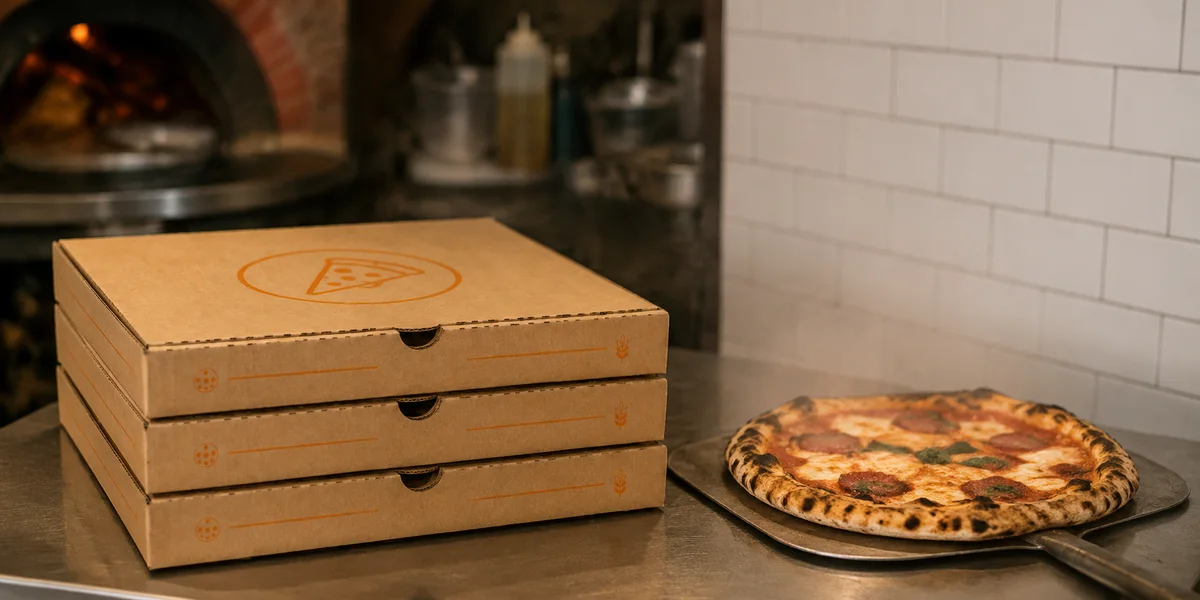
The pizza box is one of the most demanding pieces of foodservice packaging in the UK market. It must be rigid enough to stack multiple orders during a busy Friday evening service, breathable enough to prevent the base from going soggy, grease-resistant enough to survive contact with hot oil and melted cheese, and printable enough to carry your brand identity. Getting the specification right saves money, reduces waste, and prevents customer complaints that lead to negative reviews.
This guide covers the technical specifications UK pizzerias need to evaluate when ordering pizza boxes, from board construction and sizing through to ventilation, printing options, and bulk buying economics.
Corrugated vs Solid Board: Choosing the Right Construction
The UK pizza box market is split broadly between corrugated board boxes and solid board boxes, each serving different operational requirements.
Corrugated board is the industry standard for pizza delivery across the UK. Its fluted structure, typically a B-flute at 3 mmthickness or an E-flute at 1.5 mmthickness, provides an excellent rigidity-to-weight ratio. A standard 12-inch corrugated pizza box weighs approximately 120 to 140 grams and can support stacked loads of 8 to 10 boxes without deformation, provided the liner board weight is at least250 gsmwith a 28 to32 gsmB-flute medium. The Edge Crush Test (ECT) value for a typical corrugated pizza box ranges from 5.0 to 7.5 kN/m, making it suitable for stacked delivery runs where 4 to 6 boxes are frequently carried in a single insulated bag.
Solid board pizza boxes, made from a single thick layer of paperboard typically 600 to 1,000 gsm, are more common in dine-in pizzerias and takeaway counters where boxes are handed directly to customers rather than stacked for delivery. Solid board offers a smoother printing surface and a premium feel but has significantly lower stacking strength. A solid board box of equivalent size may collapse under the weight of just 3 to 4 stacked boxes, making it unsuitable for high-volume delivery operations.
The price difference is meaningful for growing businesses. Corrugated pizza boxes in the UK typically range from 0.18 to 0.35 pounds per unit for standard sizes at medium order volumes, while solid board boxes range from 0.30 to 0.55 pounds per unit. For a pizzeria dispatching 500 delivery orders per week, the annual cost difference between corrugated and solid board could exceed 3,000 pounds.
Standard UK Pizza Box Sizes: From 7 to 18 Inches
Pizza boxes in the UK are sized to match standard pizza diameters, with allowances for the box side wall construction. The actual box internal dimension is typically 0.5 to 1 inch larger than the nominal pizza size to accommodate easy insertion and removal.
The most common UK sizes are 7-inch boxes for personal pizzas and children menu options (costing 0.14 to 0.22 pounds per box), 9-inch for small or child portions, 12-inch which is the most popular delivery size in the UK accounting for an estimated 45 to 50 percent of all pizza delivery orders, 14-inch for large sharing pizzas, 16-inch for extra large, and 18-inch party size which is also used by some traditional Italian restaurants for their larger offerings.
Ordering a single box size simplifies inventory but means you are either under-boxing larger pizzas or over-boxing smaller ones, wasting money on extra material. Most UK pizzerias standardise on two sizes: 12-inch for their core offering and 14-inch for sharing pizzas. Some operators also stock 7-inch boxes for children menu items or side dishes like garlic bread and dough balls.
Ventilation: Why Steam Management Is Critical
A closed pizza box traps steam released by the hot pizza. As the steam condenses, moisture pools on the box inner surfaces, softening the board and creating the classic soggy base problem that generates customer complaints. Proper ventilation prevents this.
Ventilation holes in pizza boxes serve a specific thermodynamic function: they allow steam to escape while minimising heat loss. The standard configuration is 4 to 8 small holes, each 8 to12 mmin diameter, arranged in a grid pattern on the box lid. This provides approximately 500 to 900 square mm of total open area, which is sufficient for steam release without causing excessive cooling that would affect pizza temperature at delivery.
Some UK operators use pizza boxes with side-wall vents rather than top vents. Side vents reduce the risk of liquid dripping through top holes onto the pizza during stacking, but they are marginally less effective at steam evacuation. A well-ventilated pizza box will maintain base crispness for 15 to 20 minutes after packing, compared to just 5 to 8 minutes in an unventilated box, according to foodservice packaging studies.
If your supplier offers custom vent placement, consider matching the vent pattern to your oven type. Deck ovens produce less steam than conveyor ovens, so the vent area can be at the lower end of the range. High-moisture topping combinations, such as those featuring fresh vegetables or extra sauce layers, benefit from the maximum recommended vent area.
Grease Resistance: Keeping the Box Intact and Presentable
Pizza boxes are exposed to hot oil from cheese, cured meats, and drizzled finishes. Without adequate grease resistance, the oil migrates through the board, weakening its structural integrity and potentially staining through to the outer printed surface, ruining your brand presentation.
Grease resistance in pizza boxes is achieved through one of three methods: aPE(polyethylene) coating applied to the inner surface, a silicone coating, or the natural grease resistance of high-density board fibres.PE-coated boxes are the most common in the UK market. A standardPEcoating of 12 to15 gsmapplied to the inner surface provides sufficient resistance for typical 20 to 30 minute delivery windows.
UK food safety regulations underRegulation (EC) 1935/2004require that any coating material used in food contact packaging does not migrate into the food.PEcoatings used in pizza boxes must comply with UK migration limits for overall migration (10 mg per dm2) and specific migration limits for any additives used in the coating formulation.
Operators serving pizzas with very high oil content, such as those featuring nduja, pepperoni, or extra mozzarella-heavy toppings, may need boxes with a heavier coating of 18 to22 gsmor a silicone-based barrier for enhanced performance. The additional cost is approximately 5 to 10 percent above standard coated box pricing.
Custom Print Options for Pizza Boxes
Custom printed pizza boxes are one of the most cost-effective brand touchpoints in foodservice. A well-designed box sitting on a customer kitchen counter delivers an advertising impression that lasts the entire meal. The industry standard print methods areflexographic printingfor high-volume orders of 10,000 plus units anddigital printingfor low to medium volume orders of 500 to 10,000 units.
Digital printing has opened up custom pizza box printing to independent UK pizzerias. Setup costs are eliminated, and colour matching is consistent across repeat orders. At OkeyPackaging, ourdigital print service allows orders as low as 500 boxes per design, with free artwork setup support and a choice of stock or custom sizes. View our pizza box range at okeypackaging.com/products/pizza-boxes.
The cost premium for full-colour custom printing on pizza boxes is approximately 0.06 to 0.12 pounds per box over plain stock, depending on coverage area and number of colours. For a pizzeria ordering 5,000 boxes per quarter, that represents an additional investment of 300 to 600 pounds per quarter for a branded touchpoint that reaches every single customer.
Bulk Ordering Economics and Timing
The economics of pizza box ordering follow a clear volume-cost curve. At 500 units, the per-unit price might be 0.32 pounds for a standard 12-inch corrugated box. At 2,000 units, that drops to approximately 0.24 pounds. At 10,000 units, it can fall to 0.18 pounds or lower. These price breakpoints are driven by paperboard purchasing volumes, print plate amortisation, and production run efficiency.
However, storage costs and the risk of design obsolescence must be factored into any bulk buying decision. Pizza boxes stored for more than six months can begin to degrade, particularly in environments with fluctuating humidity. Boxboard absorbs moisture from the air, reducing its rigidity and ECT value. Storing boxes in a climate-controlled area at 18 to 22 degrees C and below 60 percent relative humidity will preserve board quality for up to 12 months.
The optimal order quantity balances unit price with realistic consumption rates. For a pizzeria serving 200 delivery pizzas per week, an order of 5,000 boxes represents approximately 6 months of supply at a favourable price point. Ordering 15,000 boxes to achieve a lower unit price means committing to 18 months of the same box design, which may not accommodate menu changes, rebranding, or seasonally limited offerings. Our team at OkeyPackaging can help you calculate the optimal order quantity for your specific operation. Visit okeypackaging.com/contact to discuss your requirements. For custom artwork and branding support, visit our design page at okeypackaging.com/design where you can download templates and review print specifications for pizza boxes.