
Plastic-Free Paper Bags for UK Takeaways: What to Check Before Ordering
Most UK paper carrier bags contain hidden PE plastic lining that makes them unrecyclable. Learn the water test, what to ask suppliers, and how to find genuinely plastic-free paper bags for your takeaway or retail business.
Filed under Operations.
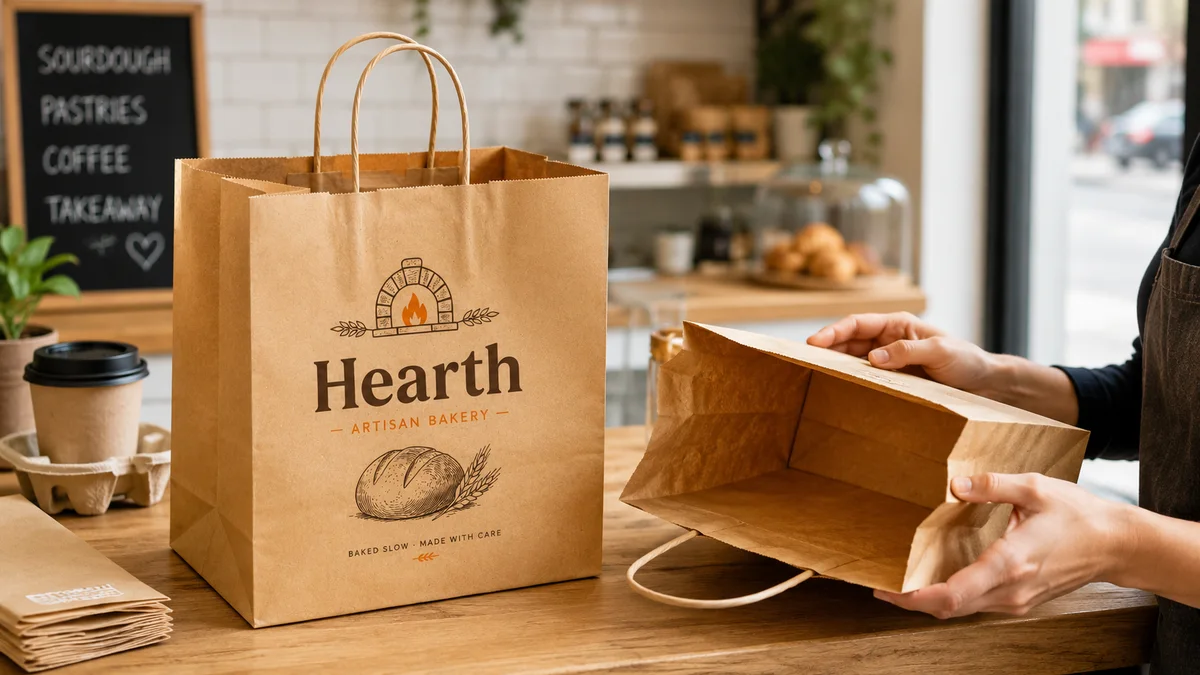
Most takeaway owners think they're buying paper bags. What they actually get is paper laminated with a thin layer of polyethylene — a plastic film that makes the bag unrecyclable in every kerbside collection in the UK. The bag looks eco-friendly. It feels like paper. But when it hits the Materials Recovery Facility, it gets pulled off the line and sent straight to incineration.
If you run a takeaway, cafe, bakery, or retail shop in the UK and you've been buying "paper bags" assuming they are the sustainable choice, this article will tell you exactly what to check, what the alternatives cost, and how to avoid the most common mistake operators make when switching to genuinely plastic-free bags.
Key Takeaways:
- Most standard paper carrier bags sold in the UK contain a hidden polyethylene (PE) lining that prevents recycling and composting.
- Unlined kraft paper bags are kerbside recyclable and home compostable — but they cost 10–25% more per unit.
- From March 2027, all UK councils must collect flexible plastics kerbside under Simpler Recycling — but plastic-lined paper bags still will not be accepted in the paper stream.
- The WRAP UK Packaging Pact now covers all packaging materials, and foodservice operators who switch to verified plastic-free bags can use this in their sustainability claims.
- Always ask suppliers for the EN 13432 compostability certificate or a written "no PE lining" specification before placing an order.
UK Plastic Bag Regulations: What Changed and What Did Not
The single-use plastic carrier bag charge that started in England in 2015 has been one of the UK's most successful environmental policies. Sales of single-use plastic bags by major retailers dropped by 98% between 2015 and 2024, according to Defra data. Shoppers adapted. Retailers switched. And the visible plastic carrier bag essentially vanished from British high streets.
But here is what the policy did not fix.
The replacement bags — the brown kraft paper carriers, the white twisted-handle bags, the flat-handled boutique bags — were never regulated for what they are made of beyond the paper you can see. A paper bag with a PE lining still counts as a "paper bag" under current UK law. There is no mandatory labelling requirement that tells a takeaway operator whether the bag they are buying has a plastic layer sandwiched between the paper plies.
This regulatory blind spot has created a market where operators believe they have gone plastic-free, while their customers are putting lined paper bags into recycling bins — contaminating the paper stream and increasing costs for local councils.
Northumberland County Council reported that kerbside recycling contamination reached 23% in 2026, costing the council over £1 million in additional sorting and disposal fees. Paper bags with hidden plastic linings are a significant contributor to that figure.
The Hidden Plastic Problem: Why Most Paper Bags Are Not What They Seem
A standard twisted-handle paper carrier bag is typically made from two or three plies of kraft paper. For strength — and especially for tear resistance when carrying heavier items — manufacturers laminate a thin layer of polyethylene between the outer and inner paper layers. This PE film is invisible to the eye. You can't feel it from the outside. The bag rips like paper, crumples like paper, and sits in your hand like paper.
But when it reaches a recycling facility, the optical sorters can't separate it. The PE layer means the bag behaves as a composite material — and in the UK, composite fibre packaging with more than 15% non-paper content is rejected at MRFs. The bag, along with everything it contaminated, goes to energy-from-waste incineration or, in the worst case, to landfill.
Tom runs a burger takeaway in Leeds. He switched all his packaging to what his supplier called "eco paper bags" in 2024. He paid a 15% premium over his previous plastic vest bags. He printed his logo on them. He told his customers the bags were recyclable. Then a customer emailed him a photo of the local council's recycling contamination leaflet, which specifically listed "paper bags with plastic lining" as a non-recyclable item. Tom had spent more money on bags that were actually worse for the recycling system than the thin plastic carriers he had replaced — because thin plastic bags can at least be returned to supermarket collection points, whereas composite paper-plastic bags can't.
Tom's story is common. A 2025 survey by the Paper Industry Technical Association found that 68% of UK consumers believe all paper bags are recyclable. In practice, the recycling rate for paper carrier bags in the UK is estimated at less than 40%, precisely because of the PE lining issue.
How to Identify a Genuinely Plastic-Free Paper Bag
The difference between a lined and unlined paper bag is not something you can determine by looking at it or touching it. Here are the reliable checks:
Ask for the Material Specification Sheet
Every reputable packaging supplier has a material data sheet or technical specification. Look specifically for these terms in the "barrier" or "lining" section: "PE laminate," "polyethylene coating," "LDPE liner," or "plastic film." If any of these appear, the bag is not plastic-free.
The terms you want to see are: "unlined kraft," "no PE," "aqueous coating only" (for greaseproof bags), "natural kraft paper only," or "100% paper fibre."
Request the Compostability Certificate
Genuinely plastic-free paper bags are typically certified to EN 13432 (industrial compostable) or carry the OK Compost HOME certification (TÜV Austria). If a supplier claims the bags are compostable but can't produce a certificate number you can verify on the TÜV or Din Certco database, they almost certainly contain a plastic lining.
The Water Test
This is a quick field test you can do yourself. Take a sample bag and submerge a corner in water for 30 seconds. Rub the wet area between your fingers. If a thin translucent film starts to separate from the paper fibres, that is the PE layer detaching. A genuine unlined kraft bag will simply turn to pulp when wet — no film, no separation, just wet paper.
The Tear Test
Tear the bag slowly from the top edge. An unlined kraft bag tears with a fibrous, slightly irregular edge. A PE-lined bag will show a cleaner separation between plies — you can often see the thin plastic film stretching slightly before it breaks. It looks like a very thin layer of cling film between two sheets of brown paper.
Check the Price
Plastic-free unlined kraft bags typically cost 10–25% more per unit than standard PE-lined paper bags. If the price seems unusually low — especially below £0.08–£0.12 per bag for standard takeaway sizes at typical UK wholesale quantities — it is almost certainly a lined product. The cost difference exists because genuine unlined bags require higher grammage (thicker paper) to achieve the same tear strength without the plastic reinforcement.
Plastic-Free Paper Bag Options for UK Operators
Once you know what to look for, there are several genuine plastic-free options available to UK foodservice operators. Here is what each format does well — and where each falls short.
Standard Unlined Kraft SOS Bags
The "self-opening sack" (SOS) is the classic brown paper bag with a flat bottom and no handles. These are the simplest paper bags to source plastic-free because they are constructed from a single ply of kraft paper with no lamination step. They work well for bakery items, sandwiches, wrapped burgers, and small retail purchases. They are widely accepted in kerbside recycling and are home compostable if not contaminated with grease. Unit cost at wholesale: roughly £0.04–£0.08 depending on size and quantity.
Twisted-Handle Kraft Carrier Bags
The standard takeaway carrier bag. Most versions on the UK wholesale market contain a PE liner because the handle anchors need the extra tear resistance. Plastic-free versions exist but require heavier paper stock — typically 100–120 gsm kraft instead of the standard 80–90 gsm. The heavier stock adds cost but the bags are genuinely recyclable and compostable. Ask suppliers specifically for "unlined twisted handle kraft bags" and confirm the grammage. Unit cost: £0.12–£0.25 depending on size and print.
Flat-Handle Paper Bags (Boutique / Retail Style)
These are the premium retail bags with flat paper handles, often used by bakeries, delis, and gift shops. Most UK suppliers use a PE liner in these bags for structure and handle strength. Plastic-free versions are rarer and more expensive because the handle attachment requires reinforced paper rather than plastic bonding. If you need this style, look for suppliers who use water-based adhesives and explicitly state "no PE" in their specifications. Some specialist UK manufacturers now offer these with FSC-certified kraft and water-based glue throughout, but expect to pay 30–50% more than the standard lined version.
Greaseproof Paper Bags (Plastic-Free Coatings)
For hot food — chips, fried chicken, samosas, bhajis — you need a grease barrier. Traditional greaseproof bags use a PE or silicone coating. Plastic-free alternatives now exist using aqueous (water-based) barrier coatings or natural parchment paper. The key thing to check is that the coating is not PLA (polylactic acid), which is technically a bioplastic but still requires industrial composting facilities — it will not break down in home composting or kerbside recycling.
BioPak and Vegware both offer certified compostable greaseproof bags for the UK market, though note that they require industrial composting and are not kerbside recyclable. For kerbside-recyclable greaseproof options, look for suppliers using aqueous barrier coatings that have been validated by On-Pack Recycling Label (OPRL) guidelines.
Custom-Printed Plastic-Free Bags
You can print your logo on plastic-free bags using water-based or soy-based inks. The important thing is to confirm with your printer that the ink system is compatible with the recycling stream. UV-cured inks and some solvent-based inks can cause issues at the repulping stage — the ink particles do not break down properly and can create "stickies" that contaminate the recycled pulp. Water-based flexographic inks are the safest choice for recyclable paper bags.
Cost Comparison: Lined vs Unlined Paper Bags (UK Wholesale Pricing, 2026)
Here is a realistic price comparison for UK operators buying at typical wholesale quantities (5,000–10,000 units):
Small kraft SOS bag (no handles, ~200 x 100 x 300mm):
- PE-lined: £0.04–£0.06 per unit
- Unlined plastic-free: £0.05–£0.08 per unit
Medium twisted-handle kraft bag (~300 x 200 x 400mm):
- PE-lined: £0.08–£0.12 per unit
- Unlined plastic-free: £0.12–£0.18 per unit
Large flat-handle boutique bag (~350 x 250 x 450mm):
- PE-lined: £0.18–£0.25 per unit
- Unlined plastic-free: £0.25–£0.38 per unit
Greaseproof paper bag (hot food, ~250 x 150 x 100mm):
- PE/silicone coated: £0.06–£0.10 per unit
- Aqueous barrier (plastic-free): £0.10–£0.16 per unit
The premium for going genuinely plastic-free ranges from 25% to 60% depending on the format. For a busy takeaway using 2,000 bags per week, the annual difference could be £4,000–£8,000. But there are offsets to consider.
How the Economics Work Out in Practice
Sarah runs a small chain of three bakery-cafes in Manchester. She switched from PE-lined paper bags to unlined kraft bags in early 2025. Her bag cost went up by £0.04 per unit. On 3,000 bags per week across three sites, that is an extra £120 per week — roughly £6,000 per year.
She offset this in three ways:
First, she removed the double-bagging habit her staff had developed with the lined bags. Because the unlined bags use heavier paper stock (100 gsm vs 80 gsm), they actually feel more substantial in the customer's hand. Staff stopped reflexively double-bagging heavy items like sourdough loaves, cutting total bag consumption by about 15%.
Second, she added a small line to her counter signage: "Our bags are 100% paper — recyclable in your kerbside bin." This generated genuine customer goodwill. Her Google reviews started getting comments specifically mentioning the eco-friendly packaging.
Third, she included the switch in her business's submission for a local council Green Business Grant, which covered 40% of her first year's packaging cost increase.
The net annual cost came to roughly £2,400 — about £1.50 per day per site. She considered that good value for the marketing benefit alone.
What to Ask Your Supplier Before Ordering Paper Bags
Print this section out or copy it into an email. Send these five questions to any paper bag supplier before placing an order:
-
Does this bag contain any polyethylene (PE) or LDPE layer between the paper plies? — If the answer is yes or "I'll need to check," do not order until you have a written confirmation of "no PE."
-
Is the bag certified compostable to EN 13432 or OK Compost HOME? — Ask for the certificate number. Verify it independently at the TÜV Austria or Din Certco database.
-
What is the paper grammage (gsm), and is the bag constructed from a single ply or multiple plies? — Single-ply unlined kraft above 90 gsm is a strong indicator of a genuinely plastic-free bag. Multi-ply bags almost always have something between the plies.
-
Are the inks and adhesives water-based and free from PVC, UV-cured solvents, and hot-melt plastics? — Even an unlined paper bag becomes unrecyclable if the handles are attached with plastic-based hot-melt adhesive.
-
Can you provide an OPRL (On-Pack Recycling Label) assessment or equivalent evidence that this bag is accepted in UK kerbside paper recycling? — If they can't provide this, their bag almost certainly will not make it through a UK MRF.
UK Packaging Regulations That Affect Your Choice
Several regulatory changes make 2026 the right year to get serious about packaging choices:
Extended Producer Responsibility (EPR)
From 2025, UK packaging producers — and by extension, the brands and retailers who use that packaging — pay modulated fees based on the recyclability of their packaging. Packaging that is difficult to recycle attracts higher fees. Paper bags with PE linings fall into a higher fee bracket than unlined paper bags. Those costs will be passed down the supply chain.
UK Packaging Pact (Launched April 2026)
WRAP's successor to the UK Plastics Pact now covers all packaging materials. Nearly 100 founding signatories have committed to four goals: optimise packaging design, scale reuse and refill systems, support recycling infrastructure investment, and harmonise packaging data reporting. For a takeaway operator, this matters because your packaging choices may increasingly be scrutinised by delivery platforms and commercial clients who are Pact signatories.
Simpler Recycling (Mandatory Food Waste and Dry Recycling Collections)
From March 2025 for businesses (March 2026 for micro-firms with fewer than 10 employees), all UK businesses must separate dry recycling from general waste. From March 2027, flexible plastic collections become mandatory for all councils. However — and this is critical — plastic-lined paper bags still will not belong in either the paper bin (because of the plastic) or the flexible plastic bin (because of the paper fibre). They will remain general waste. Switching to unlined, genuinely paper-only bags means your packaging goes into the paper recycling stream — compliant, simple, and cheaper on waste disposal costs.
Frequently Asked Questions
Are paper bags always recyclable in the UK? No. Paper bags with a hidden polyethylene (PE) lining are not recyclable through kerbside collection. Only unlined, 100% paper fibre bags are accepted in the paper recycling stream. In 2025, an estimated 60% of paper carrier bags sold in the UK contained some form of plastic lining.
How can I tell if my paper bags have a plastic lining? The fastest way is the water test: submerge a corner in water for 30 seconds, then rub the wet area between your fingers. If a translucent film separates from the paper, the bag has a PE liner. Alternatively, ask your supplier for the material specification and look for "PE," "LDPE," or "polyethylene."
Are plastic-free paper bags more expensive? Yes, typically 25–60% more per unit than PE-lined equivalents, depending on the format. The premium is driven by higher paper grammage needed to achieve tear strength without plastic reinforcement. However, reduced waste disposal costs and marketing benefits can offset part of the difference.
Can I get custom printing on plastic-free paper bags? Yes, using water-based or soy-based flexographic inks. Avoid UV-cured and solvent-based inks, which can contaminate the paper recycling stream. Confirm with your printer that the full ink system is compatible with standard UK paper repulping.
What is the difference between compostable and recyclable paper bags? Compostable bags (certified to EN 13432) are designed to break down in industrial composting facilities. They may use bioplastic coatings like PLA that are not accepted in paper recycling. Recyclable paper bags are accepted in kerbside paper collections and processed at standard UK MRFs. A bag can be both, but you should verify each claim separately — do not assume that a compostable bag is recyclable, or vice versa.
Are foil-lined paper bags recyclable? No. Foil-lined paper bags — often used for hot food like fish and chips or kebabs — are composite materials that can't be recycled through any UK kerbside system. The aluminium foil layer is bonded to the paper with adhesive and can't be separated at standard MRFs. If you need heat retention, consider a heavier unlined kraft bag with a separate greaseproof inner wrap that is certified compostable.
Your Next Move: Making the Switch Without the Headaches
Switching to plastic-free paper bags is not a one-day decision, but it is simpler than most operators expect. Here is a practical sequence:
Start by auditing what you currently use. Take one of each bag type from your stockroom and do the water test. You may find that some of your bags are already plastic-free without you realising it. At minimum, you will know exactly which SKUs need replacing.
Next, ask your current supplier for material specifications. If they can't provide them within a week, start talking to a second supplier in parallel. The UK wholesale packaging market is competitive and there are now specialist plastic-free suppliers who stock certified unlined bags as standard lines rather than special orders.
Order samples before committing to a production run. Test the bags in your actual operation — fill them with your heaviest typical order, carry them 50 metres in the rain (seriously), and see how they hold up. A plastic-free bag that fails in service is not an eco-friendly choice; it is waste.
Finally, tell your customers what you have done. A simple line on your counter, your menu, or your website — "Our paper bags contain zero plastic and can go straight in your kerbside recycling bin" — turns a packaging decision into a customer loyalty moment. In a market where UK consumers increasingly choose businesses that match their environmental values, that clarity is worth more than the few pence extra per bag.
Ready to switch to genuinely plastic-free paper bags for your takeaway or retail business? Request a quote for unlined, recyclable kraft paper bags — with custom printing available using water-based inks, no minimum order quantity for stock sizes, and full material specification sheets provided before you commit.