
Why Your Bakery Wrapping Paper Turns Into a Greasy Mess (And Which Paper Actually Works)
Wax paper, greaseproof paper, and baking parchment are not interchangeable. Learn which paper to use for wrapping, baking, and hot food — and why getting it wrong costs money and reputation.
Filed under Materials.
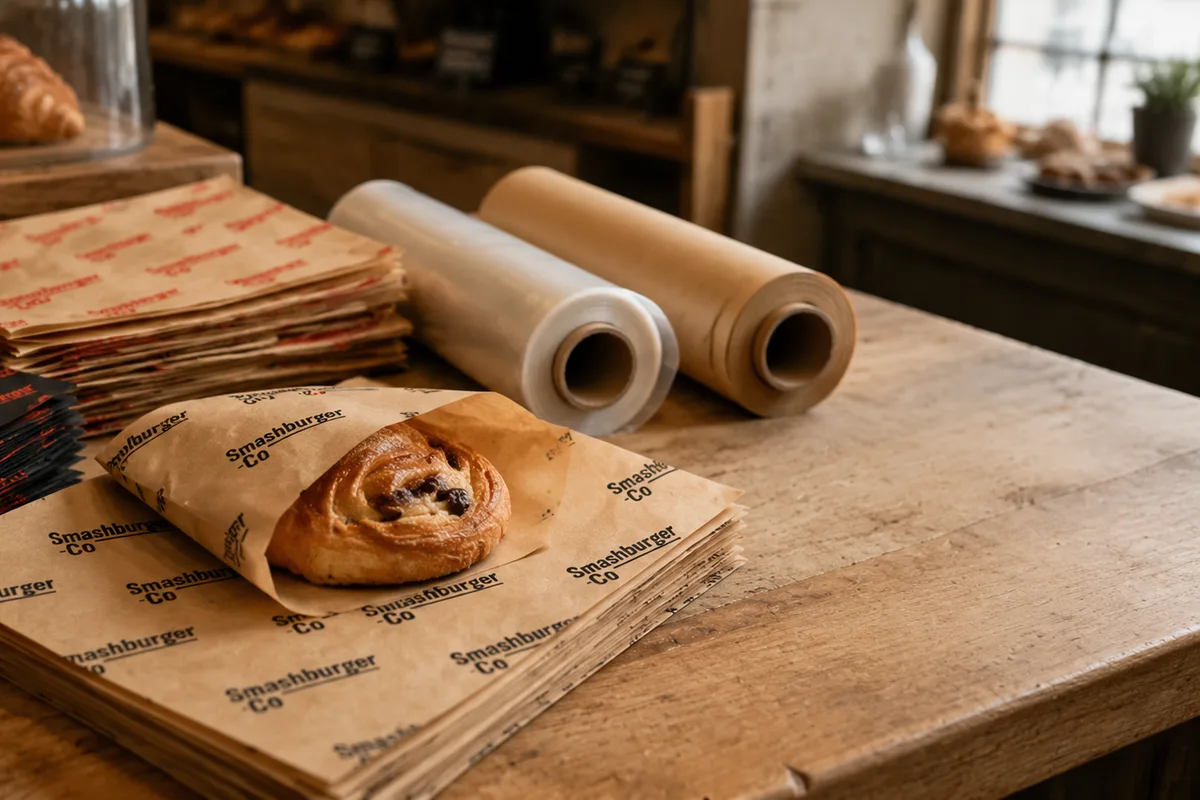
A baker in Manchester posted on a hospitality forum last winter: she'd wrapped a batch of warm mince pies in what she thought was greaseproof paper. By the time customers unwrapped them at home, the paper had gone translucent with butter, the pies were stuck to the wrapping, and one customer messaged to ask whether the 'plasticky taste' was intentional.
She'd used wax paper. It melts at 60°C.
The pies were fine. Her reputation took the hit.
Key Takeaways:
- Wax paper melts at 60-80°C — never use it on warm food or near heat
- Greaseproof paper resists oil but has limited non-stick ability — ideal for wrapping burgers, lining baskets, and interleaving
- Baking parchment (silicone-coated) is the only one rated for oven use up to 220°C+
- UK supermarkets sell 'baking and greaseproof paper' as one product — it's usually parchment, but always check the temperature rating
Why It's So Confusing: The UK Labeling Problem
Walk down the baking aisle of any UK supermarket and you'll see the problem immediately. One roll says 'greaseproof.' Another says 'baking paper.' A third says 'baking and greaseproof paper' as if they're the same thing. They're not.
The confusion has real consequences for food businesses. A café wrapping warm sausage rolls in wax paper creates the same problem the Manchester baker faced: melting wax, food stuck to packaging, and customers questioning the quality. A dark kitchen lining oven trays with standard greaseproof instead of silicone parchment gets scorched paper flaking into the food. A fish and chip shop wrapping hot battered cod in the cheapest roll from the cash-and-carry watches the paper disintegrate before the customer reaches the car park.
Here is what each paper actually is, what it does, and where it fails.
Wax Paper: Cold Only, No Exceptions
Wax paper is paper coated on both sides with a thin layer of wax — traditionally paraffin, though some suppliers now use soybean or plant-based waxes. The wax gives it a smooth, slightly glossy surface that water and grease cannot penetrate at room temperature.
It works brilliantly for wrapping cold sandwiches, deli meats, cheese, pastry dough, and burger patties headed for the freezer. It lines countertops for rolling and decorating. It separates sticky items without clinging.
But the moment heat enters the picture, wax paper fails catastrophically. Wax melts between 60°C and 80°C — well below the temperature of a freshly baked sausage roll, a hot pasty, or anything that has been in a pie warmer. When the wax melts, it transfers into the food (that 'plasticky taste'), the paper loses all structural integrity, and in a hot oven, wax paper can smoke and ignite.
One operator on a UK food forum described the lesson succinctly: 'Used wax paper under the grill once. Once.'
If your food is cold or ambient, wax paper is fine. If it has been anywhere near heat, do not touch wax paper.
Greaseproof Paper: The Workhorse That Isn't Non-Stick
Greaseproof paper is often what UK food businesses mean when they say 'chip paper' or 'burger wrap.' It is made from dense, mechanically pressed pulp — a process called supercalendering — that creates a tight fibre structure resistant to oil and grease penetration. Unlike wax paper or baking parchment, true greaseproof paper has no coating at all.
This matters because it keeps grease from soaking through without adding anything to the food. It also means greaseproof paper is typically recyclable and biodegradable — a genuine advantage over silicone-coated alternatives.
The trade-off is that greaseproof paper offers only moderate non-stick performance. It can handle the low, ambient heat of wrapped warm food — burgers, pasties, chips, toasties — but it will stick to anything with high sugar content or direct oven heat. At sustained temperatures above 180°C, standard greaseproof paper begins to brown and scorch.
For most UK takeaways, greaseproof paper is the correct choice for wrapping. It handles the oil from fried food, it does not transfer any taste, and it costs significantly less than baking parchment — typically £12-18 per 500 sheets for foodservice-grade rolls compared to £20-30 for the equivalent in parchment.
But it is not a baking product. Lining a tray of flapjacks with greaseproof paper because 'it looks the same' will end with caramelised sugar welded to the paper and angry kitchen staff scraping a tray for twenty minutes.
Baking Parchment: The Only One for the Oven
Baking parchment — also sold as 'baking paper' or 'bakery paper' in the UK — is paper coated with a microscopically thin layer of food-grade silicone. That silicone coating is what transforms ordinary paper into a heat-resistant, genuinely non-stick surface that nothing adheres to.
Quality baking parchment withstands temperatures up to 220-230°C. It can go under a grill (at distance), into a microwave, and into a commercial convection oven. It releases cookies, scones, pastry, bread, roasted vegetables, and glazed proteins without any additional greasing. It can even be reused for multiple batches of dry baking.
The silicone coating is also the downside. It makes baking parchment non-recyclable in standard paper streams, and it costs roughly 30-50% more than greaseproof paper per sheet. For a bakery producing hundreds of items daily, that cost difference is meaningful.
The right rule: if heat is involved, use parchment. If only grease is the concern, use greaseproof.
What UK Food Businesses Actually Need
The answer depends on what you produce and how it reaches the customer.
For a bakery selling ambient-temperature pastries, cookies, and bread over the counter: you need baking parchment for production (tray lining, oven work) and either greaseproof paper or wax paper for wrapping at point of sale. If the items are fully cooled before wrapping, wax paper is cheaper and gives a more premium presentation with its slight gloss. If items are still warm, use greaseproof.
For a fish and chip shop, burger joint, or kebab house: you need greaseproof paper. It handles hot, oily food without disintegrating, costs £0.02-0.03 per sheet in bulk, and does not add anything to the food. Wax paper melts. Parchment is overkill for wrapping.
For a dark kitchen or delivery-only operation: the packaging has to survive 20-40 minutes in a thermal bag. Greaseproof paper works for wrapping individual items (burgers, wraps, sandwiches), but for anything sauced or exceptionally greasy, consider a foil-lined paper bag or a foil wrap with a greaseproof inner layer. Standard thin greaseproof alone may not hold up for long delivery runs with high-moisture food.
For a café doing takeaway toasties and paninis: greaseproof paper is the standard choice, but the paper grade matters. Sub-30gsm paper tears too easily when wrapping hot, slightly steamy food. Look for 35-40gsm minimum for hot wrapped items.
How to Read a Paper Spec Sheet (Without a Chemistry Degree)
If you are ordering from a catering supplier rather than grabbing rolls from Tesco, you will see terms that matter:
GSM (grams per square metre): This is paper weight. Standard greaseproof for wrapping is 28-40gsm. Baking parchment is typically 38-45gsm. Anything under 30gsm will feel flimsy and tear-prone with hot food.
Temperature rating: The single most important number on any food-grade paper. 'Suitable for oven use to 220°C' means it is silicone-coated parchment. 'Do not expose to temperatures above 80°C' means it is wax paper. No temperature rating at all usually means standard uncoated greaseproof — safe for wrapping warm food but not for direct heat.
Coating: 'Silicone-coated' means baking parchment. 'Wax-coated' means wax paper. 'Uncoated' or 'supercalendered' means greaseproof paper. If the specification does not state the coating, ask the supplier before ordering in bulk.
Food contact certification: For the UK, look for compliance with EU Regulation (EC) No 1935/2004 (still applicable under retained EU law) and, for compostable claims, EN 13432 certification. A supplier who cannot produce a Declaration of Compliance for food contact is not one you should buy from.
What It Costs (UK Bulk Pricing, Mid-2026)
Greaseproof paper sheets (250 x 350mm, foodservice grade): approximately £12-18 per 500 sheets, or £0.024-0.036 per sheet in bulk. Pre-cut sheets cost slightly more than rolls but save labour.
Baking parchment sheets (same size, silicone-coated): approximately £20-30 per 500 sheets, or £0.04-0.06 per sheet. The silicone coating adds roughly 30-50% to the price compared to uncoated greaseproof.
Wax paper sheets (same size): approximately £10-15 per 500 sheets, or £0.02-0.03 per sheet. It is the cheapest option — as long as you never use it on warm food.
Branded or custom-printed greaseproof paper: approximately £50-120 per 1,000 sheets depending on print complexity, with MOQs typically starting at 1,000-5,000 sheets. The branding premium is significant but the marketing return — your logo on every burger someone unwraps — is measurable for delivery-focused businesses.
For a typical UK fish and chip shop using 200 sheets of greaseproof per day, the annual cost at £0.03 per sheet runs approximately £1,872 for plain paper. Switching to branded paper at £0.08 per sheet pushes that to £4,992 — an extra £3,120 per year that needs to earn its keep through repeat business.
One Operator's System That Actually Works
A café owner in Brighton shared a surprisingly simple system on a UK hospitality forum. She keeps three types of paper and uses none interchangeably:
Production (oven, trays, baking): baking parchment. She buys it in bulk rolls and cuts to size. Nothing sticks. Nothing scorches.
Wrapping (ambient pastries, cookies, bread for display): wax paper sheets from a catering supplier. The slight gloss makes the display look intentional. Everything is fully cooled before wrapping.
Wrapping (warm sausage rolls, toasties, hot sandwiches): 38gsm greaseproof paper. The extra weight stops the paper tearing when it hits steam from hot food.
Her rule: 'If it has been in the oven in the last thirty minutes, it does not touch wax paper. If it is going anywhere near a customer's hands, the paper should look like part of the product, not an afterthought.'
That last point is worth dwelling on. The paper your food arrives in is part of the customer experience. Grease bleeding through a paper bag, wax sticking to a warm pastry, parchment fused to a cookie because someone bought the wrong roll — these are not packaging failures. They are specification failures. And they are entirely avoidable.
Next time you restock, check the temperature rating on the roll. If there isn't one, find out why. If the supplier cannot tell you whether it is wax-coated or silicone-coated, find a supplier who can.
Because the Manchester baker's mince pies were good. The paper was the problem.