
Takeaway Packaging That Survives UK Delivery Runs: A Durability Guide for Foodservice Operators
Guide to takeaway packaging that survives UK delivery runs. PFAS-free greaseproofing, leak-resistant sealing, stackable designs, and temperature tolerance for Deliveroo, Uber Eats, and Just Eat.
Filed under Operations.
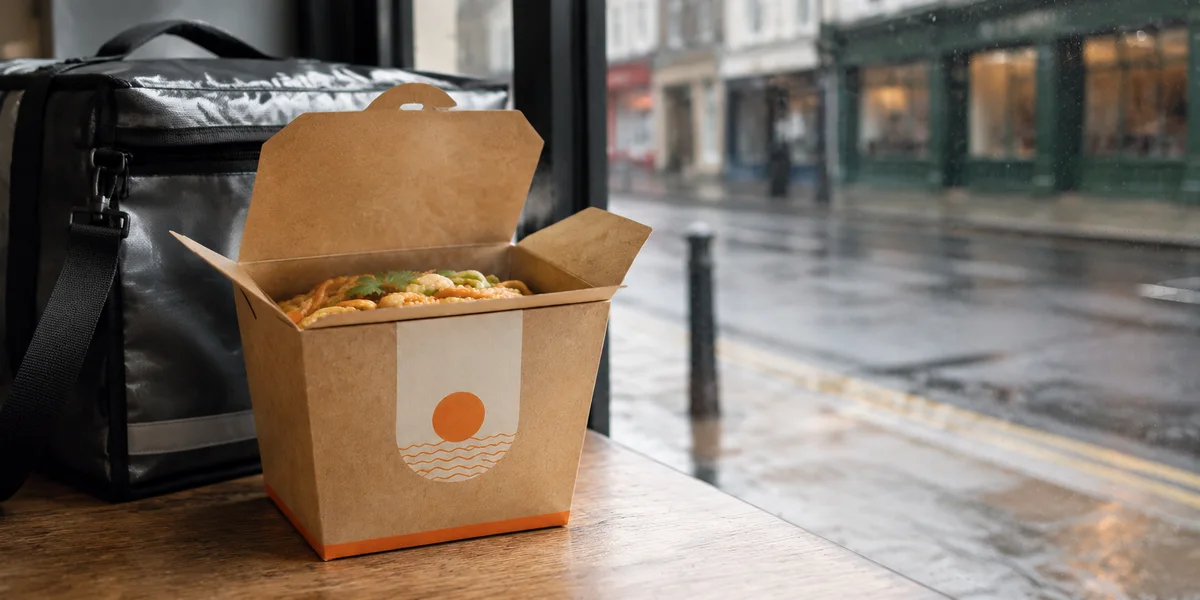
When a takeaway order reaches a customer via Deliveroo, Uber Eats, or Just Eat, the packaging is the last line of defence between a 5-star review and a complaint. Soggy chips, leaked sauces, crushed burger boxes, and cold food are the top reasons UK takeaway customers leave negative reviews. According to a 2024 survey by the Consumer Goods Forum, 47% of UK diners said they would not reorder from a restaurant after a single bad takeaway experience caused by packaging failure. This makes packaging durability a direct revenue concern, not just an operational detail.
What Delivery Platforms Actually Require
Deliveroo, Uber Eats, and Just Eat each publish packaging guidelines for their restaurant partners. While the specifics vary, the core requirements are consistent: all packaging must be leak-proof, grease-resistant, stackable, and capable of maintaining food temperature for at least 30 minutes after packing. Deliveroo specifically requires that liquid containers have secure, tamper-evident seals. Uber Eats mandates that hot and cold items be packaged separately to prevent temperature transfer. Just Eat recommends packaging that can withstand a 10-minute motorcycle journey without structural failure.
These platform requirements translate into specific packaging specifications. For UK operators using delivery services, the minimum standard is: greaseproof lining on all food-contact surfaces, secure lid closure tested to withstand jostling, rigid side walls that do not collapse under stacking, and insulation capable of keeping food above 63 °Cfor hot items during transit.
Greaseproofing: Why It Matters and Where It Fails
Grease migration is the most common failure point in takeaway packaging. When oil or fat from food soaks through the packaging, the structural integrity collapses — boxes go soft, bags tear, and customers end up with greasy hands and ruined food. For fried items like chips, chicken wings, and onion rings, the grease load is significant. A standard portion of chips releases approximately 5-8 mlof oil during a 15-minute delivery run, and standard paperboard absorbs this within minutes if not properly barrier-coated.
The solution is barrier-coated paperboard. This can be either aPE(polyethylene) coating applied to the interior surface, or a PFAS-free aqueous coating. Note that PFAS (per- and polyfluoroalkyl substances) coatings, historically used for grease resistance, are being phased out across the EU and UK due to environmental and health concerns. Denmark banned PFAS in paperboard food packaging in 2020, and the UK is expected to follow with similar restrictions by 2027. Forward-looking operators should specify PFAS-free greaseproof packaging now. Our greaseproof paper and takeaway boxes use PFAS-free barrier coatings that meet or exceed the performance of traditional PFAS-lined materials.
Leak Resistance: Sealing the Deal
Leaks are the single biggest complaint category for delivery orders. A leaked sauce or drink ruins not just the affected item but every other item in the bag. The three most common leak points are: the lid-cup interface (cups), the bottom seam (boxes and bowls), and the closure flap (boxes and bags). Each requires a different solution.
For cups, the lid must snap securely onto the rim with an audible click. Sip-through lids should have a silicone or rubber gasket around the drinking hole to prevent spillage during transit. For boxes and bowls, the bottom seam must be heat-sealed or glued to a standard that withstands internal liquid pressure. A typical curry sauce at65 °Cexerts enough steam pressure to open a poorly sealed box seam within 5 minutes. For closure flaps, interlocking tab-and-slot designs are more secure than adhesive-only closures, which can fail when condensation softens the glue.
Our salad bowls and takeaway boxes feature reinforced bottom seams and secure click-lock lids designed for delivery use. We recommend testing each container type with your hottest, oiliest menu item before committing to a full order.
Stackability: Maximising Delivery Efficiency
Delivery drivers carry multiple orders per run. Packaging that does not stack securely wastes space and increases the risk of crushing. For boxes, rigid side walls with vertical stacking lugs allow containers to be stacked 5-6 high without collapsing. Round containers should have flat, reinforced lids that support the weight of the container above. The industry standard for stackable takeaway packaging is a top-load strength of at least5 kg, which accommodates the typical delivery load.
Non-stackable packaging forces drivers to use oversized carrier bags, reducing the number of orders they can carry per run and increasing the likelihood of items shifting during transit. For operators using third-party delivery platforms, this inefficiency can lead to slower dispatch times and warmer food.
Temperature Tolerance: Keeping Food Hot, Cold Things Cold
UK delivery runs can last 20-45 minutes from kitchen to doorstep, and food temperature during this period is regulated by the Food Standards Agency. Hot food must be held above63 °C. Cold food must remain below8 °C. Packaging plays a critical role in maintaining these temperatures.
For hot food,double-wallpaperboard containers provide significant insulation. Adouble-wall 12 ozcup holds coffee at70 °Cfor 25 minutes, compared to 18 minutes for asingle-wallcup with a sleeve. For cold items, insulated liners and foil-backed bags extend safe temperature windows. Some premium packaging now includes thermal reflective layers that can maintain cold chain temperatures for up to 2 hours.
Our burger boxes and hot food containers are designed with insulated paperboard to keep food at serving temperature during typical delivery windows. For cold items, we recommend combining appropriate packaging with insulated delivery bags for the best results.
Testing Your Packaging for Delivery Readiness
Before investing in a full packaging run, run a simple field test. Fill your chosen container with the most challenging menu item — usually the hottest, oiliest, or wettest dish. Seal it according to your standard operating procedure. Place it in a delivery bag and simulate a 20-minute car or motorcycle journey (a 15-minute drive over uneven roads is realistic). Then open and inspect: any leaks? Any structural deformation? Is the food at the correct temperature?
Repeat this test with a stacked configuration — three boxes on top of each other — to verify stacking strength. The bottom box should show no visible compression after 20 minutes under load. If it does, you need a box with a higher board weight or reinforced seams.
We provide free samples of our takeaway boxes and containers so you can run these tests before committing. A few hours of testing upfront can prevent hundreds of negative delivery reviews.
Making the Right Choice for Your Delivery Menu
The ideal packaging for your delivery operation depends on your menu. A fried chicken shop needs heavy-duty greaseproofing and secure lid closure. A ramen bar prioritises leak resistance and heat retention. A dessert shop needs cold-chain performance and crush-resistant stacking. Our full range of packaging — from paper cups to pizza boxes to cutlery — is designed with delivery durability in mind. Browse the collection or contact our team for advice on the best packaging for your specific menu.
Choosing Cutlery and Accessories for Delivery
Cutlery is a frequently overlooked component of delivery packaging. If a customer orders a takeaway salad or pasta dish and receives no fork, the experience is ruined regardless of how well the main packaging performed. For delivery orders, individually wrapped cutlery sets (knife, fork, spoon, napkin, salt, pepper) are the industry standard. Biodegradable wooden orPLA cutlery is an option for operators prioritising compostability, though plastic remains the most cost-effective choice at 2-4p per set versus 5-8p for wooden alternatives. Our cutlery range includes wrapped sets suitable for delivery orders, available with custom branding for an additional 1-2p per set.
Building a Packaging System, Not Just a Package
The most successful delivery operations treat packaging as an interconnected system rather than a collection of individual containers. The right cup is useless without a compatible lid. The right burger box needs a correctly sized paper bag. Cold items need separation from hot items. A well-designed packaging system accounts for every component of the order and ensures everything fits together securely. Review your full menu and map each item to its ideal packaging. Identify gaps where a single packaging type needs to serve multiple items and test accordingly. OkeyPackaging offers a complete range of takeaway packaging — from cups and boxes to bags, napkins, and cutlery — so you can build a cohesive system from a single supplier.
OkeyPackaging supplies UK foodservice operators with delivery-ready takeaway packaging backed by PFAS-free greaseproofing, secure lid systems, and reinforced construction. Low MOQs and free UK delivery make it practical for operators of any size. Get in touch for samples and a quote.