
Leak-Proof Takeaway Containers for UK Curry Houses and Saucy Kitchens
Compare PP vs coated paper curry containers, clip-lock vs heat-seal vs press-on lids, 80C+ temperature tolerance, UK compliance, and cost per unit for UK Indian takeaways and saucy kitchens.
Filed under Operations.
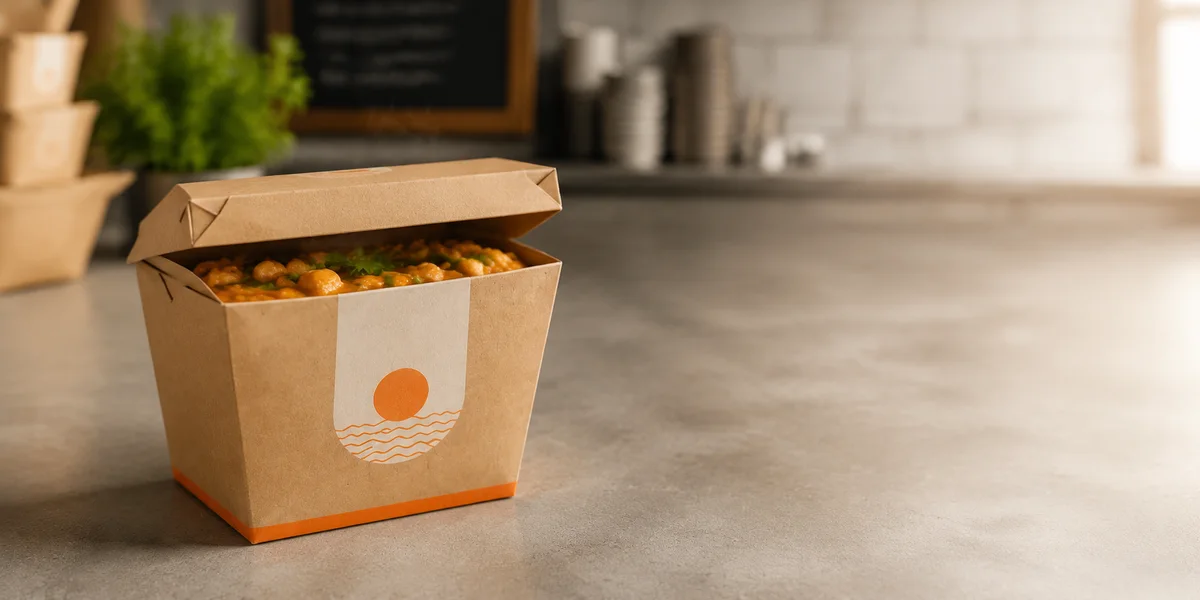
Curry is the nation favourite takeaway - the UK market serves approximately 900 million curry meals annually, with British Indian restaurants (BIRs), Thai kitchens, and street-food vendors competing for delivery ratings on Just Eat, Deliveroo, and Uber Eats. Yet one operational issue undermines even the highest-rated kitchen: sauce that escapes the container en route. A single leaky lid costs you the meal, the packaging, the delivery fee, and - if the sauce reaches the customer bag - a refund plus a negative review. For UK operators running 150-300 covers on a Friday night, the failure rate on standard PPcontainers can hit 5-8% when the rider tilts the bag. That is 15-24 ruined orders from a single service. Fixing the seal is the single highest-ROI change a curry kitchen can make.
The core decision for saucy takeaways is polypropylene (PP) versus coated paper.PPcontainers are injection-moulded, typically 0.6-0.8 mmwall thickness, and offer superior rigidity when filled with hot, viscous liquid. Coated paper containers - usually made from paperboard with a polyethylene orPLAlining - are lighter and cost 10-15% less per unit at equivalent volumes, but they rely entirely on the coating to resist moisture migration. When a paper container holds a Madras or a Thai green curry at 80C+ for longer than 20 minutes, the sidewall seam becomes the weak point.PPcontainers do not have a seam. For any dish with a gravy, sauce, or broth consistency,PPis the safer structural choice. Coated paper works well for drier curries, biryanis, or side dishes where the risk of free liquid is low.
Lid design determines whether a container is genuinely leak-proof or merely splash-resistant. Three lid types dominate the UK takeaway market. Standard press-on lids are the most economical, costing roughly 2-4p per lid at 1,000-unit volumes, but they rely on friction alone and will fail under tilt. Clip-lock lids feature a recessed channel that snaps into a corresponding groove on the container rim, creating a mechanical seal that withstands lateral movement. These add 1-2p per unit but reduce leak rates to below 1% in controlled tests. Heat-seal lids use a thin foil or film layer bonded to the container rim with a handheld sealer, producing an airtight, tamper-evident closure. Heat-sealing adds 3-5p per container including the film cost and sealer amortisation, but it is the only option that guarantees zero leakage through a 45-minute delivery run, regardless of rider behaviour. For UK curry houses operating on delivery platforms, clip-lock is the minimum viable seal. Heat-seal is the gold standard for high-value orders and premium branding.
A fresh curry leaves the kitchen at 85-95C. By the time it reaches the customer, UK Food Standards Agency guidelines recommend a minimum serving temperature of 63C for hot-held food, but the packaging must tolerate the initial fill temperature without warping, leaching, or losing seal integrity. StandardPPhas a heat deflection temperature of approximately 100-110C, which is adequate for most curry applications. However, budget-gradePPcontainers - often sourced from unbranded import channels - may contain recycled content that reduces heat tolerance to 80C or below, causing the lid rim to distort on contact with fresh curry. Coated paper containers typically handle fill temperatures up to 90-95C before the polyethylene lining begins to soften. For operators regularly serving phaal, vindaloo, or Thai tom yum at near-boiling temperatures, crystallinePET(CPET) containers offer a heat deflection temperature of 130-150C and are microwave-safe up to 180C.CPETcosts approximately 25-40% more than standardPPbut eliminates the risk of heat-related failure entirely.
UK food delivery compliance for hot takeaways falls under the Food Safety and Hygiene (England) Regulations 2013, supplemented by the FSA guidance on cook-chill and hot-hold systems. Packaging must not transfer harmful constituents to the food -Regulation (EC) 1935/2004on materials and articles intended for food contact applies directly. All containers supplied to UK food businesses must carry a suitable Declaration of Compliance from the manufacturer, confirming migration testing against simulated food simulants at the intended temperature range. For curry containers, the relevant test conditions are olive oil (simulant D1) at 100C for two hours, representing hot fatty foods. Many budget import containers lack documented test data at this temperature, which places the liability on the food business operator. Okeypackaging provides Declarations of Compliance for allPP,CPET, and coated paper containers, with full migration test reports available on request.
Microwave reheating is standard practice in UK households: 73% of takeaway customers report reheating leftovers in the microwave, according to a 2023 survey by the Food Standards Agency.PPcontainers are microwave-safe up to 110C, making them suitable for 2-3 minute reheating cycles.CPETcontainers extend this to 180C. Coated paper containers are not microwave-safe unless specifically marked, because the polyethylene lining can delaminate under microwave heating and the paperboard may scorch. Freezer storage is equally relevant - many UK curry houses batch-cook base gravies and freeze portions for later use.PPandCPETcontainers are freezer-safe down to -20C, while coated paper containers may suffer from moisture migration when thawed. If your kitchen operates a cook-chill or batch-prep system,PPis the safer all-rounder for the cook-freeze-reheat cycle.
Cost per unit varies significantly with container choice and volume. At 500-unit MOQ, standardPPcontainers with press-on lids cost approximately 18-25p per unit delivered in the UK. At 5,000 units, the same specification drops to 12-16p per unit. Clip-lockPPat 5,000 units runs 14-19p per unit. Coated paper containers with press-on lids at 5,000 units cost 10-14p per unit.CPETcontainers at 2,000-unit MOQ start at 22-30p per unit. These figures include lids but exclude custom print setup fees, which typically range from 40-80 GBP per colour forflexographic print, or 100-200 GBP per plate foroffset print. The per-unit cost difference between a standard press-on and a clip-lock lid is approximately 1.5p at 5,000 units - equivalent to 75 GBP extra for 5,000 containers. Against a single delivery failure that costs 15-25 GBP in refund and lost goodwill, the clip-lock premium pays for itself before the first order cycle.
Choosing a UK-warehoused supplier rather than importing directly from Asia shortens lead time from 8-14 weeks to 3-7 working days and eliminates customs clearance risk. The unit price may be 5-15% higher from a UK stockist, but the total cost of ownership - factoring in rejected shipments, delayed launches, and minimum order quantities of 10,000+ units from direct-import channels - favours domestic supply for any kitchen doing under 100,000 units annually. Okeypackaging carries a UK stock range ofPPand coated paper takeaway containers with clip-lock and press-on lids, all with full food-contact compliance documentation, and offers custom print from 500 units per design. Browse the takeaway boxes range for square, rectangular, and compartment options from250 mlto 1,500 ml capacity, or visit the quote page for pricing estimates based on your volume and specification requirements. The full product range includes compatible lids, inserts, and delivery bags.
Before placing a production order, run a tilt test with your actual product. Fill each container type to 80% capacity with your hottest, thinnest curry - usually the base gravy or the least viscous sauce on the menu. Seal the lid, place the container in an insulated delivery bag, and tilt to 45 degrees for 10 minutes. Inspect the rim and bag interior for moisture. Repeat the test with a clip-lock lid and, if the budget allows, with a heat-seal. The test takes 30 minutes and costs nothing except the sample containers. Every UK curry house that adopts this protocol before a menu launch reports zero leakage complaints in the first month of service.