
Tamper-Evident Takeaway Packaging for UK Food Delivery: What Operators Need to Know
Tamper-evident takeaway packaging cuts UK delivery complaint rates by up to 60%. Compare sticker, container and bag options from 5p per order. Real 2026 prices and supplier guide for independent operators.
Filed under Operations.
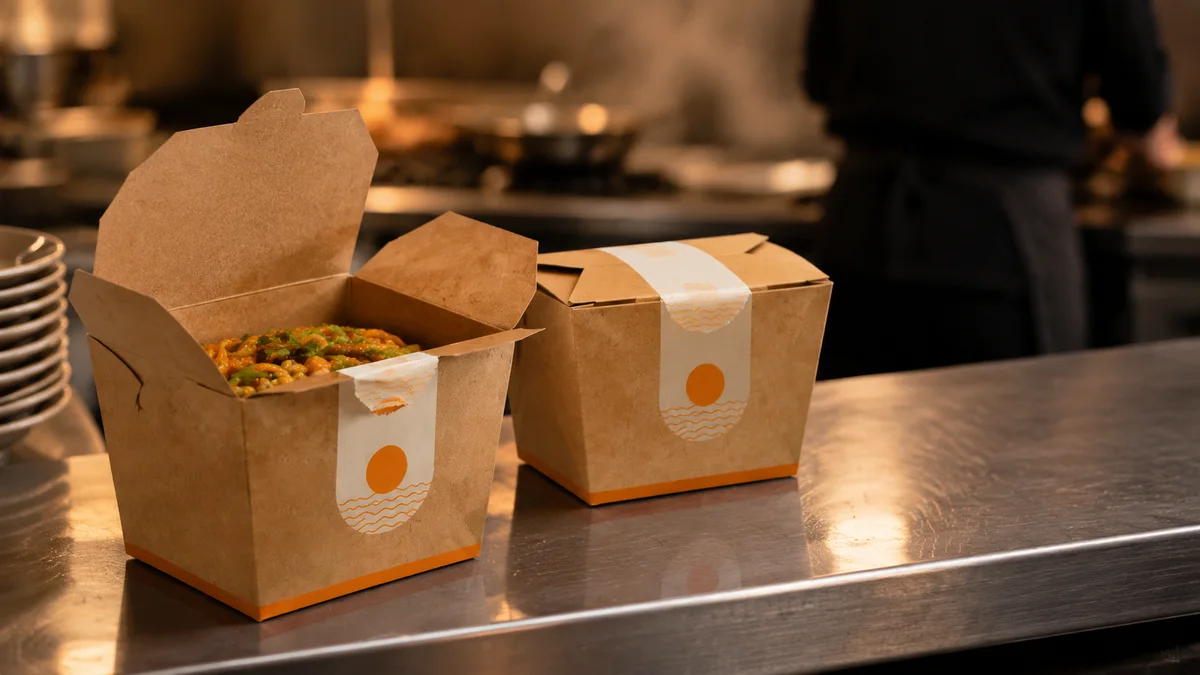
Tamper-evident packaging is any container, seal, or closure that shows visible proof when it has been opened or interfered with — and for UK food delivery operators, it's quickly moving from optional upgrade to operational necessity. Independent takeaways lose an average of £180 to £400 per month in refunds and chargebacks from customers who receive orders they believe have been tampered with, according to a 2025 survey by UK Hospitality. That figure does not include the long-term cost of one-star reviews, lost repeat orders, or platform account penalties when complaint ratios climb too high.
If your takeaway still leaves containers with a simple snap-on lid and a plastic bag knot, you are leaving your reputation — and your revenue — exposed to a risk you can fix for as little as 5p per order.
Key Takeaways
- Tamper-evident packaging gives customers visible proof their food has not been opened between your kitchen and their door — it cuts delivery-related complaint rates by 40 to 60 per cent according to UK supplier data.
- Options range from 5p self-adhesive security stickers to purpose-moulded containers with break-tab lids at 12 to 25p per unit — the right choice depends on your volume, menu, and delivery mix.
- Delivery platform terms from Deliveroo, Just Eat, and Uber Eats increasingly expect operators to use sealed or tamper-evident packaging — and may side with the customer in disputes where no seal is present.
- UK food safety law does not yet mandate tamper-evident seals specifically, but the Food Safety Act 1990 duty of care and Natasha's Law allergen requirements make traceable, sealed packaging the safest compliance position.
- Custom-branded tamper-evident stickers cost roughly the same as generic ones at volume — 1,000 units or more — and double as marketing: your logo on a security seal tells customers you take their safety seriously.
What Tamper-Evident Packaging Actually Means for a UK Takeaway
Tamper-evident does not mean tamper-proof. No packaging can stop a determined person with a blade. What tamper-evident packaging does is leave undeniable evidence: a torn seal, a snapped tab, a "VOID" message that appears when the sticker is peeled, or a lid that will not reclose once opened. For the customer receiving a delivery at 9pm on a Friday, that visual signal is the difference between confidence and suspicion.
Most UK takeaways discover they need tamper-evident packaging the hard way. A customer calls claiming their container arrived with the lid half-open and sauce on the bag. The delivery driver says it was fine when they collected it. The platform refunds the customer and deducts it from your settlement. You have no evidence either way — and no way to prove your kitchen sent the order out intact.
Maria runs a Greek takeaway in Birmingham with roughly 200 delivery orders a week. After a run of three disputed deliveries in one month — each refunded automatically by the platform — she started applying custom-branded void stickers across every container lid. Her disputed-delivery rate dropped from roughly one in 70 orders to fewer than one in 400. The stickers cost her 8p each at 2,000 units. "The first month paid for the whole year's supply," she says.
The Three Types of Tamper-Evident Packaging Available in the UK
There are genuinely only three practical approaches for independent UK takeaways, and each serves a different volume and menu type.
Security Stickers and Tamper-Evident Labels
These are self-adhesive labels that tear, break apart, or leave a "VOID" pattern when someone tries to remove them. They're the cheapest option and the easiest to deploy across an existing packaging setup without changing your containers.
You stick one across the lid-container seam on each box or pot before it leaves the pass. If the seal is intact when the customer opens the bag, they know the container has not been opened since your kitchen sealed it.
Pricing in the UK market as of mid-2026:
- Generic brown kraft tamper seals from Amazon or eBay: 4 to 6p each in packs of 250 to 500
- Void-pattern security stickers — sequentially numbered, professional grade — from Versapak: 14 to 20p each at 1,000 units
- Custom-branded tamper-evident stickers from noissue or Vistaprint: 8 to 16p each at 1,000 units, dropping to 6 to 8p at 5,000 or more
- Custom stickers from Intelibee (PackGenie) on 51 by 153mm rolls: roughly 9 to 15p each depending on volume
Stickers work for any container type — paper boxes, plastic pots, foil trays, paper bags — and require no change to your existing packaging inventory. The downside is labour: someone on the pass has to apply a sticker to every order, which adds 3 to 5 seconds per container.
Break-Tab and Snap-Lock Tamper-Evident Containers
These are purpose-moulded plastic containers — typically PP (polypropylene) or rPET (recycled PET) — where the lid has an integrated tab or locking ring that must be physically broken to open. Once snapped, the tab cannot be reattached, giving the customer instant visual confirmation.
Common formats in the UK wholesale market:
- Round deli pots with tamper-evident tear bands (120ml to 1,000ml) from Ashwood: roughly 12 to 28p per unit depending on size
- Rectangular meal-prep containers with snap-lock corners from Venturepak: 15 to 22p each
- Sandwich and salad wedge packs with security-lock lids from Celebration Packaging (SolutionWare): 10 to 18p each
- rPET tamper-evident packs with 30 per cent recycled content, exempt from Plastic Packaging Tax, from Celebration Packaging: 14 to 25p each
These are ideal for high-volume operations running 300 or more deliveries a week where the labour cost of applying stickers outweighs the per-unit premium of integrated tamper-evident containers. They also look more professional and are harder to dispute — a snapped tab is unambiguous.
The trade-off is that you are locked into one container format and supplier, and integrated tamper-evident containers typically have higher minimum order quantities — 500 to 1,000 units per size.
Tamper-Evident Delivery Bags
This is the newest category, led by Westpak's StikLok range — paper or plastic delivery bags with an integrated adhesive strip that seals the entire bag shut. Unlike stickers or container tabs, these secure the whole order in one action: bag, peel strip, press shut. The strip cannot be opened without tearing the bag material.
Westpak StikLok bags cost roughly 18 to 35p each depending on size, with custom branding available at volume. They are particularly useful for multi-item orders — burger, chips, and drink — where individually stickering each container would be slow, and for operators who want a single sealing action at the pass.
The downside is that sealed bags trap steam and condensation, which can soften fried food during transit. Some operators use vented bag designs or add a small perforation, but this partially defeats the tamper-evident function.
Plastic Packaging Tax and rPET: What UK Operators Need to Know
If you choose plastic tamper-evident containers, the UK Plastic Packaging Tax applies — £217.85 per tonne from April 2026 — unless your packaging contains at least 30 per cent recycled content. rPET containers with 30 per cent or more recycled material are exempt and widely available in the tamper-evident category from suppliers like Celebration Packaging and Venturepak.
Paper-based options — kraft stickers, paper delivery bags — are outside the tax scope entirely. For an independent takeaway buying 5,000 to 10,000 plastic containers a year, the tax differential between virgin and 30 per cent recycled containers is small — perhaps £40 to £80 a year — but the reputational advantage of rPET is significant with UK consumers who increasingly check packaging for recycled content claims.
How to Choose the Right Option for Your Operation
The decision tree is straightforward and driven by three factors: weekly order volume, average items per order, and whether you use your own drivers or platform fleets.
Operators doing fewer than 150 delivery orders a week with 1 to 2 containers per order will almost always find stickers the best balance of cost, flexibility, and labour. You can buy 500 generic tamper-evident stickers for under £30 on Amazon and test them across a weekend service without committing to a container change.
Operators doing 150 to 400 deliveries a week with 2 to 4 items per order should compare the labour maths. If stickering adds 20 seconds per order and you are paying someone £12 per hour, that's roughly 7p in labour per order. Add 5p for the sticker and you are at 12p — at which point integrated tamper-evident containers at 14 to 18p each start to make operational sense, especially if you factor in the professional presentation benefit.
Operators above 400 deliveries a week, or those with four or more items per order, should look hard at tamper-evident delivery bags. One seal action replaces 3 to 5 sticker applications, and the bag itself becomes part of the branding surface.
Context matters too. If you sell high-value orders — £40 or more for family meals — the cost of tamper-evident packaging is noise next to the refund liability on a single disputed order. A £40 refund pays for roughly 500 tamper-evident stickers.
UK Food Safety Law and Platform Requirements
No specific UK regulation says "you must use tamper-evident packaging." But the legal landscape is moving in that direction through several overlapping requirements.
The Food Safety Act 1990 requires that food be "of the nature, substance, and quality demanded" — and food that has been interfered with in transit fails that test. Environmental Health Officers increasingly view tamper-evident seals as part of a reasonable due-diligence defence if a contamination complaint reaches investigation.
Natasha's Law, effective since October 2021, requires full ingredient and allergen labelling on all Prepacked for Direct Sale (PPDS) food. If your takeaway pre-packs items before the customer orders — salads, desserts, meal-deal components — those labels must be accurate and attached to the specific container the customer receives. A tamper-evident closure creates a chain of custody between the label and the food inside, which is hard to achieve with a loose lid.
On the platform side, Deliveroo, Just Eat, and Uber Eats all have clauses in their restaurant partner agreements requiring "secure" and "hygienic" packaging. When a customer disputes an order and there is no seal, the platforms almost always side with the customer. Some UK operators report that simply adding tamper-evident stickers and photographing sealed orders before handover to drivers has eliminated platform disputes almost entirely — because the photo plus the intact seal creates an evidence trail that is hard for a customer to dispute credibly.
What Your Options Actually Cost: Real UK Prices (June 2026)
Here is a practical cost comparison for a typical independent takeaway doing 200 delivery orders a week, with an average of 2.5 containers per order — roughly 500 containers a week or 26,000 containers a year.
Option 1: Generic tamper-evident stickers on existing containers. At 500 stickers a week at 5p each, that's £25 per week. Annual cost roughly £1,300 plus 2 to 3 hours a week of staff time for application. Total annual cost including labour at £12 per hour: approximately £3,172.
Option 2: Custom-branded tamper-evident stickers on existing containers. At 2,000 stickers a month at 8p each, that's £160 per month. Annual cost roughly £1,920. Labour cost is identical to Option 1 — the sticker costs more but your brand is on every seal, which drives repeat orders. Total annual cost: approximately £3,792.
Option 3: Integrated tamper-evident containers (rPET, snap-lock). Replacing all containers with tamper-evident versions adds roughly 7 to 12p per container versus standard equivalents. At 26,000 containers a year, that's £1,820 to £3,120 in additional packaging cost. Labour savings offset roughly £936 a year — no sticker application needed. Net annual premium over standard packaging: £884 to £2,184.
Option 4: Tamper-evident delivery bags (Westpak StikLok or equivalent). At 200 bags a week at 22p each, that's £44 per week. Annual cost roughly £2,288. Labour is faster than stickering individual containers, saving roughly £624 a year in pass time. Net annual cost: approximately £1,664 above standard packaging.
These aren't mutually exclusive. Many operators run tamper-evident containers for their main dishes and a single branded sticker across any supplementary items — combining the professional look of moulded containers with the flexibility of stickers for odd-shaped items like naan breads or sauce pots.
Red Flags to Watch For When Ordering Tamper-Evident Packaging
Not every supplier that prints "tamper-evident" on a product page is selling something that actually works. Before committing to a bulk order, check these five things.
First, order samples and test them with your actual food. A sticker that adheres perfectly to a clean, dry, room-temperature box in the supplier's warehouse may peel straight off a warm, grease-misted container coming off your pass. Condensation from hot food is the number-one enemy of tamper-evident adhesives — if the sticker won't stick to a warm, slightly humid surface, it will not work in service.
Second, check the tamper-evident mechanism under real opening conditions. Some lids marketed as "tamper-evident" simply make a clicking sound when closed and can be reopened silently with a fingernail. If you can open and reclose the container without leaving visible damage in under 10 seconds, it isn't tamper-evident enough for a delivery dispute.
Third, verify that break-tab containers actually break. Some cheaper imported containers have tabs that flex rather than snap, or that can be pushed back into position after opening. The tab must physically separate from the lid or body — anything less is a false promise.
Fourth, ask for the adhesive specification if you are using stickers on chilled or frozen items. Standard tamper-evident adhesives lose grip below 4 degrees Celsius. If you run a gelato shop or send out chilled meal-prep orders, you need cold-grade tamper-evident labels — and they cost roughly 20 to 30 per cent more.
Fifth, check minimum order quantities and lead times. Custom-printed tamper-evident stickers typically have a 7 to 14 day production lead time. If you order 500 and run out in two weeks, you will be back to unsealed containers while waiting for the reorder. Build a two-week buffer into your first order and set a reorder trigger at 25 per cent remaining stock.
Five Ways Tamper-Evident Packaging Pays for Itself
Operators who adopt tamper-evident packaging typically recover the cost within the first one to three months — not through higher prices, but through cost reduction and retention gains.
Reduced refund liability is the most immediate return. At a conservative dispute rate of 1 in 100 delivery orders and an average refund value of £22 — food cost plus delivery fee plus platform penalty — a takeaway doing 200 deliveries a week loses roughly £2,288 a year in direct refunds. Cutting that rate by 60 per cent saves £1,373, which alone covers the cost of tamper-evident stickers or bags.
Improved platform ratings have compounding commercial value. Just Eat and Deliveroo both factor "order accuracy" and "packaging quality" into their restaurant rankings. Higher-ranked restaurants appear higher in search results, which drives more orders. Several UK operators have reported 10 to 15 per cent increases in weekly order volume after moving to sealed, professional-looking packaging — partly from better rankings and partly from improved customer confidence reflected in reviews.
Lower driver-dispute friction is harder to quantify but real for operators using platform fleets. When every order leaves the pass sealed and photographed, drivers cannot be blamed for missing items or opened containers — and platform support teams have a clear audit trail. Some operators report that platform dispute resolution time dropped from days to hours after implementing photo-plus-seal protocols.
Reduced food waste is an unexpected but welcome side effect. When containers are properly sealed at the pass, they are less likely to tip, leak, or open in transit — which means fewer remakes and less wasted food. A single remade order costs roughly £6 to £10 in food and labour; preventing one a week saves £312 to £520 a year.
Marketing value from branded seals is real. A customer who sees your logo on a tamper-evident sticker every time they order starts to associate your brand with care and professionalism. Several UK operators using custom-branded void stickers report that customers mention the seals positively in reviews — "you can tell they care, everything is sealed properly" is a recurring theme in five-star Just Eat and Google reviews.
Frequently Asked Questions
Do I legally need tamper-evident packaging for my UK takeaway? There is no specific UK law that requires tamper-evident seals on takeaway packaging in 2026. However, the Food Safety Act 1990 requires that food be safe and of the quality expected. If a customer receives food that may have been interfered with, you could be liable. Delivery platforms also increasingly expect sealed packaging in their partner agreements.
What is the cheapest way to make my takeaway packaging tamper-evident? Generic tamper-evident stickers from UK sellers on Amazon or eBay cost 4 to 6p each in packs of 250 to 500. They are self-adhesive labels that tear or leave a VOID pattern when peeled. No change to your existing containers is needed — you simply apply one sticker across the lid-container seam on each item before it leaves the pass.
Do tamper-evident stickers work with hot food? They can, but you must test with your actual food first. Condensation and grease from hot food are the most common reasons tamper-evident adhesives fail. Order samples of 20 to 30 stickers, apply them to containers straight off your pass during a real service, and check adhesion after 10, 20, and 30 minutes before committing to a bulk order.
Are tamper-evident containers recyclable in the UK? Most tamper-evident containers made from PP (polypropylene) or rPET (recycled PET) are widely recyclable through UK kerbside collections. rPET containers with 30 per cent or more recycled content are also exempt from the UK Plastic Packaging Tax. Check with your specific council, but PP and PET are accepted in the majority of UK local authority recycling schemes.
Can I get tamper-evident packaging with my logo on it? Yes. Suppliers including noissue, Vistaprint, Intelibee, and Avery UK offer custom-branded tamper-evident stickers with minimum orders as low as 250 to 1,000 units. Custom-printed integrated tamper-evident containers are available from Ashwood, Venturepak, and Celebration Packaging with higher minimums — typically 2,000 to 5,000 units per size.
What is the difference between tamper-evident and tamper-proof? Tamper-evident means the packaging shows visible proof if it has been opened — a torn seal, a snapped tab, or a VOID message. Tamper-proof means the packaging cannot be opened at all, which is not realistic for takeaway containers. No food container is truly tamper-proof; the goal is tamper-evident packaging that leaves clear, undeniable evidence of interference.
Making the Switch: A Practical Three-Week Rollout Plan
Week one: order samples. Buy 20 to 50 tamper-evident stickers in two or three different styles — generic kraft, void-pattern, custom-branded sample — and test them across a full weekend of real service. Photograph every sealed order before driver handover. Track which sticker type adheres best to your specific containers with your specific food.
Week two: choose your supplier and place your first order. Order enough for four weeks of service plus a two-week buffer — roughly six weeks of stock. If you are ordering custom-branded stickers, submit artwork in vector format — AI or EPS — and request a digital proof before production begins. Standard lead time for custom stickers is 7 to 14 days.
Week three: train your pass team. The process is simple — one sticker across the lid-container seam on every item before it goes into the delivery bag — but it needs to become automatic. Put a phone or tablet at the pass and photograph every sealed order before driver handover. The photo is your insurance policy in any dispute. After one week, review any disputes or sticker failures and adjust your process or product choice before placing your regular reorder.
The takeaway industry has spent a decade optimising food quality, delivery radius, and platform marketing. Packaging security has been the missing piece — and it's one of the few remaining levers that measurably reduces costs, improves ratings, and builds customer trust in a single move. At 5p to 22p per order, it's among the cheapest insurance policies an independent operator can buy.