
Dark Kitchen Packaging: What Works When You're 100% Delivery-Only in the UK
Packaging guide for UK dark kitchens and delivery-only operations. Covers container types by food, cost per order, tamper-evident seals, packing stations, and EPR compliance. Real UK operator examples included.
Filed under Operations.
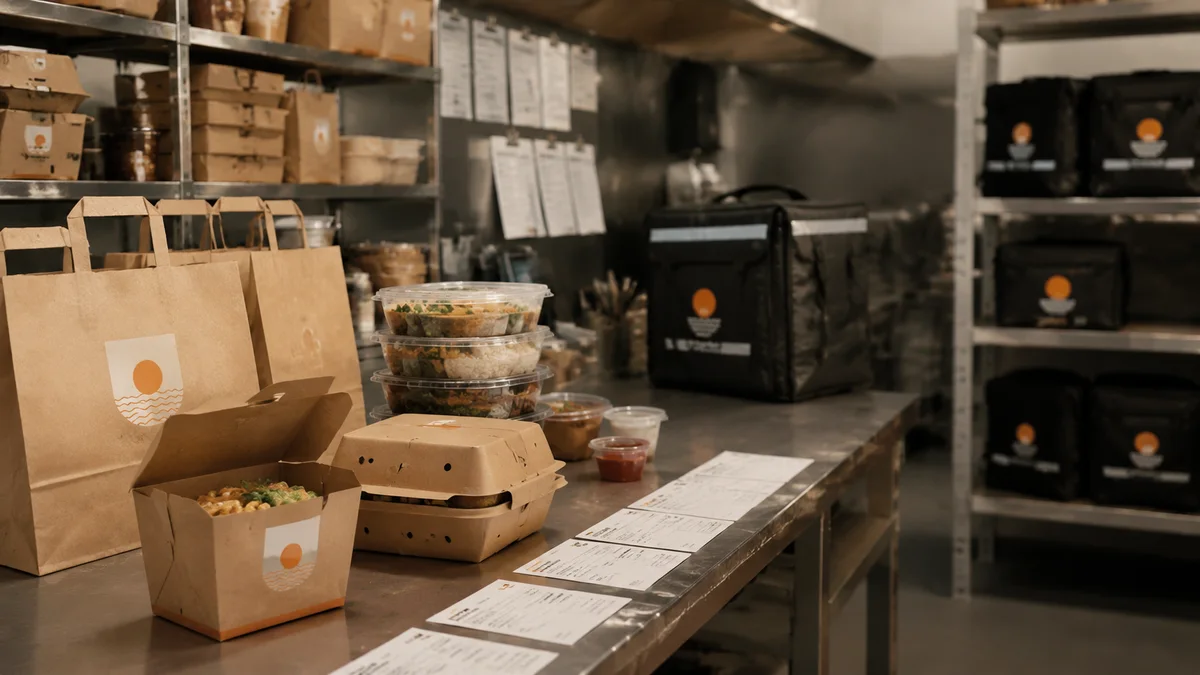
Dark Kitchen Packaging: What Works When You're 100% Delivery-Only in the UK
If you run a dark kitchen, your packaging isn't just a container — it's the only part of your business your customer ever touches. Unlike a restaurant with a shopfront, tables, and front-of-house staff, a delivery-only operation lives or dies by what arrives at the doorstep. A container that leaks curry sauce into the delivery bag, a burger box that steams the bun into a soggy sponge, or a lid that pops open in transit isn't just a packaging failure — it's a lost customer, a bad review, and a refund that wipes out your margin on that order.
Most packaging advice online is written for traditional restaurants that send 20% of their trade through delivery. Dark kitchens send 100%. That changes everything. Your containers travel further, sit longer in thermal bags, get stacked sideways by riders, and arrive at doors where no server is there to apologise for a spill. This guide covers exactly what packaging works for UK delivery-only operations — from container selection and material comparison to packing station setup and EPR compliance.
Key Takeaways
- Choose containers by food type and delivery distance, not by price per unit alone — the cheapest container often costs more in refunds and lost repeat orders.
- Vented containers are mandatory for fried and crispy foods; sealed, leak-proof containers are mandatory for curries, sauces, and soups — never use the same container type across your whole menu.
- Budget £0.80 to £1.50 per order for packaging at moderate volumes (200-500 orders per week), which typically runs 6% to 10% of order revenue.
- Tamper-evident seals are now expected by UK delivery platform customers — a branded sticker or tear-away strip costs under 3p per order and prevents both tampering and "missing item" disputes.
- UK dark kitchens must comply with EPR data reporting, the Plastic Packaging Tax, and food contact material regulations — non-compliance penalties start at £1,000.
Why Dark Kitchen Packaging Is Different From Restaurant Packaging
A restaurant with a dine-in service can afford the occasional packaging shortfall. If a plate looks slightly messy, the server catches it. If food cools slightly, the customer is five metres from the kitchen. If a container leaks, it leaks onto a table that gets wiped down anyway.
None of that applies to a dark kitchen. The food travels 15 to 45 minutes in a thermal bag, gets jostled by a rider on an e-bike or moped, and arrives at a customer who has already paid and has no staff member to complain to — only the review screen. Packaging in this context does three jobs that restaurant packaging doesn't need to do as well: it preserves food quality through extended transit, it represents your brand without any other touchpoint, and it creates trust in a kitchen the customer will never see.
The UK dark kitchen market has grown significantly. Research published in 2025 found that almost 15% of online food orders now come from dark kitchens, and a study by the University of Central Lancashire identified packaging-related failures — leaks, temperature loss, and condensation damage — as recurring themes in customer complaints. Environmental health officers are also paying closer attention: a 2025 investigation found that some UK dark kitchens were skipping food business registration and sharing equipment across multiple virtual brands, which means compliant, clean, well-sealed packaging matters more than ever for building consumer confidence.
The Real Cost of Getting Packaging Wrong
Let's put numbers on packaging failures. Suppose you run a dark kitchen doing 400 orders per week at an average order value of £22. If 5% of orders have a packaging-related issue — a leak, a crushed container, cold food, or a missing item due to poor labelling — that's 20 complaints per week. At a typical platform refund rate of 60% on complaints, you're refunding 12 orders per week.
That's £264 in direct refunds, or £13,728 per year. Add the cost of remaking and redelivering replacement meals, and you can easily double that figure.
Then add the less visible cost: customers who don't complain but simply never order again. Industry data suggests a dissatisfied delivery customer tells 8 to 10 people and rarely returns to a brand after a bad first experience.
Now compare that to the cost of upgrading packaging. Moving from a basic unvented clamshell to a vented kraft box with a leak-resistant coating might cost an extra 6p per unit. Across 400 orders per week, that's £24 per week or £1,248 per year. If that upgrade eliminates even half of your packaging complaints, it pays for itself nearly six times over — and that's before accounting for improved ratings, repeat orders, and word of mouth.
The cost structure for UK dark kitchen packaging breaks down roughly like this for a typical operation doing 300 to 500 orders per week:
Primary container (box, bowl, or tray with lid): £0.25 to £0.60 per unit depending on material and size. Secondary packaging (outer bag, wrap, or sleeve): £0.10 to £0.30 per order. Tamper seal (sticker, tape, or tear-away strip): £0.02 to £0.05 per order. Extras (cutlery pack, napkin, sauce pot, menu insert): £0.08 to £0.20 per order. Branded elements (custom print, sticker, QR code card): £0.05 to £0.25 per order when amortised across volume.
Total: £0.50 to £1.40 per order, or roughly 3% to 8% of a £20 average order. This falls within the industry benchmark of 6% to 10% of revenue for packaging in delivery-only operations.
Amit runs a burger dark kitchen in Leeds doing 350 orders per week. He started with the cheapest unprinted kraft boxes he could find — £0.18 per unit.
Within two months, his Deliveroo rating dropped to 3.8, driven by complaints about squashed burgers, cold chips, and grease soaking through the box. He switched to a vented, grease-resistant burger box with a branded sticker seal at £0.32 per unit.
His rating recovered to 4.5 within six weeks. Refund requests dropped by 70%. Orders increased by 20% as his listing climbed back up the platform rankings. His annual packaging spend increased by £2,500 — and his annual refund bill dropped by over £8,000.
Choosing the Right Container for Every Food Type
No single container works for every dish. The container that holds a curry perfectly will ruin fried chicken. The box that works for a salad will collapse under hot pasta. Matching container to food type is the most important packaging decision you will make.
For hot, saucy dishes — curries, stews, pasta with sauce, gravy-based meals — use leak-proof polypropylene containers with tight-fitting, snap-down lids. Look for containers rated to at least 100°C if food is packed hot. Bagasse (sugarcane fibre) containers are a strong compostable alternative with good heat retention, but verify the lid seal — some bagasse lids fit less tightly than plastic equivalents. Avoid standard paperboard containers for wet dishes unless they carry a verified leak-proof certification.
For fried and crispy foods — fried chicken, fish and chips, tempura, spring rolls, onion rings — ventilation is non-negotiable. Steam is the enemy of crispiness.
- Use vented paperboard clamshells or kraft boxes with perforated lids. The vents let steam escape during transit while the box structure protects the food from crushing.
- If you are using a standard box for crispy items, punch two to three small holes in the lid — this alone can reduce sogginess noticeably.
- For chips, dedicated vented chip boxes with a wide opening keep them crispy and make them easy to eat from.
For burgers and sandwiches, use grease-resistant paper wraps inside a structured box.
- The wrap prevents the bun from sliding apart and absorbs condensation, while the outer box prevents squashing.
- Kraft burger boxes with a greaseproof inner coating are widely available from UK wholesalers.
- Avoid wrapping hot burgers in foil — it traps steam and turns the bun into paste. If you need foil for heat retention, wrap the patty separately and assemble at the last possible moment.
For pizzas, standard corrugated pizza boxes work well provided the pizza is not overloaded with toppings that release moisture. The box should have small vent holes in the lid or sides. A common mistake is boxing a pizza straight from the oven — let it rest for 60 to 90 seconds on a cooling rack first, which reduces steam inside the box by roughly half.
For salads, cold bowls, and desserts, use clear PET or PP containers with tight-sealing lids. Clarity matters — customers want to see fresh food. Add a condensation-absorbing paper liner for salads that sit longer than 20 minutes. Keep dressings and wet toppings in separate portion cups to prevent wilting.
For soups and liquids, use round polypropylene containers with screw-top or press-fit lids rated for hot fill. Round containers handle liquid pressure better than rectangular ones because stress distributes evenly around the circumference. A 12oz (350ml) container serves a starter portion; a 16oz (475ml) container handles a main-course soup.
Materials at a Glance: Heat, Leak Resistance, Cost, and Eco-Credentials
Choosing a material means balancing four factors: thermal performance, leak resistance, unit cost, and environmental compliance. Here is how the main options compare for UK dark kitchens.
Polypropylene (PP) is the workhorse of delivery packaging. It handles temperatures up to 120°C, provides the best leak resistance of any common material, and costs £0.08 to £0.25 per unit at volume. It is widely recyclable in UK kerbside collections. The downside is that it is plastic, which some customers dislike, and it is subject to the UK Plastic Packaging Tax if it contains less than 30% recycled content. The tax is £217.85 per tonne — roughly 0.2p per container, so the cost impact is modest but the reporting requirement adds admin.
Bagasse (moulded sugarcane fibre) is the leading compostable option. It handles temperatures up to 100°C, has good natural insulation, and resists oil and grease without a plastic lining. It costs £0.12 to £0.35 per unit and is certified compostable to EN 13432. The main weakness is lid fit — bagasse lids are less precise than injection-moulded plastic, so test before committing. Bagasse also absorbs ambient moisture in humid UK stockrooms, so storage conditions matter (see our guide on packaging storage and EHO compliance).
Kraft paperboard with a PE or aqueous coating is lightweight, printable, and inexpensive (£0.06 to £0.18 per unit). It works well for dry and semi-dry foods like burgers, wraps, and baked goods. Aqueous-coated board is recyclable in standard paper streams; PE-coated board generally is not. Check with your supplier which certification applies.
Aluminium foil containers offer the best heat retention and are 100% recyclable when clean. They cost £0.10 to £0.25 per unit and are excellent for oven-to-delivery meals. The downside is that foil cannot go in a microwave, which limits customer convenience, and the lids can be less secure than snap-fit plastic options.
Clear PET is the standard for cold, visible-food applications — salads, desserts, sushi, and cold drinks. It costs £0.06 to £0.15 per unit and is widely recycled in the UK. It is not suitable for hot food and does not insulate.
Tamper-Evident Packaging: The Small Investment That Protects Your Reputation
Tamper-evident packaging used to be optional. On UK delivery platforms in 2026, it is effectively mandatory. Customers expect to see a seal, sticker, or tamper-proof closure when their order arrives. If they don't, and something is missing or looks wrong, the assumption defaults to tampering — and the platform nearly always sides with the customer.
A tamper-evident seal serves three purposes. First, it reassures the customer that the food has not been opened between kitchen and doorstep. Second, it prevents riders from opening containers — a rare but real problem that generates viral social media outrage when it happens. Third, it protects your kitchen from false "missing item" claims, because a broken seal provides clear evidence of whether the container was opened.
The options, from cheapest to most premium:
A branded sticker across the lid join costs £0.01 to £0.03 per unit. A 30mm by 60mm sticker with your logo and "Sealed for your safety" does the job. Apply it across the lid and base so it tears visibly if opened.
Self-adhesive bag seals for outer delivery bags cost £0.02 to £0.05 per order. These are peel-and-seal strips built into the bag itself. Once closed, they cannot be opened without tearing the bag.
Tear-away strips on containers cost £0.04 to £0.08 per unit but require custom-manufactured containers with a perforated tear band. The customer pulls a tab to open — like a cigarette packet or a bottle cap seal. This is the most tamper-evident option but requires higher minimum order quantities.
Heat-sealed film lids on plastic bowls cost £0.03 to £0.06 per unit and provide the most secure seal for liquids. The film is applied with a heat-sealing machine (£80 to £300 depending on throughput). Once sealed, the film must be peeled or pierced to access the food.
For most UK dark kitchens doing 200 to 500 orders per week, the branded sticker approach is the practical starting point. It is cheap, requires no equipment, can be customised with your logo, and satisfies the customer expectation. Upgrade to heat-sealed lids for soup and curry containers if those make up a significant portion of your menu.
Branding Through Packaging: Your Box Is Your Storefront
A dark kitchen has no signage, no shopfront, no interior, and no face-to-face service. The packaging is the brand — and good branding on packaging does not require custom-printed everything.
Start with a branded sticker. A 50mm circular sticker with your logo costs £0.02 to £0.05 each at quantities of 5,000. Apply it to plain kraft boxes and bags. This alone makes a generic brown box feel intentional rather than cheap.
Add a small printed insert card. A 90mm by 55mm card — the size of a business card — costs under £0.02 per unit at 10,000 quantity. Print your logo on one side and a short message on the other: "Made fresh in our Manchester kitchen. Tag us @yourbrand." This turns a delivery into a social media prompt and gives customers a tangible connection to your kitchen.
If you run multiple virtual brands from one kitchen — a common UK dark kitchen strategy — colour-code your packaging. One brand gets kraft brown, another gets white, a third gets black containers. This prevents dispatch mix-ups and keeps each brand visually distinct even though they share a kitchen and staff. A study of UK dark kitchens found that operators running multiple brands from one site were particularly prone to cross-brand packaging errors, which confuses customers and damages each brand's credibility.
Chloe runs a dark kitchen in Bristol operating three virtual brands from one unit: a premium burger concept, a vegan bowl brand, and a dessert delivery brand. She colour-codes everything: black boxes for burgers, kraft for vegan bowls, and white with a pastel sticker for desserts. Her packing station has three clearly labelled lanes, one per brand. Order errors dropped to near zero after implementing this system, and customers of each brand see a consistent, distinct packaging experience despite all three coming from the same postcode.
Setting Up an Efficient Packing Station
The packing station is where your kitchen's output meets the delivery world. A well-designed station reduces errors, speeds up dispatch, and keeps packaging clean and organised.
Position the station between the kitchen pass and the exit door. It needs a stainless steel or laminate worktop at least 120 cm wide, with shelving above and below for containers, lids, bags, stickers, and extras. Keep it separate from food prep surfaces — the packaging station is a clean zone, not a food handling area.
Organise containers by size and type in clearly labelled bins or shelves, largest at the back, smallest at the front. Pre-stage stacks of your most-used container with lids nested beside them. Keep a roll of branded stickers and a dispenser at the station — peeling stickers from a roll during a rush costs seconds per order that add up.
The packing workflow for each order should follow the same sequence every time: check the receipt against the items on the pass, pack each item into its primary container and seal it, place all containers into the outer delivery bag, apply the tamper seal to the bag, attach the order label so it faces outward, and place the sealed bag in the rider collection zone. A consistent sequence means consistent output. Label every bag with the order number, customer name, and delivery address — riders should never have to open a bag to check it is the right one. A thermal receipt printer or label printer costs £80 to £150 and pays for itself in reduced dispatch errors within weeks.
Include one unexpected extra per order. A small branded item — a mint, a hand wipe, a loyalty card with a QR code — costs under £0.05 per unit and creates a moment of delight that customers mention in reviews. In a delivery-only business, every positive touchpoint compounds.
UK Compliance: EPR, Plastic Tax, and Food Contact Regulations
Dark kitchens in the UK are subject to the same packaging regulations as any other food business — and the regulatory burden has increased significantly in 2026.
Extended Producer Responsibility (EPR) for packaging requires businesses with an annual turnover above £1 million that handle more than 25 tonnes of packaging per year to register, report packaging data, and pay waste management fees. Most dark kitchens fall below the 25-tonne threshold, but if you are part of a group or scaling rapidly, check your obligations. From April 2026, fees are modulated by recyclability — packaging rated Green (widely recyclable) costs less than packaging rated Red (hard to recycle). Black plastic, multi-layer laminates, and non-recyclable composites are Red-rated and carry penalty fees. Switch to Green and Amber-rated materials to minimise your EPR liability from the start.
The Plastic Packaging Tax applies to plastic packaging with less than 30% recycled content and is charged at £217.85 per tonne. For individual containers, this tax adds roughly 0.15p to 0.3p per unit — negligible per order but meaningful at scale. More importantly, it creates a reporting obligation. Keep records of your packaging materials, weights, and recycled content percentages. If your supplier cannot provide recycled content certification, assume the packaging is taxable.
UK food contact material regulations require that all packaging that touches food complies with retained EU Regulation (EC) 1935/2004. Your supplier should provide a Declaration of Compliance for every product. If they cannot, find a different supplier. This is not a paperwork formality — an EHO inspection that finds non-compliant food contact materials will result in a formal requirement to replace them, and potentially a hygiene rating impact.
Allergen labelling is a specific compliance risk for dark kitchens because the packaging is the only place the customer sees the information. If your online menu lists allergens, your packaging should repeat or reference that information. A printed allergen statement or a QR code linking to your full allergen matrix is the standard approach. Natasha's Law, which requires full ingredient and allergen labelling on foods pre-packed for direct sale, may apply if you prepare food and seal it before a specific order is placed — check whether your workflow triggers this requirement.
Frequently Asked Questions
What is the minimum I should spend on packaging per order for a UK dark kitchen?
Budget £0.80 to £1.20 per order for a basic but functional setup at 200 to 500 orders per week. This covers a decent primary container, an outer bag, a tamper seal, and basic cutlery and napkins. Spending below £0.60 per order almost always results in leaks, complaints, or both. Above £1.50 per order, you are in premium territory with fully branded packaging and custom containers.
Can I use the same containers across my whole menu to save money?
No. Standardising on one container type forces you to compromise on at least half your menu. A container that works for a burger will fail for a curry. A container that works for a salad will steam a portion of chips. Standardise on two to three container types — a leak-proof bowl for wet dishes, a vented box for crispy and dry items, and a clear container for cold food — and buy each in volume.
Do UK delivery platforms have packaging requirements?
Yes, though they are mostly guidelines rather than hard rules. Deliveroo, Just Eat, and Uber Eats all recommend tamper-evident packaging and leak-proof containers. Deliveroo's packaging guidelines specifically call out vented lids for fried food and secure closures for liquids. Repeated packaging-related complaints can affect your platform ranking and, in extreme cases, lead to account suspension.
How do I test packaging before committing to a bulk order?
Order samples from at least two suppliers for each container type. Pack your actual menu items in them, seal them as you would in service, place them in a delivery bag, and leave them for 45 minutes — longer than your average delivery time.
Then open and inspect each container:
- Is the food at an acceptable temperature?
- Has any liquid leaked through or around the lid?
- Is the container structurally intact — no crushing, splitting, or warping?
- Have crispy items gone soggy from trapped steam?
Test three times per container type with different dishes. Only then place a bulk order.
What is the most common packaging mistake UK dark kitchens make?
Using non-vented containers for fried food. It accounts for a disproportionate share of negative reviews because the customer expectation for crispy food is absolute — nobody wants soggy chips or limp fried chicken. The fix is a vented container and a 60-second rest before boxing, and it costs essentially nothing to implement.
Do I need separate packaging for each virtual brand if I run multiple concepts from one kitchen?
Yes. At minimum, use different coloured containers or different branded stickers for each brand. Customers of one brand who receive packaging from another brand lose trust immediately. Colour-coding also prevents dispatch errors — your packing team can see at a glance which box belongs to which brand. A stockroom system with clearly labelled shelves per brand prevents restocking mix-ups.
Conclusion
Packaging for a UK dark kitchen is a profit centre disguised as a cost. Get it right — containers matched to food types, tamper-evident seals in place, an efficient packing station, and compliance with UK regulations — and your packaging actively grows your business through better reviews, fewer refunds, and stronger repeat purchase rates. Get it wrong, and the best food in the country will still arrive as a disappointing, leaky mess.
Start with the container-to-food-type mapping. If you are using the same box for your curry and your chicken burger, fix that first. Add tamper-evident stickers — they are the cheapest insurance policy in the delivery business. Set up your packing station properly with labelled storage and a consistent workflow. And make sure your supplier has provided Declarations of Compliance for every food-contact product — the paperwork matters when the EHO visits.
If you are scaling a delivery-only kitchen and need containers that survive real UK delivery conditions, browse our takeaway boxes range — all available with samples before you commit to bulk. For volume pricing on three or more container types, request a quote and we will put together a package matched to your menu and order volumes.