
Burger Boxes for UK Takeaways: What to Check Before Ordering
How to choose burger boxes that survive UK delivery. Compare kraft, bagasse, and corrugated materials, get the sizing right, and check compliance before you order.
Filed under Operations.
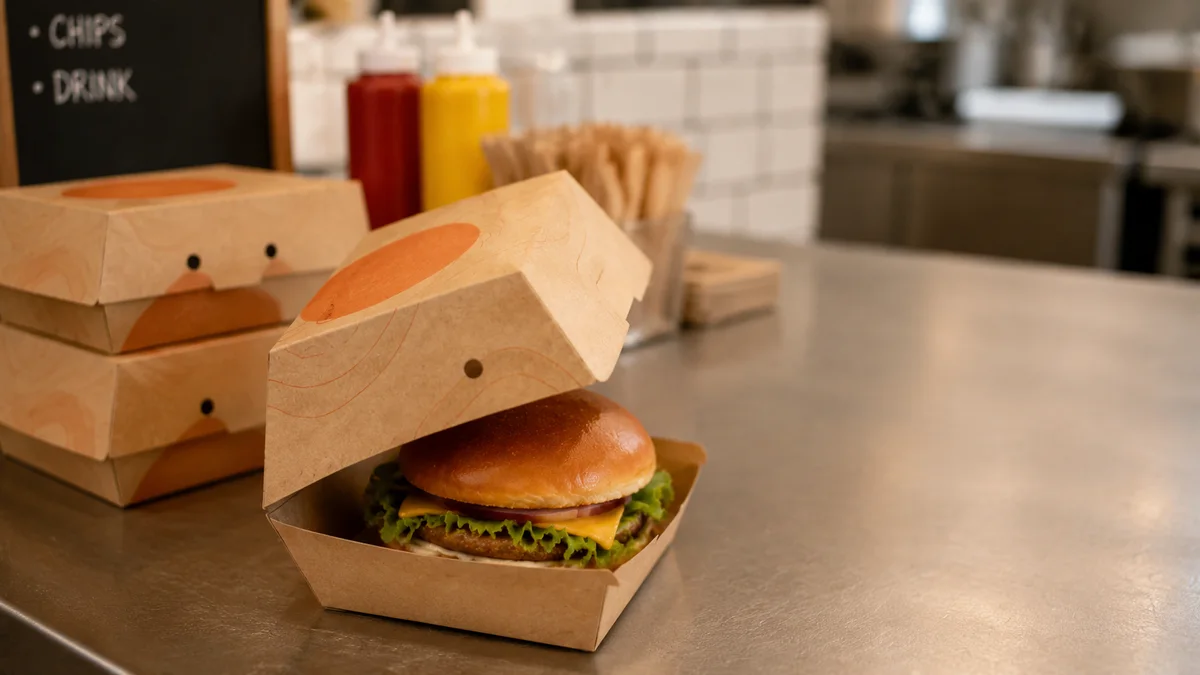
Most burger boxes fail in the first 15 minutes. Not because the cardboard is too thin or the supplier cut corners – but because nobody tested them with an actual double-patty burger, sauce on, lid closed, sat in a thermal bag for a 20-minute delivery run. The box that looked fine on the shelf turns into a steamy, grease-stained mess before it reaches the customer's door. This guide walks through what actually matters when buying burger boxes for a UK takeaway or delivery kitchen: materials that match your menu, sizing that handles your full range, venting that stops soggy buns, and the compliance basics that keep your operation on the right side of UK food-contact law.
Key Takeaways
Bagasse clamshells handle delivery moisture better than standard kraft because they are naturally porous – steam escapes instead of soaking into the bun. Kraft boxes work well for counter-service burgers eaten within minutes, but struggle on longer delivery runs unless the box has vent holes and a grease-resistant lining. Most UK operators get better results carrying two box depths – a standard clamshell for single patties and a deep format for stacked builds, brioche buns, and loaded toppings. Steam vents or perforations in the lid are not optional for delivery – a fully sealed box traps condensation and turns a toasted bun soggy in under 10 minutes. UK food-contact regulations require a Declaration of Compliance from your supplier – if they cannot produce one, walk away.
Why the Wrong Burger Box Costs You More Than the Right One
The cheapest box on a per-unit basis is rarely the cheapest box once you factor in what goes wrong. A box that collapses, leaks grease onto a customer's car seat, or delivers a soggy bun does not just cost you the replacement meal – it costs you the review score, the repeat order, and the word-of-mouth that keeps a small takeaway growing.
Tom runs a smash burger kitchen in Bristol. He switched to the lowest-cost kraft clamshell he could find on a wholesale site. Within the first week, three Deliveroo orders arrived with the box lid popped open because the locking tab could not hold under the steam pressure of a hot double patty. He refunded all three, lost a five-star rating, and spent the next month digging out of a 3.8 average. The saving per box was 4 pence. The cost of lost ratings took six months to reverse.
The real cost of a burger box sits in three places. First, food quality on arrival – if the bun is soggy, the burger is ruined regardless of what went into it. Second, structural integrity during transit – if the box pops open or grease bleeds through, the customer's first impression is a mess. Third, packing speed during service – a box that is fiddly to fold costs labour during peak hours, and labour costs more than cardboard.
When you evaluate burger boxes, price per unit matters. But the number that matters more is what one failed delivery costs your business in refunds, ratings damage, and lost repeat custom. For most UK takeaways doing 200 to 400 covers a week, that number is between 15 and 40 pounds per incident once you include the platform penalty, the food cost, the labour to remake, and the downstream effect of a lower rating on order volume.
Material Match: Kraft, Bagasse, or Corrugated – Which One Fits Your Menu
The material you pick determines how your burger box handles heat, moisture, and time. There is no single best material – but there is a best material for your specific menu and delivery profile.
Kraft paperboard is the classic brown clamshell. It stores flat, assembles quickly, and gives a clean artisan look that suits burger bars and street food operators. It prints well with stamps, stickers, or full branding. Kraft works best for burgers eaten within 10 minutes of packing – counter collection, market stalls, or short-walk footfall. Where kraft falls short is moisture. Without a grease-resistant coating or inner liner, hot burger fat soaks into the board, weakens the structure, and stains through in under five minutes. Some UK suppliers offer kraft with an aqueous grease-resistant coating – this is worth the small premium if you are serving anything saucier than a plain cheeseburger.
Bagasse is made from sugarcane fibre and has become the default recommendation for delivery-first burger operations. It is naturally porous, which means steam vents through the material itself rather than condensing on the inside of the lid. It absorbs enough oil to stay clean without losing structural strength. Bagasse boxes are home-compostable and avoid the Plastic Packaging Tax entirely because they contain no plastic content. The trade-off is bulk – bagasse clamshells are moulded, not folded, so they take up roughly twice the storage space of flat-packed kraft boxes. For a small kitchen with limited shelving, that is a real consideration. They also run 2 to 4 pence more per unit than uncoated kraft at UK wholesale volumes, though the gap narrows at pallet quantities.
Corrugated boxes use a fluted inner layer between two flat liners, giving them more rigidity and insulation than solid board. They hold heat better and resist crushing under stacking pressure – useful if your orders go out in thermal bags with multiple containers piled on top. Corrugated burger boxes are heavier and take up more storage space than kraft or bagasse, but they are the strongest option for tall builds and long delivery routes. Look for E-flute or micro-flute profiles – these give the rigidity benefit without making the box feel oversized for a single burger.
EPS foam boxes still exist in the UK supply chain and they insulate well. But they are increasingly blocked by delivery platforms – Deliveroo and Uber Eats both encourage paper-based packaging in their merchant guidelines – and they attract the full Plastic Packaging Tax rate if they contain less than 30 percent recycled content. Most UK burger operators are moving away from foam for environmental and brand perception reasons.
The practical rule most operators land on: if more than half your orders come through delivery apps and average transit is over 15 minutes, start with bagasse or vented corrugated. If you are primarily counter-service with a short eat window, kraft with a grease-resistant coating will do the job and cost less to store.
Sizing That Survives Your Full Menu, Not Just the Standard Burger
A box that fits a single smashed patty on a standard bun won't close over a brioche double with onion rings and slaw. Yet many UK burger kitchens order one box size and force every menu item into it. The result – squashed toppings, sauce smeared on the lid, and a presentation that looks nothing like the menu photo.
Standard burger box dimensions on the UK market run roughly 110 mm by 110 mm with a 55 to 65 mm depth. This fits a single quarter-pound patty on a standard seeded bun with basic toppings. For double patties, fried chicken fillets, or brioche buns, look for deep-format boxes – same footprint but 75 to 85 mm of internal headroom. These add roughly 1 to 2 pence per unit and save the cost of remakes and refunds.
Compartment boxes – with a burger section and a chip section side by side – are popular for meal deals. The trade-off is moisture transfer. Chips produce steam, and when sealed in the same container as a burger, that steam migrates into the bun. If your average delivery window is under 12 minutes, compartment boxes work. Beyond that, separate the burger and chips into their own packaging. The chip quality and bun texture will both be better.
Clamshell boxes with a secure locking tab or tuck-top closure are the standard. Avoid friction-fit lids on boxes intended for delivery – they pop open under steam pressure or when jostled inside a thermal bag. A tab-lock clamshell is faster to close than a tuck-top during service, which matters when you are clearing a Friday night queue.
For slider or kids' menu items, mini clamshells at around 85 by 85 mm with 45 to 50 mm depth keep small burgers centred and presentable. Carrying a small format alongside your standard and deep boxes covers the full menu without over-ordering slow-moving SKUs.
Steam, Grease, and the Delivery Window: What Ruins a Burger in Transit
A burger straight off the grill produces a surprising amount of steam. When you seal that burger in a closed box, the steam has nowhere to go. It condenses on the inside of the lid, drips back onto the bun, and within five to eight minutes, the top half of the bun is wet. By 15 minutes, the bottom bun has absorbed enough standing moisture to start disintegrating. This is not a material failure – it is physics, and the fix is ventilation.
Vented burger boxes have small perforations or slot vents in the lid that let steam escape while retaining enough heat to keep the burger warm. UK suppliers including Albiz Packaging and Reynopoly offer kraft and corrugated burger boxes with integrated vent holes as standard. If your current box does not have vents, you can add them – a small hole punch through the lid corner works, though it looks less polished than factory-vented packaging.
Grease resistance is the second critical variable. A standard uncoated kraft box will absorb burger fat within minutes, creating visible oil stains on the outside and weakening the box structure. Three solutions exist. A grease-resistant inner wrap – a sheet of coated paper or foil wrap around the burger – creates a barrier between food and box. A coated box uses an aqueous or PLA lining on the inner surface to repel oil. Bagasse boxes are naturally oil-tolerant without a separate coating. Each approach works; the right choice depends on how greasy your burgers are. Smash burgers and sauce-heavy builds need at minimum a coated inner wrap if the box itself is uncoated.
The delivery window dictates how much protection you need. For collection orders eaten within 10 minutes, a basic vented kraft box with a paper wrap is sufficient. For deliveries in the 15 to 30 minute range, step up to a grease-resistant lined box or bagasse clamshell with vents. For routes exceeding 30 minutes – out-of-town deliveries, large meal orders with multiple containers – use a corrugated vented box with a greaseproof inner wrap and ensure the box sits upright in the thermal bag. Stacking burger boxes flat in the bag will crush the bottom one and force steam through every layer above it.
Letting burgers rest for 60 to 90 seconds before boxing reduces the initial steam burst without making the food cold. This small step in the kitchen makes a measurable difference to bun texture on arrival, and it costs nothing.
UK Compliance: What the Box Needs to Pass Before You Sign the Order
Packaging that touches food in the UK must comply with retained EU Regulation 1935/2004 on food contact materials. In practice, this means your burger box supplier needs to provide a Declaration of Compliance confirming the product is safe for food contact under normal and foreseeable use conditions – hot, fatty foods in this case.
Ask your supplier for the DoC before placing a first order. If they cannot produce one or tell you it is not needed, find a different supplier. A legitimate UK packaging wholesaler will have this document on file and can email it to you within a working day.
The Plastic Packaging Tax applies to plastic packaging manufactured in or imported into the UK that contains less than 30 percent recycled content. Most paper-based burger boxes – kraft, corrugated, bagasse – are exempt because they're not primarily plastic. But boxes with a PE plastic lining or a PLA bioplastic coating may fall within scope, depending on the coating weight relative to the total packaging weight. Check with your supplier whether each SKU is in or out of scope.
The tax rate as of April 2026 is 223.69 pounds per tonne of chargeable plastic packaging. For a small takeaway buying a few thousand boxes a year, the tax exposure is modest. But it's your legal obligation to register if you exceed the 10-tonne annual threshold. Not knowing about it doesn't excuse non-compliance.
EPR packaging data reporting became mandatory for most food businesses in 2026. If your business places packaging on the UK market – which includes handing a burger box to a customer – you may need to register with the Environment Agency and submit packaging weight data by SKU. Small businesses below the 25-tonne annual packaging threshold are exempt from EPR fees but may still need to report data. The rules changed in early 2026 and are evolving, so check the latest guidance on gov.uk before assuming you are exempt.
FSC or PEFC certification on your burger boxes confirms the paper fibre comes from responsibly managed forestry. It's not a legal requirement in the UK, but it's increasingly expected by customers who read the fine print on packaging. Most UK wholesalers now stock FSC-certified burger boxes as their standard line – if yours does not, ask why.
A Practical Burger Box Buying Checklist for UK Operators
Before you place your next order, run through these checks. They take 20 minutes and will save you more than they cost in refunds and remakes.
Order samples across three materials – kraft coated, bagasse, and corrugated vented – in your most popular box size. Pack your best-selling burger into each one straight off the grill. Close the lid. Place it in the thermal bag you actually use for deliveries – not a brand-new bag, the one with 12 months of daily wear. Wait 20 minutes. Open each box and check the bun texture against a freshly plated burger. If the bun is wet, the box failed.
Measure your tallest menu burger – double patty, brioche, loaded, whichever is the maximum build. Add 10 mm of headroom above the highest point. That is your deep-box internal height. Order a sample in that depth and verify it closes without pressing on the bun crown before bulk ordering.
Ask the supplier for three documents: the Declaration of Compliance for food contact, the Plastic Packaging Tax status confirmation for the specific SKU, and the FSC or PEFC chain-of-custody certificate. File them in a folder. If your local environmental health officer asks for packaging documentation during a routine inspection, you will have answers ready.
Check the box closure under load. Fill the box with a burger and close it. Hold it by the lid only and gently shake – the sort of movement it experiences in a thermal bag on the back seat of a moped. If the lid releases, the closure is not adequate for delivery.
Count your weekly burger orders and split by delivery versus collection. Run two box formats if delivery is more than 40 percent of burger sales. The per-unit cost difference between a basic kraft box and a delivery-optimised bagasse box is small. The cost of a refunded order isn't.
FAQ
Are burger boxes recyclable in the UK?
Most kraft and corrugated burger boxes are recyclable in kerbside collections provided they are not heavily soiled with food residue. Boxes with a PE plastic coating may not be accepted by all councils – check local recycling guidance. Bagasse boxes are compostable but should go in general waste unless your customer has access to a home compost bin or a commercial composting collection, which most UK households do not.
What size burger box do I need for a double patty?
A deep-format clamshell with internal height of at least 75 mm works for most double patty builds on standard buns. For brioche double patties with loaded toppings, look for 80 to 85 mm of internal headroom. Standard boxes at 55 to 65 mm depth will crush a double.
Do I need vented burger boxes for collection orders?
For collection orders eaten within 10 minutes, vents are helpful but not essential. A short rest before boxing and a paper wrap inside an unvented box will keep the bun texture acceptable for that window. For anything beyond 10 minutes, vents make a measurable difference.
What is the minimum order quantity for branded burger boxes in the UK?
Custom-print burger boxes typically start at 500 to 1,000 units for flat-packed kraft clamshells, and 5,000 to 10,000 units for glued or moulded box formats. UK suppliers including Packaging Bull, Teal Packaging, and Creative Boxes offer low MOQs in the 50 to 100 unit range with shorter lead times. For small operations, starting with plain boxes and custom-printed greaseproof paper wraps or branded stickers is a lower-cost way to add branding without committing to a large custom box order.
Are bagasse burger boxes better than kraft for delivery?
Bagasse boxes manage steam and oil better than uncoated kraft on delivery runs over 15 minutes because the material is naturally porous and oil-tolerant. Kraft with a grease-resistant coating and vent holes performs comparably on most delivery routes and stores in less space. The choice comes down to storage capacity and how heavily you rely on delivery platforms.
What UK compliance documents do I need for burger boxes?
At minimum, a Declaration of Compliance confirming the product meets UK food contact material regulations. If the box contains any plastic content, request confirmation of its Plastic Packaging Tax status. Keep FSC or PEFC certificates on file if you make sustainability claims on your menu or website. Environmental health officers may ask for packaging documentation during inspections, particularly for hot food operations.
The Box That Earns the Rating
A burger box is the first thing your customer touches when their order arrives. Before they see the burger, they see the box – whether it held together, whether it looks clean, whether it feels like something they paid for. The difference between a box that protects the food and a box that ruins it usually comes down to three decisions: choosing the right material for your delivery profile, matching the box depth to your tallest build, and making sure steam has somewhere to go. Get those three right, and the rest follows.
If you are reviewing your burger packaging setup and want to test our range of coated kraft, bagasse, and corrugated burger boxes – with vented lids, UK food-contact compliance documentation as standard, and low minimum order quantities – request a sample pack through our quote page. Test them with your actual menu, not an empty bun, and see which one holds up.