
Takeaway Box Buying Guide for UK Foodservice: Materials, Sizes, and Lid Types
Complete UK buyer's guide to takeaway boxes: kraft vs white vs greaseproof materials, size dimensions, lid closure types, ECT stacking strength, ventilation design, UK food safety compliance, and volume pricing.
Filed under Operations.
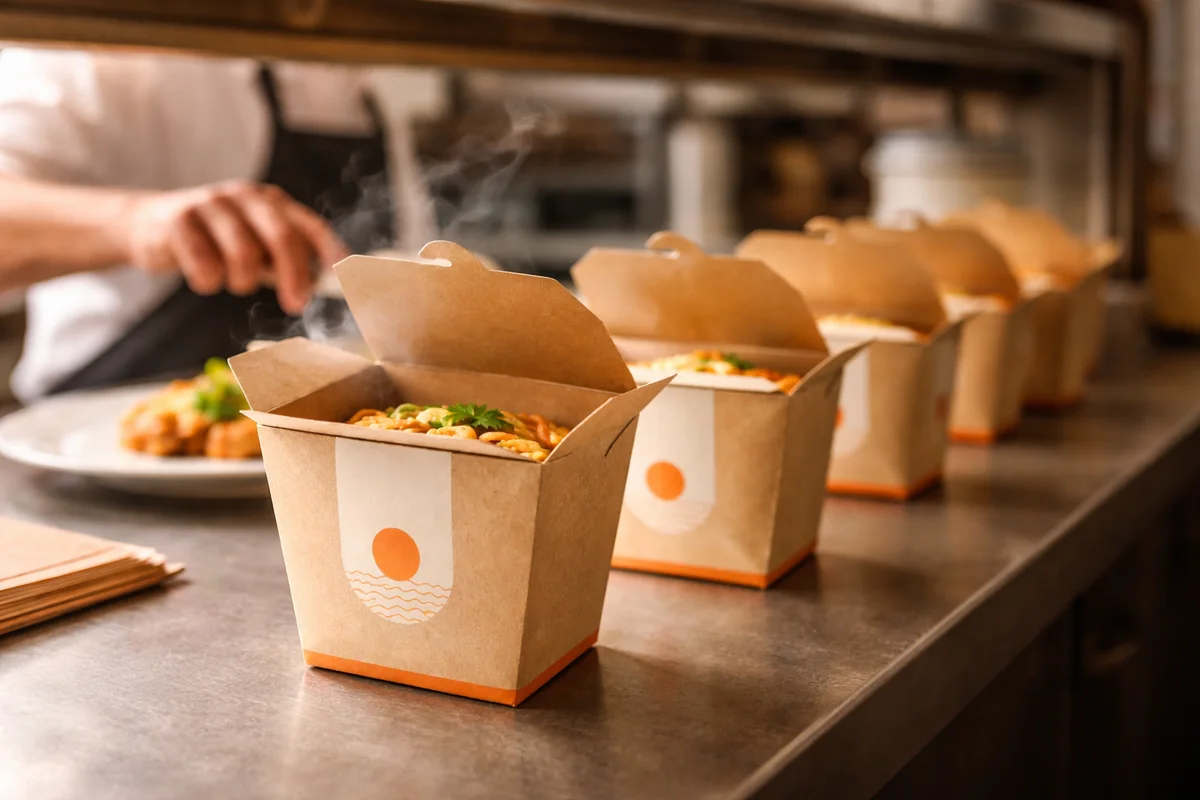
Beyond the Brown Box: Why Takeaway Boxes Reward Thoughtful Specification
The humble takeaway box is the most common piece of branded packaging in British foodservice, and among the most underspecified. Operators who spend hours selecting coffee beans or sourcing free-range chicken often order their takeaway boxes from the first supplier they find on Google, accepting whatever stock is available. This is a missed opportunity. The right box — in the right material, the right size, with the right lid — protects food during transit, presents it well on arrival, and costs less per unit than a poorly chosen alternative that leaks or collapses. Here is how to specify takeaway boxes properly, with UK-specific pricing, material data, and procurement guidance.
Material Selection: What Your Box Is Made Of
UK takeaway boxes fall into three material categories, each with distinct properties, costs, and best-use cases.
Kraft Cardboard
Kraft is unbleached, natural brown cardboard with visible fibre texture. It is the least expensive option and the most common in UK takeaways.
Specifications: Typically 280 to 350 gsm (grams per square metre) paperboard. Heavier weights (350 gsm) provide better rigidity and are recommended for saucy or heavy dishes. The material is porous — it absorbs moisture from food over time, which gradually reduces structural strength. A PE (polyethylene) or PLA coating can be applied to the interior for grease and moisture resistance, adding roughly £0.02 to £0.04 per unit.
Best for: Burgers, chips, fried chicken, wraps, dry foods. Any application where the food is consumed within 20 to 30 minutes of packing.
UK pricing (custom printed, 1,000 units): Approximately £0.10 to £0.14 per box for standard sizes.
White Cardboard
White cardboard uses bleached pulp for a cleaner, brighter appearance. It is the preferred choice for higher-end takeaway and catering applications where presentation matters — sushi, salads, premium sandwiches, afternoon tea boxes.
Specifications: Similar GSM range to kraft (280 to 350 gsm). The bleaching process adds cost but does not materially change the structural properties. White board is often clay-coated on the exterior for better print reproduction — colours appear more vibrant and fine detail prints more sharply than on uncoated kraft.
Best for: Premium fast food, sushi, salads, catering, deli counters, any application where the box is part of the brand presentation.
UK pricing (custom printed, 1,000 units): Approximately £0.14 to £0.18 per box for standard sizes. The 25 to 35 percent premium over kraft reflects the cost of bleached board and coating.
Greaseproof-Coated Board
Greaseproof board adds a chemical or mechanical barrier that prevents oil and moisture from penetrating the paper fibres. This is the material you need for anything fried, oily, or heavily sauced.
Specifications: Standard board (280 to 350 gsm) with a greaseproof coating applied during manufacture. Coatings are typically water-based and food-safe under UK Regulation EC 1935/2004. Greaseproof board does not make the box liquid-proof — it resists oil penetration but will still soften if exposed to standing liquid.
Best for: Fish and chips, fried chicken, curry boxes, anything with significant oil or sauce content.
UK pricing (custom printed, 1,000 units): Approximately £0.16 to £0.20 per box for standard sizes. The premium covers the coating process.
For operators who need both grease resistance and heat retention, our leak-proof curry containers guide covers more specialised options.
Size Guide: What Dimensions Mean in Practice
Takeaway box sizes are specified by length, width, and height in millimetres, typically in the format L x W x H. The internal volume is calculated differently depending on whether the box is rectangular (standard) or clamshell-style (hinged lid).
| Size Name | Dimensions (mm) | Capacity | Best For |
|---|---|---|---|
| Small | 120 x 90 x 50 | ~500ml | Side portions, small chips, snacks |
| Standard | 150 x 110 x 60 | ~900ml | Burger and chips, standard takeaway portion |
| Medium | 180 x 130 x 65 | ~1.3L | Main meal with sides, kebab and chips |
| Large | 220 x 150 x 70 | ~2.0L | Family meals, multiple portions, pizza slice boxes |
| Extra Large | 250 x 180 x 80 | ~2.8L | Catering portions, buffet boxes |
The most commonly ordered size among UK takeaways is the Standard (150 x 110 x 60mm), which suits a single burger with chips or a standard curry and rice container.
A practical tip: always test your actual food portions in a sample box before ordering. Chip portions that fill a standard box when loosely packed may overflow when pressed down to close the lid. Curry portions that look neat in the kitchen can shift during delivery and leak through a lid that is not fully sealed. Order physical samples and pack a real order in them.
Lid Types and Closure Mechanisms
The lid is where most takeaway box failures happen. There are three common closure types, with clear trade-offs in security, cost, and ease of use.
Tuck-Top Lid
The standard closure: a flap folds over the top and tucks into a slot on the front panel. Simple, fast, no additional materials needed.
Advantages: Lowest cost, fastest to close during service, widely familiar to customers. Disadvantages: Least secure. Tuck-tops can pop open if the box is overfilled, if it is handled roughly, or if the tuck flap loses rigidity from moisture absorption. Not recommended for delivery of liquid or saucy foods. Best for: Counter service where the customer carries the food a short distance. Burgers, chips, dry items.
Snap-Lock / Click-Lock Lid
Small tabs on the lid snap into corresponding slots on the box body, creating a more secure mechanical closure. The audible "click" confirms engagement.
Advantages: More secure than tuck-top, audible confirmation of closure, adds minimal cost (£0.01 to £0.02 per unit). Disadvantages: Slightly slower to close than tuck-top. Tabs can tear if boxes are roughly handled after closure. Best for: Delivery orders where the box will be stacked, jostled, or transported by a rider. Curries, saucy foods, anything where a spill is unacceptable.
Tuck-Top with Tuck-Flap Side Panels
The most secure standard closure: the main tuck-top is supplemented by tuck-in side panels that lock the box structure. This design also provides additional stacking strength because the side panels transfer vertical load to the box walls.
Advantages: Best stacking strength, most secure closure for delivery, boxes can be stacked 3 to 4 high without crushing. Disadvantages: Highest cost of the three, slowest to close during service, more complex to manufacture. Best for: Premium delivery, catering orders, large boxes with heavy contents.
For more on selecting packaging that survives delivery, see our takeaway packaging durability guide.
Ventilation: The Overlooked Detail
Steam is the enemy of fried food. When hot chips or fried chicken go into a sealed box, steam builds up, condenses on the lid, and drips back onto the food, turning crisp batter soggy within minutes. The solution is ventilation: small holes or slots in the box that allow steam to escape without letting significant heat out.
Ventilation options:
- Die-cut vent holes: 3 to 5 small holes (3 to 5mm diameter) punched in the lid. Most common on pizza boxes but also available on takeaway boxes.
- Corner relief vents: Small openings at the top corners of the box, created by the box geometry rather than additional cutting.
- Perforated panels: A section of the lid with multiple small perforations for high-steam foods like fish and chips.
The trade-off: more ventilation means crisper food but faster cooling. For delivery orders with a 15 to 20 minute transit time, moderate ventilation is ideal. For counter-service food eaten within 5 minutes, ventilation matters less.
UK Food Safety and Compliance
All takeaway boxes sold for food contact in the UK must comply with Regulation EC 1935/2004 on materials and articles intended to come into contact with food. This regulation requires that packaging does not transfer its constituents to food in quantities that could endanger human health, change the composition of the food, or deteriorate its taste or odour.
Additionally, Regulation EU 10/2011 on plastic materials and articles applies to boxes with PE or PLA coatings, setting specific migration limits for substances used in the plastic layer.
Boxes manufactured with recycled content in the food-contact layer must comply with Regulation EC 282/2008 on recycled plastic materials. Most UK takeaway boxes use virgin fibre for the food-contact surface and recycled content (where present) in the outer layers only, which avoids this requirement.
All OkeyPackaging takeaway boxes carry the required Declaration of Compliance documentation. For our full product specifications, visit our takeaway boxes page.
Stacking Strength and Delivery Performance
In a delivery rider's bag, boxes are stacked, tilted, and vibrated over potholes for 15 to 25 minutes. The physical load on a box at the bottom of a stack is significant. Stacking strength is measured by ECT (Edge Crush Test) value, expressed in kN/m (kilonewtons per metre):
- Standard takeaway box (300 gsm kraft): ECT approximately 1.2 to 1.5 kN/m
- Heavy-duty takeaway box (350 gsm kraft with side panel reinforcement): ECT approximately 1.8 to 2.2 kN/m
- Lightweight pizza box (E-flute corrugated): ECT approximately 1.0 to 1.3 kN/m
For delivery operations, specify boxes with ECT of 1.5 kN/m or higher. If your boxes consistently arrive crushed, check the ECT rating with your supplier — you may need a heavier board weight or a reinforced design.
Assembly time also matters during service. A box that takes 10 seconds to fold and close versus 5 seconds adds up. In a takeaway doing 200 orders per evening, that 5-second difference is roughly 17 minutes of additional labour — about £3.50 in staff cost per evening, or £1,200 per year. Fast-folding designs with pre-creased fold lines reduce assembly time and pay for their slight cost premium through labour efficiency.
Pricing Guide: What to Budget
UK market pricing for custom-printed takeaway boxes as of mid-2026:
| Specification | 500 units | 1,000 units | 5,000 units | 10,000 units |
|---|---|---|---|---|
| Standard kraft, tuck-top, 1-colour print | £0.22-0.28 | £0.14-0.18 | £0.08-0.11 | £0.06-0.09 |
| White board, tuck-top, full-colour print | £0.28-0.34 | £0.18-0.24 | £0.11-0.15 | £0.09-0.12 |
| Kraft, snap-lock, full-colour print | £0.26-0.32 | £0.16-0.22 | £0.10-0.14 | £0.08-0.11 |
| Greaseproof, tuck-top, full-colour print | £0.30-0.36 | £0.20-0.26 | £0.12-0.17 | £0.10-0.14 |
Prices are per unit, excluding delivery and VAT. Ranges reflect variations in size, print complexity, and order volume. These are indicative street prices for UK-manufactured custom boxes from low-MOQ suppliers, not the lowest-possible prices from volume-only manufacturers.
Six Questions to Ask Before Ordering
- What is the board weight and ECT rating? Get these in writing. Heavier board costs more but reduces the risk of crushed deliveries.
- Is a PE or PLA coating included? If your food is oily or saucy, you need a coating. Confirm whether the quoted price includes it.
- What is the exact internal volume? Millimetre dimensions tell you the external size. Internal volume tells you whether your food fits. Always test with samples.
- Can you provide a Declaration of Compliance? Required for food-contact packaging under UK law. If the supplier hesitates, walk away.
- What is the lead time and where is production? UK production typically delivers in 7 to 14 working days. Imported boxes take 4 to 8 weeks and carry higher minimums.
- Can I order samples first? Yes, you should. Blank stock samples are usually free. A printed sample of your artwork costs £25 to £50 and is essential for first orders.
The Bottom Line
A takeaway box is not a commodity — the difference between a well-specified box and the cheapest available option is the difference between food that arrives intact versus food that arrives crushed and leaking. For a UK takeaway or delivery kitchen, the box is the last thing the customer touches before they eat. When it works, nobody notices. When it fails, everyone remembers. Spend the time to specify the right material, the right size, and the right lid. It costs less than you think, and the alternative costs more than you calculate.
For custom-printed takeaway boxes with low minimums, free design support, and UK-based production, visit our quote page or browse our full product range.