
Double Wall Paper Cups: Plastic-Free vs PE Coating — What UK Cafes Need to Know
PE or aqueous coating? How the UK's 5% non-fibre kerbside threshold changes your cup choice. Real performance tests, costs, and 2026 regulatory timeline for cafe owners.
Filed under Materials.
Double Wall Paper Cups: Plastic-Free vs PE Coating - What UK Cafes Need to Know
In January 2025, McDonald's UK switched its hot drink lids from plastic to moulded fibre. Within eight months, the chain reversed the decision. Customers reported lids that dissolved mid-sip, collapsed while driving, and leaked hot coffee onto hands and clothes. A staff member told The Sun that "coffee was leaking out" and the "lids weren't secure enough." McDonald's public statement was blunt: "The innovation didn't meet expectations."
The lesson is not that fibre-based packaging can't work for hot drinks. It's that the transition from plastic to plastic-free in any hot beverage application is harder than it looks - and the coating technology that makes it possible is the difference between a cup that performs and one that fails in a customer's hand. For UK cafe owners watching the regulatory clock tick toward kerbside recycling mandates, this is the specification that decides whether your cup programme survives the next three years.
This guide walks through the coating technologies inside double-wall paper cups, explains why the UK's new 5% non-fibre threshold changes the buying decision for every cafe in the country, and provides a practical framework for testing plastic-free cups before you commit your entire hot drink operation to an unproven specification.
Key Takeaways
- PE-lined cups are the cheapest and most proven option but contain 15-20% plastic by weight - which means they fail the UK's emerging ≤5% non-fibre threshold for kerbside recycling and will attract higher EPR fees from 2026.
- Aqueous (water-based) coated cups can hit 96%+ fibre content and are kerbside-recyclable in standard paper streams - but early-generation coatings had documented leakage problems, and even current versions need real-world testing with your hottest, longest-hold drinks.
- Double-wall construction is the smartest pairing with plastic-free coatings because the second paper layer adds structural reinforcement that compensates for the slightly lower rigidity of aqueous coatings versus PE at the same wall thickness.
- The cost difference is narrowing. PE cups cost roughly 5-8p per 12oz double-wall unit in bulk. Plastic-free aqueous cups cost 8-12p. The gap closes further when you factor in EPR fee differentials from 2026.
- Always test with your actual drinks, not water. A cup that holds water for 4 hours can fail with a latte in 20 minutes because milk fat and heat interact differently with water-based barrier coatings than plain water does.
Why the Coating Inside Your Cup Matters More Than the Wall Thickness
Tom runs a specialty coffee shop in Bristol doing 300 covers on a Saturday. For three years he used standard double-wall PE-lined paper cups. They were reliable. The outer wall stayed cool. The inner PE layer kept the coffee hot and the cup structurally sound for the 20 minutes it took the average customer to finish a flat white.
In early 2026, his waste contractor told him his used cup collection would stop being accepted in mixed recycling from April. The reason was the PE lining - at roughly 18% of the cup's total weight, it pushed the cup over the 5% non-fibre threshold that UK reprocessors were increasingly enforcing ahead of formal regulation. Tom's cups, which he'd been told were "recyclable," were going to landfill. His EPR fees were set to rise by roughly 40% per tonne of packaging when the modulated fee structure took effect.
He switched to an aqueous-coated plastic-free double-wall cup from a different supplier. The new cups looked identical to the old ones - white outside, rolled rim, standard 12oz double-wall profile. Within the first week, three customers complained about cups that had gone soft at the seam. The issue turned out to be a combination of the aqueous coating's slightly different sealing temperature during manufacturing and Tom's specific drink profile - his flat whites sit at roughly 65°C, which is within the stated tolerance of the cup but near the upper range of the coating's continuous-exposure comfort zone. The PE cups had handled 65°C effortlessly. The aqueous cups could handle it, but only just - and the margin was thinner than the spec sheet implied.
Tom's story is not an argument against plastic-free cups. He still uses them. But he now tests every new batch with his actual hottest drink, held for his actual longest delivery time, before putting them into service. What he learned the hard way is that the coating inside a paper cup is not a commodity - it's the component that determines whether your cup holds up, whether your customer burns their hand, and whether your waste contractor accepts the empty cup in the paper bin.
PE vs Aqueous vs PLA: What Each Coating Actually Does
Three coatings dominate the UK paper cup market in 2026. They look identical from the outside. The customer cannot tell which one they are holding. The difference is invisible and absolute - it determines where the cup goes after use, how much you pay in regulatory fees, and whether the cup survives a 20-minute hot drink session.
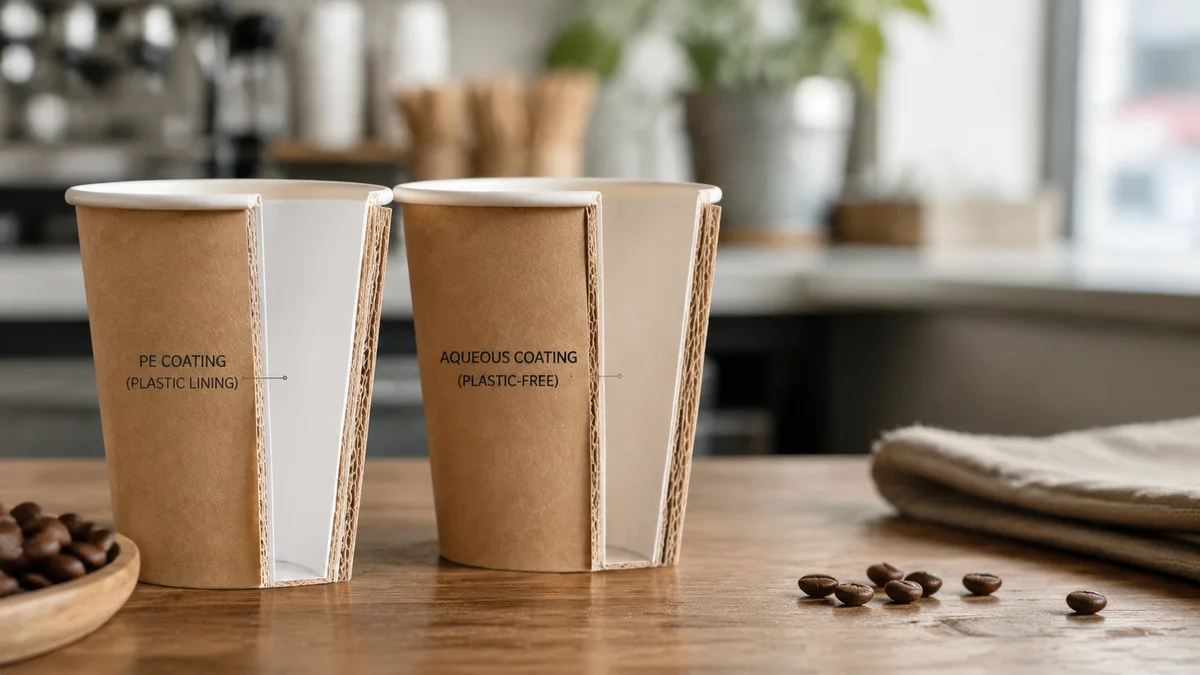
PE (polyethylene) is a thin layer of petroleum-based plastic laminated to the inside of the paper cup. It's been the industry standard for decades because it works. PE creates a complete moisture barrier that prevents liquid penetration even with boiling water - the cup could hold 100°C coffee indefinitely without leaking. It adds structural rigidity to the cup wall. It seals reliably during cup forming at a well-understood temperature range. A 12oz double-wall PE-lined cup costs roughly 5-8p per unit in bulk quantities from UK suppliers.
The problem with PE is disposal. PE makes up 15-20% of the cup's total weight. When the cup reaches a recycling facility, the PE cannot be separated from the paper fibre using standard pulping equipment. The cup is either rejected from the paper stream (becoming contamination), sent to a specialist recycling facility (of which the UK has a small handful), or landfilled. Under the UK's emerging kerbside recycling framework - pushed by the Flexible Packaging Association's July 2025 submission to Defra - packaging with more than 5% non-fibre content by weight is classed as a fibre composite and excluded from standard paper recycling. PE-lined cups fail this threshold by a factor of three or more.
Aqueous (water-based) coating replaces the PE layer with a water-dispersible barrier - typically a modified starch, cellulose, or acrylic-polymer dispersion applied at a thickness of 4-5μm, compared to 12-15μm for a typical PE lining. Because the coating is so thin and is compatible with the paper pulping process, the overall cup achieves 95-97% fibre content - well within the 5% non-fibre threshold. The cup goes in the paper recycling bin. It is processed alongside cardboard and newsprint. The coating disperses during pulping and does not contaminate the recovered fibre.
The trade-offs are real. Aqueous coatings are slightly less effective as moisture barriers than PE over extended contact times. A cup that holds a black Americanano at 85°C for 15 minutes with no visible softening may show slight edge wicking (liquid creeping into the paper at the cup seam) after 25 minutes with a latte at 65°C - because milk fat interacts with the coating differently than water. The sealing temperature during manufacturing is narrower for aqueous coatings than PE, which means batch-to-batch consistency can vary more between production runs. And aqueous-coated cups cost 40-60% more than PE equivalents at current volumes - roughly 8-12p per 12oz double-wall unit.
PLA (polylactic acid) is a bioplastic made from fermented plant starch. It sits in an awkward middle ground. PLA-lined cups are certified industrially compostable under EN 13432 but are not recyclable in the UK paper stream - PLA does not disperse during pulping and behaves like PE in a recycling facility. PLA is not home-compostable. And most UK local authorities do not provide industrial composting collection for post-consumer packaging. The practical result is that a PLA-lined cup put in a street bin goes to the same destination as a PE-lined cup - landfill or incineration - at roughly twice the per-unit cost. PLA is not a solution for the UK's 5% non-fibre threshold problem. For most high-street cafes, it is the least rational coating choice: it costs more than PE, performs worse than aqueous in cold drinks (PLA can become brittle), and still cannot go in the paper recycling bin.
The decision framework is straightforward but depends on your priorities. If upfront cost is the dominant consideration and your waste contractor hasn't yet enforced the 5% threshold, PE remains the cheapest and most proven option. If you want a cup that goes in the customer's paper recycling bin at home and minimises your EPR liability from 2026 onwards, aqueous-coated is the direction the UK market is moving. If you operate in a closed-loop venue (campus, festival, office canteen) with guaranteed industrial composting and price is not the primary constraint, PLA is defensible - but it is not the mass-market solution.
Why Double-Wall Construction Is the Smartest Pairing with Plastic-Free Coatings
Double-wall paper cups have two layers of paperboard separated by an air gap. The outer layer stays cool to the touch even when the inner layer holds near-boiling liquid. No separate sleeve is needed - the insulation is built into the cup. Double-wall cups are slightly more expensive than single-wall cups (roughly 1-3p extra per unit) and take up roughly 30% more storage space per case. For hot drink service, the extra cost is almost always justified by the elimination of sleeves and the cleaner presentation.
Double-wall construction matters more for plastic-free cups than it does for PE-lined cups. Here is why.
The aqueous coating on a plastic-free cup is slightly less rigid than a PE lining of the same thickness. In a single-wall cup, that reduced rigidity translates to a marginally softer cup wall - noticeable to the customer when they grip the cup, and potentially problematic for larger sizes (16oz and above) where the weight of the liquid creates more lateral pressure on the cup wall. In a double-wall cup, the outer paper layer provides structural reinforcement that the inner coating doesn't need to supply. The two paper layers, each at 250-300gsm, give the cup its stiffness. The coating only needs to block liquid - not to contribute to the cup's structural integrity.
This is why Jeffrey Packaging's July 2025 submission to Defra specifically highlighted double-wall aqueous cups as the path to 96.3% fibre content. Their construction - a 250-300gsm FSC bamboo pulp inner layer with water-based coating at 4.2% of total weight, a 230-250gsm uncoated outer layer, and an insulating air gap - achieves the recycling threshold without compromising the cup's hand feel or structural performance. A single-wall aqueous cup at similar paper weights would struggle to match the rigidity of a double-wall PE cup. The double-wall design makes the plastic-free transition technically feasible without asking customers to accept a noticeably different cup experience.
The practical takeaway for UK cafe operators: if you are considering switching from PE to plastic-free, don't start with single-wall cups. The cost saving versus double-wall is small (roughly 1-3p per cup), and the structural advantage of the second paper layer is what makes the aqueous coating viable in service. Test double-wall aqueous cups first. If they pass your performance tests, you have a solution that meets the recycling threshold, feels familiar to customers, and eliminates the sleeve - a cleaner, more sustainable serve with no additional operational complexity.
UK Regulations: What the 5% Non-Fibre Threshold Means for Your Next Cup Order
Three regulatory developments are reshaping UK paper cup procurement in 2026. Together, they make PE-lined cups progressively more expensive and plastic-free cups progressively more attractive - even if the upfront unit price hasn't fully converged yet.
The kerbside recycling threshold is the biggest change, and it's not yet formal legislation - it's an industry and regulatory direction of travel. In July 2025, the UK's Flexible Packaging Association formally urged Defra to expand kerbside collection eligibility to paper cups that contain 5% or less non-fibre content by weight. The logic is straightforward: cups with minimal non-fibre content can be processed in standard paper recycling mills without contaminating the recovered fibre stream. Cups above the threshold - including all PE-lined cups at 15-20% non-fibre - require specialist separation facilities that don't exist at scale in the UK. If Defra adopts the FPA's recommendation, the 5% threshold becomes the de facto industry standard. Even before formal adoption, UK waste contractors and reprocessors are already applying it - rejecting PE-lined cups from paper collections and charging higher gate fees for fibre-composite packaging.
The practical impact for a UK cafe doing 400 hot drinks a day: roughly 146,000 cups per year. If all are PE-lined and excluded from kerbside recycling, the cafe's packaging waste shifts from "recyclable" to "general waste" - potentially doubling the waste disposal cost per cup, depending on the local contractor's fee structure. If the cafe switches to aqueous-coated cups, the cups go in the paper bin, the waste stream stays compliant, and the EPR fee liability drops.
Extended Producer Responsibility (EPR) modulated fees take effect from 2026, with the fee structure based on packaging recyclability. Under the proposed framework, packaging classed as "paper" (≥95% fibre) attracts lower per-tonne fees than packaging classed as "fibre composite" (5%+ non-fibre). PE-lined cups fall into the higher-fee category. Aqueous-coated cups fall into the lower-fee category. For a cafe chain doing a million cups a year, the fee differential could be hundreds or thousands of pounds annually - not a huge number per cup, but a meaningful one at scale.
The UK Plastic Packaging Tax (£228.82 per tonne from April 2026) applies to plastic packaging with less than 30% recycled content. PE-lined paper cups are classified as paper-based composite packaging and are currently outside the scope of the tax. PLA cups are bioplastic and outside the scope. Aqueous-coated cups contain no plastic and are outside the scope. The tax is not the primary driver of the shift away from PE - the kerbside recycling threshold and EPR fees matter more - but it reinforces the direction of travel.
The UK Green Claims Code (CMA, enforced since 2022) is the regulation most likely to catch out a cafe operator who switches to plastic-free cups and promotes the switch without verifying the claims. If you market your new cups as "recyclable," you must be able to demonstrate that they are recyclable in practice through UK kerbside collections - not just recyclable in a laboratory or a specialist facility. If you market them as "compostable," you must specify industrial or home composting and provide certification evidence (EN 13432 for industrial). If you market them as "plastic-free," the cup must contain no plastic - including PE linings and PLA bioplastic. Aqueous-coated cups can substantiate "plastic-free" and "kerbside-recyclable" claims. PE-lined cups cannot substantiate either. PLA-lined cups can substantiate "plastic-free" (PLA is bioplastic, not petroleum-based plastic) but not "kerbside-recyclable" (PLA contaminates the paper stream).
The regulatory direction is unambiguous: the UK is moving toward a system where packaging is either widely recyclable through existing kerbside collections or it pays a premium. Aqueous-coated paper cups are currently the only coating technology that aligns with both the 5% non-fibre threshold and the EPR fee structure, while also being ready for service in a double-wall hot drink cup. That may change - advanced recycling technologies and new barrier coatings are in development - but for orders being placed in 2026, the choice is effectively between PE (cheap now, likely more expensive over the cup's regulatory lifetime) and aqueous (more expensive now, lower regulatory risk and disposal cost).
How to Test Plastic-Free Cups Before You Commit Your Entire Operation
Supplier spec sheets and marketing material will tell you that plastic-free cups perform identically to PE. Some do. Some do not. The only way to know is to test with your own drinks, in your own service conditions, before you place a pallet order. Four tests matter.
The hot-hold test. Fill the cup with your hottest, fattiest drink - a large latte at 65-70°C, not water. Water is an easy test liquid that tells you nothing about how milk fat interacts with a water-based coating. Place the filled, lidded cup on a counter for 30 minutes - longer than a typical customer hold time, because you want to find the failure point, not confirm the happy path. Check the exterior of the cup every 10 minutes for softening, moisture at the seam, or visible deformation. At 30 minutes, empty the cup and check the interior coating for blistering, peeling, or edge wicking at the seam. A PE cup should pass this test with no visible change. An aqueous cup that passes this test is ready for service. An aqueous cup that shows any interior coating change at 30 minutes is not fit for your hottest drinks.
The grip-and-squeeze test. Fill the cup with your standard hot drink at serving temperature. Lid it. Hold it by the body with normal hand pressure - the grip your customer uses when they pick up the cup from the counter. If the cup wall compresses noticeably more than your current PE cup under the same pressure, the aqueous coating is not providing enough structural contribution and the cup may feel "cheap" or "flimsy" to customers. This is more common with single-wall aqueous cups than double-wall. If you are switching from double-wall PE to double-wall aqueous, the grip difference should be minimal. If you are switching from double-wall PE to single-wall aqueous, expect a noticeable difference and test for customer reaction before committing.
The stack-and-leave test. Fill three cups with hot liquid to normal serving level. Lid them. Stack the second on top of the first, the third on top of the second. Leave for 15 minutes. This simulates a delivery bag or a customer carrying multiple cups. Unstack and check each cup. If any cup has softened, deformed under the weight, or shows lid seal compromise, the cup lacks sufficient top-load strength for delivery or multi-cup orders. Double-wall cups should pass this test more comfortably than single-wall cups regardless of coating type - the air gap between walls provides crush resistance that a single paper layer cannot match.
The customer blind test. If you are switching from PE to plastic-free and the cup looks different (some aqueous cups have a slightly more matte interior finish), give the new cup to five regular customers without telling them what changed. Ask one question: "Does anything feel different about this cup?" If more than one customer notices something negative - the cup feels softer, the rim texture is different, the cup gets warmer to the touch sooner - you have a customer experience gap that needs to be addressed, either by switching to a different aqueous cup spec or by sticking with PE until the aqueous options in your cup size have improved.
Ask your supplier four questions before placing a first order. What is the coating type and the total non-fibre content percentage? Has the cup been tested with hot milk-based drinks, not just water, and can you share the test results? What is the recommended maximum continuous hot-hold time for the cup? Is the cup certified as recyclable in the UK paper stream, and can you provide documentation confirming the classification under the EPR Recyclability Assessment Methodology? A supplier who hesitates on any of these is reselling imported stock with no UK-specific performance validation. For a cup that holds the hottest, most spill-prone product in your cafe, that isn't acceptable.
Frequently Asked Questions
What is the difference between PE-coated and aqueous-coated paper cups? PE (polyethylene) is a thin layer of petroleum-based plastic applied to the inside of the cup. It provides a complete moisture barrier and is the cheapest coating option, but it makes up 15-20% of the cup's weight and prevents recycling through standard paper streams. Aqueous (water-based) coating is a plastic-free barrier applied at roughly 4-5μm thickness. It achieves 95%+ fibre content, is kerbside-recyclable, and costs 40-60% more per cup than PE at current volumes.
Do aqueous-coated cups hold up as well as PE cups for hot drinks? Modern aqueous coatings are functionally comparable to PE for standard hot drink service - 15-20 minute holds at 65-85°C. The performance gap has narrowed significantly in the past two years. However, aqueous coatings are slightly less moisture-resistant over extended contact times (30+ minutes) and at the upper end of the temperature range. Always test with your actual drinks before committing.
Can PE-lined paper cups be recycled in the UK? No. PE-lined cups contain 15-20% plastic by weight and are rejected by standard UK paper recycling mills because the PE cannot be separated from the paper fibre. They require specialist recycling facilities, of which the UK has very few. Under the emerging 5% non-fibre threshold for kerbside recycling, PE-lined cups will be classed as general waste in most UK council areas.
How much more do plastic-free double-wall cups cost? Aqueous-coated double-wall cups cost roughly 8-12p per 12oz unit in bulk quantities, compared to 5-8p for PE-lined equivalents - a 40-60% premium. However, when EPR fee differentials, waste disposal costs, and the marketing value of a verifiable plastic-free claim are factored in, the total cost gap narrows. The premium is expected to shrink further as aqueous coating production scales.
Will the UK ban PE-lined paper cups? No ban has been announced. The regulatory mechanism is not a ban but a combination of kerbside recycling exclusion (the 5% non-fibre threshold), higher EPR fees for fibre-composite packaging, and the Green Claims Code restricting recyclability claims. The effect is to make PE cups progressively more expensive and harder to market as sustainable, rather than to prohibit them outright.
Is it worth switching to plastic-free cups now, or should I wait? If your current PE cups work, your waste contractor accepts them, and you are not facing immediate EPR fee pressure - waiting 6-12 months is reasonable. Aqueous coating technology is improving rapidly, costs are falling, and the regulatory picture will be clearer by late 2026. If you are placing a fresh order now and have the time to test properly, switching to double-wall aqueous cups is a defensible move that positions you ahead of the regulatory curve and gives you a verifiable sustainability claim that PE cannot match.
Conclusion
The coating inside your paper cup is the only part of your packaging that your customer cannot see and the only part that determines whether the cup is recyclable, whether it leaks, and whether your waste disposal costs go up or down over the next three years. PE coating is cheap, proven, and on the wrong side of every regulatory signal the UK government is sending. Aqueous coating costs more upfront, is slightly less forgiving in service, and is the only option that aligns with where UK packaging regulation is heading.
The four decisions that matter are coating type (PE for cost now, aqueous for compliance and recyclability), wall construction (double-wall is the safer pairing with aqueous coatings), supplier testing (your hottest drink, your longest hold time, your actual delivery conditions), and regulatory positioning (the 5% non-fibre threshold is coming, and EPR fees will widen the cost gap between PE and aqueous from 2026).
Check the specification of the cups you currently use. If you cannot state the coating type, the non-fibre content percentage, and whether the cup is accepted by your waste contractor in the paper stream, find out. If your supplier cannot tell you, find a different supplier. A cafe doing 300 hot drinks a day spends roughly £5,000-8,000 a year on cups. Getting the coating specification right costs nothing to test and can mean the difference between a cup programme that is compliant, recyclable, and cost-efficient - and one that becomes progressively more expensive with every regulatory cycle.
Browse our range of double-wall paper cups with PE and plastic-free aqueous coating options at okeypackaging.com. Request sample packs to test with your own hot drinks before placing a bulk order.