
Ice Cream Cups for UK Gelato Shops: What to Check Before Ordering
Paper or PLA or bagasse? 6oz or 8oz? Learn the ice cream cup specs that matter for UK gelato shops before you commit to a summer season order.
Filed under Operations.
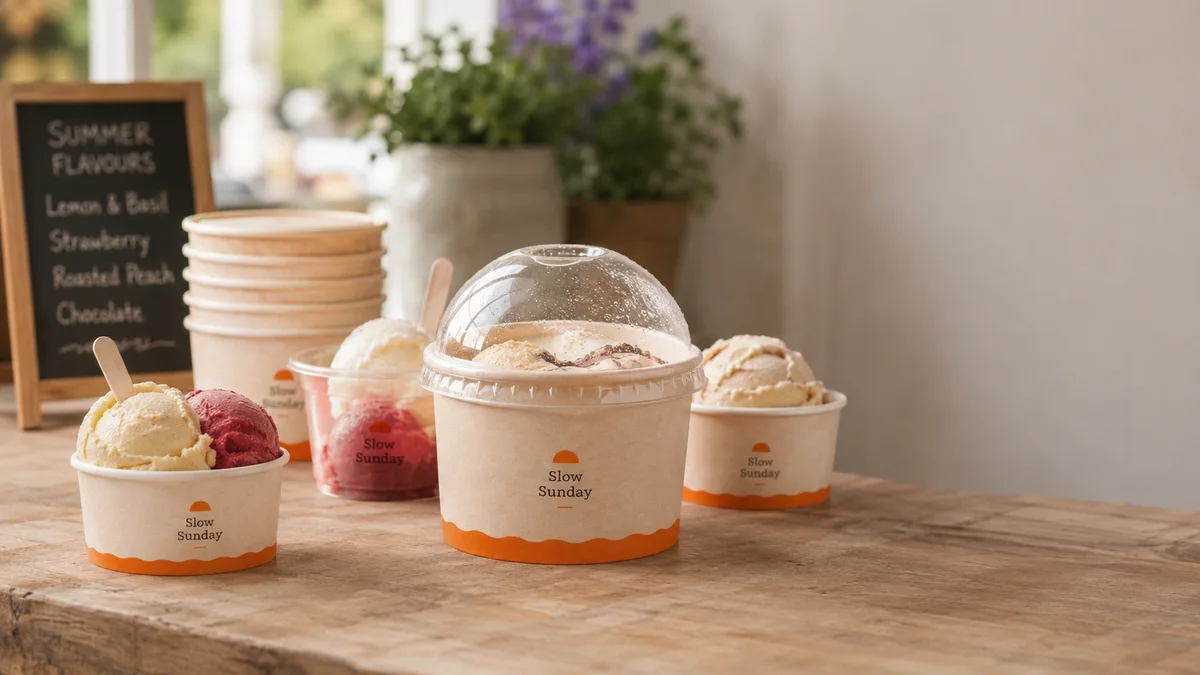
Ice Cream Cups for UK Gelato Shops: What to Check Before Ordering
Most UK gelato shops order ice cream cups the same way they order napkins - reorder the same SKU, same supplier, never think about it. Then summer hits. The cups warp in the van on a 28-degree day. The lids pop off when a customer squeezes the tub. A batch of "compostable" cups arrives that look identical to the old ones but need industrial composting - which your local waste contractor doesn't offer. Or a customer posts a photo of a paper tub that has gone soft and soggy halfway through their gelato, with the caption "premium price, budget packaging."
An ice cream cup does three jobs. It holds a frozen product that becomes a liquid within minutes of serving. It keeps the customer's hands clean and dry while they eat. And it makes an environmental statement - whether you planned one or not - because gelato customers are exactly the demographic that reads the fine print on packaging. Get any of those three wrong, and the customer blames your operation, not your supplier. This guide walks through the materials, sizes, lids, and storage considerations that determine whether your cup programme holds up when the temperature rises.
Key Takeaways
- Paper tubs with PE lining are the UK standard for a reason - they handle condensation better than PLA, cost less than compostable alternatives, and go in general waste without false environmental promises.
- Cup sizes are measured by brim-full volume. A 4oz tasting cup holds three small scoops of gelato with no room for a spoon. A 6oz cup is the single-serve workhorse for most UK gelato shops.
- Lid fit is specific to the cup manufacturer, not the cup size. A "6oz flat lid" from Supplier A will not reliably seal a 6oz cup from Supplier B. Always buy cups and lids as a matched system.
- Compostable PLA cups need industrial composting facilities that most UK councils don't provide. A PLA cup in a park bin goes to landfill and costs you 40-60% more than a standard paper tub to get there.
- Summer heat is the real test. Store cups in a cool, dry place - not in the back of a van on a sunny afternoon. PLA cups in particular can soften and warp above 35°C.
Why Ice Cream Cup Specifications Matter More Than Price
Giulia runs a small gelato shop in Bath that does 400 covers on a sunny Saturday in July. For her first two seasons she ordered whatever 6oz paper tubs were cheapest from her catering supplier. They were standard white paper with a PE lining. The tubs themselves were fine - they held the gelato, they looked clean, they cost about 4p each. The lids were the problem. They were flat transparent PET lids from a different supplier - same stated size, different actual rim profile. Roughly one in twelve lids popped off when a customer picked up the tub by the rim. That is about 33 complaints on a busy Saturday. Gelato on hands. Gelato on clothes. Gelato on the pavement outside the shop.
She switched to a matched tub-and-lid system from a single manufacturer - a kraft paper tub with a clear domed PLA lid, both from the same production line. Her per-unit cost went up by 2p. Her complaint rate dropped to near zero. The lesson isn't that Giulia was cheap. It's that most gelato operators treat cups and lids as interchangeable commodities when they are precision-engineered components that only work reliably as a matched pair.
The UK gelato market has grown roughly 12% year on year since 2022 according to the Ice Cream Alliance, driven by artisanal gelato shops expanding beyond London into every UK city and market town. Independent gelato operators are the fastest-growing segment. Yet most of them can't tell you whether their cups are PE-lined paper, PLA bioplastic, or bagasse fibre - or why that choice determines whether the cup holds its shape for the 15 minutes it takes a customer to eat a double scoop on a warm day.
Paper Tubs vs PLA Cups vs Bagasse: What the Materials Actually Mean
Four materials dominate the UK ice cream cup market. They look different behind the counter. They cost different amounts. They go to completely different places after use. And they perform differently when a cold, wet product sits inside them for 15-20 minutes on a summer afternoon.
PE-lined paper tubs are the UK market standard. A paperboard cup - usually white or kraft brown - with a thin polyethylene coating on the interior that prevents liquid penetration. They handle condensation well. The paper exterior stays dry in a customer's hand for 10-15 minutes of normal eating time. They aren't recyclable in the UK kerbside system because the PE lining can't be separated from the paper fibre in standard recycling mills. They go to general waste. They cost roughly 3-5p per unit for a 6oz tub in bulk quantities. They are the pragmatic default choice for most UK gelato shops - affordable, reliable, and honest about their end-of-life destination.
PLA (polylactic acid) cups are made from fermented plant starch and certified industrially compostable under EN 13432. They are transparent or translucent, not opaque like paper. They look premium - a clear cup showing layers of pistachio and stracciatella gelato is visually striking. They cost 40-60% more than PE-lined paper - roughly 6-9p per unit for a 6oz cup. And they come with two significant practical limitations.
First, PLA softens at temperatures above roughly 35°C. A PLA cup stored in a delivery van on a hot day can deform before it reaches the customer. A PLA cup filled with gelato and left on a sunny outdoor table for 20 minutes can lose enough structural rigidity that the lid seal fails. This isn't a theoretical concern - UK summer temperatures regularly exceed 30°C, and van interiors can reach 45°C or higher.
Second, PLA cups require industrial composting to break down. They won't compost in a home compost heap. They won't degrade in landfill in any meaningful timeframe. And most UK local authorities don't offer industrial composting collection for post-consumer packaging. A PLA cup put in a street bin or a customer's home bin goes to landfill or incineration - the same destination as a PE-lined paper tub, at roughly twice the cost. The environmental benefit of PLA only materialises if you operate in a closed-loop environment (festival, campus, office canteen) where you control the waste stream and have a guaranteed industrial composting route.
Bagasse (sugarcane fibre) tubs are the newest entrant to the UK market. They are made from the fibrous residue left after sugarcane juicing - a waste product, not a purpose-grown crop. They are opaque, with a natural off-white or light brown colour and a slightly textured surface. They are certified home and industrial compostable under EN 13432, meaning they will break down in a well-managed home compost heap - a claim that neither PE-lined paper nor PLA can make. They handle condensation well because the fibre structure absorbs and wicks moisture rather than trapping it against a plastic film. They cost roughly the same as PLA - 6-8p per unit for a 6oz tub. They are slightly less rigid than PE-lined paper of the same wall thickness but significantly more rigid than PLA at summer temperatures.
The practical decision framework: for most UK high-street gelato shops, PE-lined paper tubs are the pragmatic choice - affordable, reliable, and unpretentious about disposal. PLA cups are a defensible upgrade if you operate in a closed-loop venue with composting infrastructure and want the premium visual of a clear cup. Bagasse tubs are the strongest environmental option if the "home compostable" claim matters to your customer base and you are willing to accept a slightly less polished appearance than coated white paper.
One material detail that catches operators out: not all "paper" ice cream cups are PE-lined. Some use a water-based dispersion coating instead of PE. These are sometimes marketed as "plastic-free" or "recyclable." The coating type matters for two reasons. First, water-based coatings are less effective at blocking liquid penetration than PE over extended contact times - a 20-minute gelato eating session pushes the limits of some dispersion coatings. Second, cups with water-based coatings are sometimes accepted in the paper recycling stream where PE-lined cups aren't, but this varies by local authority. Check with your waste contractor before paying a premium for recyclability claims.
Lid Compatibility: The Number One Cause of Gelato Spills
Gelato cup lids fail more often than any other type of foodservice lid. The reasons are specific to the product. Gelato is served frozen but becomes increasingly liquid as the customer eats. The temperature cycles - frozen to ambient - cause the cup material to expand and contract, which changes the rim diameter slightly over the eating period. The customer grips the cup by the rim, applying finger pressure directly to the lid seal. And gelato is often eaten while walking, which means the cup is in motion, tilted at varying angles, for the entire consumption period.
The rule is the same as for any foodservice cup system: always buy cups and lids from the same manufacturer. Never mix brands. Never assume "6oz flat lid" fits all 6oz cups. The rim profile - the cross-sectional shape of the cup edge - varies between manufacturers by fractions of a millimetre, and lid retention depends on an interference fit that is sensitive to those fractions.
Three lid types cover the majority of UK gelato applications:
Flat lids sit flush with the cup rim and have a small eating opening or no opening at all. They are the cheapest option, the most secure against spills (the low profile creates less leverage against the rim seal), and the most stackable. They work for pre-packed tubs, takeaway orders, and any situation where the customer will remove the lid entirely to eat. They are less suitable for walk-and-eat service because the customer needs to remove and hold the lid.
Dome lids rise above the cup rim to accommodate a scoop that sits proud of the cup edge - a generous portion of gelato, a tuile biscuit, or a decorative topping. They cost slightly more than flat lids and are less secure in transit because the dome creates leverage against the rim seal when the cup tips sideways. Dome lids are essential for premium presentation. They are unnecessary for standard scooped service where the gelato sits below the rim.
Sip-through lids have a drinking opening - useful for milkshakes and thick smoothies made with gelato, but not relevant for scooped gelato service. If your shop does both scooped gelato and blended drinks, you will need both flat/dome lids for tubs and sip-through lids for cups.
One lid detail that is rarely discussed: condensation venting. A dome lid on a gelato tub creates a sealed air pocket above the product. As the cold gelato cools the air in that pocket, condensation forms on the inside of the dome. Without a small vent hole, that condensation pools and drips back onto the gelato, creating a watery layer on top of the product. A well-designed dome lid has a pinhole vent that equalises pressure and minimises internal condensation. If your supplier's dome lids don't have a vent, ask why.
Sizing: Why a 6oz Cup Is the UK Gelato Standard
Ice cream cup sizes are measured in fluid ounces to the brim - the total internal volume. Gelato is denser than ice cream (less air incorporated during churning), which means a 6oz cup of gelato weighs more and occupies less volume than a 6oz cup of standard ice cream. This matters because portion control by volume works differently for gelato than for conventional ice cream.
The standard UK gelato cup sizes and their real-world applications:
4oz (120ml) - Tasting flights, kids' portions, and espresso-affogato service. Holds roughly two small scoops (60-70g of gelato). These are the smallest standard cup. They work for sampling menus and children. They are too small for an adult single serving.
6oz (180ml) - The workhorse size for UK gelato shops. Holds roughly three scoops (90-110g) with a small amount of headroom for a wafer or spoon. This size accounts for roughly 60% of UK gelato cup sales according to catering supply data. It's the right default for a single-serve portion and the first size you should stock.
8oz (240ml) - A generous single or a modest double. Holds roughly four scoops (120-140g). Used for premium pricing tiers ("large" vs "regular" at 6oz) and for gelato served with multiple toppings or sauce.
12oz (360ml) - Sharing portions, sundae builds, and takeaway pints. Holds roughly six scoops (180-220g). At this size, cup rigidity becomes a concern - a thin-walled 12oz paper tub filled with dense gelato can buckle under the weight when a customer grips it. Look for tubs described as "heavy duty" or with a wall thickness of at least 0.4mm at this size.
One sizing trap that catches expanding gelato shops: cup volume isn't the same as serving volume. A 6oz cup filled with three scoops of gelato plus a wafer plus a spoon has no headroom. If your menu lists a "three-scoop" serving, test whether it fits in a 6oz cup with all the accompaniments before printing the menu. Many shops end up moving their standard portion to an 8oz cup not because the gelato volume increased, but because the cup size didn't account for the wafer, the spoon, and the lid clearance.
UK Regulations and What Your Cup Says to the Customer
Three regulatory frameworks affect gelato packaging in the UK. Most independent operators ignore all three. That is a liability.
The single-use plastic ban (October 2023, England) prohibits polystyrene cups and food containers. Standard PE-lined paper tubs are unaffected. PLA cups are unaffected. Bagasse tubs are unaffected. The ban primarily targeted the lowest-cost, least-recyclable end of the market. If you are using cups from a reputable UK foodservice supplier, you are almost certainly compliant. The wider message is that plastic regulation is tightening, and the cups you choose today may face additional restrictions or fees within 3-5 years.
The UK Plastic Packaging Tax (£228.82 per tonne from April 2026) applies to plastic packaging with less than 30% recycled content. PE-lined paper tubs are classified as paper-based composite packaging and are currently outside the scope of the tax. PLA cups are bioplastic and outside the scope. The tax primarily affects pure plastic packaging - PET cups, polystyrene containers - which are increasingly rare in the gelato sector. The practical impact on most independent gelato shops is minimal, but it's worth confirming with your supplier that their products are classified correctly.
The UK Green Claims Code (CMA, enforced from 2022) is the regulation most likely to catch out a gelato operator. It requires environmental claims on packaging to be truthful, clear, and substantiated. A cup labelled "compostable" with no certification mark or disposal instructions is likely non-compliant. A cup labelled "biodegradable" is almost certainly non-compliant - "biodegradable" isn't a defined term under UK law and the CMA considers it inherently misleading. A cup labelled "plastic-free" must contain no plastic - including PE linings and PLA bioplastic. If you use PE-lined paper tubs, don't describe them as "eco-friendly" or "sustainable" on your menu or signage unless you have specific, verifiable evidence to support that claim.
The practical takeaway: use the cup material that honestly matches your waste disposal reality. If your customers dispose of cups in street bins that go to landfill or incineration, PE-lined paper is the honest choice - it performs well, costs less, and makes no environmental promise it cannot keep. If you operate in a closed-loop venue with industrial composting, PLA or bagasse is a defensible upgrade with a substantiable environmental claim. Whatever material you choose, keep the certification documentation (DoC from your supplier, EN 13432 certificate if applicable) on file. The CMA has issued enforcement action against several packaging companies since 2023, and the regulator is increasingly active in the foodservice sector.
How to Test Ice Cream Cups Before You Commit to a Summer Season
Suppliers send samples. Most operators fill one with water, put a lid on, shake it, and decide. Three tests matter more.
The condensation test. Fill the cup with ice and water (simulating melting gelato). Put the lid on. Leave it on a counter at room temperature for 20 minutes. Pick it up with one hand around the body of the cup. If the exterior feels wet, soft, or structurally compromised, the cup material isn't adequately moisture-resistant for gelato service. A PE-lined paper tub should feel dry on the outside after this test. PLA and bagasse should feel dry but may show light condensation. Any cup that goes soft or deforms fails.
The heat test. Place a filled, lidded cup in direct sunlight or a warm spot (roughly 35-40°C) for 30 minutes. Check for warping, lid seal failure, or visible deformation. PLA cups are the most likely to fail this test. If your shop does outdoor service or delivery in summer, this test isn't optional - it simulates the worst conditions your cups will face.
The customer test. Give three different cup-and-lid combinations to someone who has never used them before. Ask them to open each one, eat from it while walking, and tell you which felt best. The results will surprise you. Customers notice details that operators overlook - a sharp rim edge, a lid that's hard to remove, a cup that feels "cheap" in the hand. This test costs nothing and reveals more about real-world customer experience than any spec sheet.
Ask your supplier three questions before placing a seasonal order. What is the cup material and lining type? Are the cup and lid designed and tested as a matched pair? Can you provide a Declaration of Compliance for food contact certification? A supplier who hesitates on any of these is reselling imported stock with no meaningful quality assurance.
Frequently Asked Questions
What is the best cup size for a standard gelato portion? A 6oz (180ml) cup holds three scoops of gelato (roughly 90-110g) with room for a wafer. This is the standard single-serve size for UK gelato shops and accounts for the majority of cup sales in the sector. If you serve particularly generous scoops or add multiple toppings, test an 8oz cup as your standard.
Can paper ice cream cups be recycled? PE-lined paper cups cannot be recycled through UK kerbside collections because the plastic lining cannot be separated from the paper fibre at standard recycling mills. They go to general waste. Cups with water-based dispersion coatings may be accepted in some paper recycling streams - check with your local waste contractor. Unlined paper cups (rare for ice cream due to moisture issues) are widely recyclable.
Why do PLA cups warp in summer? PLA (polylactic acid) has a glass transition temperature around 55-60°C but begins to soften at temperatures above 35-40°C. A PLA cup stored in a warm van, left on a sunny counter, or held by a customer on a hot day can lose structural rigidity. This is a material limitation, not a manufacturing defect. If your shop does outdoor service in summer, test PLA cups in real heat conditions before committing.
How many cups should I order for the summer season? For a gelato shop doing 300 covers on a peak summer day, order roughly 8,000-10,000 cups in your primary size (usually 6oz) to cover a three-month summer season. Add 2,000 each of your secondary sizes (4oz and 8oz). Order lids at a 1:1 ratio plus 5% buffer for defects and misapplied lids. Place the order by April - UK cup suppliers routinely run low on stock by June, and lead times stretch from 3-5 days to 2-3 weeks during peak season.
Do I need different cups for delivery than for in-store? Yes, for 8oz and above. Delivery involves stacking, vibration, and longer holding times than counter service. Use a heavier wall thickness and flat lids (not dome lids) for delivery orders to minimise lid pop-off during transit. If you use a delivery platform like Deliveroo or Uber Eats, test your cup-and-lid combination in a simulated delivery - fill the cup, lid it, place it in a delivery bag, and walk it around the block. If the lid survives, it will survive a delivery driver.
Are bagasse cups worth the extra cost over paper? For a shop with a strong sustainability brand and a customer base that reads packaging labels, yes. Bagasse is home-compostable (unlike PLA, which needs industrial composting), performs well with cold wet products, and carries a genuine environmental story that customers understand and value. For a high-volume shop where price per unit is the dominant consideration, PE-lined paper remains the more cost-effective choice.
Conclusion
An ice cream cup is the cheapest item in your cost of goods and the one your customer holds for the entire duration of their visit. A cup that leaks, warps, loses its lid, or makes false environmental claims tells your customer you cut corners. A cup that stays dry, holds its shape, and carries an honest, verifiable material story tells them you care about every detail of their experience.
The four decisions that matter are material (PE-lined paper for most UK high-street shops, PLA or bagasse for closed-loop venues with composting), lid compatibility (matched cup-and-lid system, never mixed), sizing (6oz is the UK standard, test with your actual scoops and accompaniments), and honesty about disposal (match your cup material to your customer's actual waste route, not the one you wish they had).
Check the specification of the cups you currently use. If you cannot state the material, the lining type, and whether the lids are manufacturer-matched to the cups, call your supplier and ask. If your supplier cannot answer, find a different supplier. A gelato shop doing 400 covers on a summer Saturday spends roughly £20-30 a day on cups and lids. Getting the specification right costs nothing to test and typically saves 10-20% in waste, refunds, and customer complaints - while making your product look as good as it tastes.
Browse our range of paper, PLA, and bagasse ice cream cups with matched lids in sizes from 4oz to 12oz at okeypackaging.com. Request a sample pack to test with your own gelato before the summer season.