
Why your ice cream cups leak during delivery (and how to fix it before summer)
Most ice cream cup leaks start at the base seam, not the lid. Learn why your delivery cups fail, which coatings survive melt contact, and how to test properly before summer.
Filed under Operations.
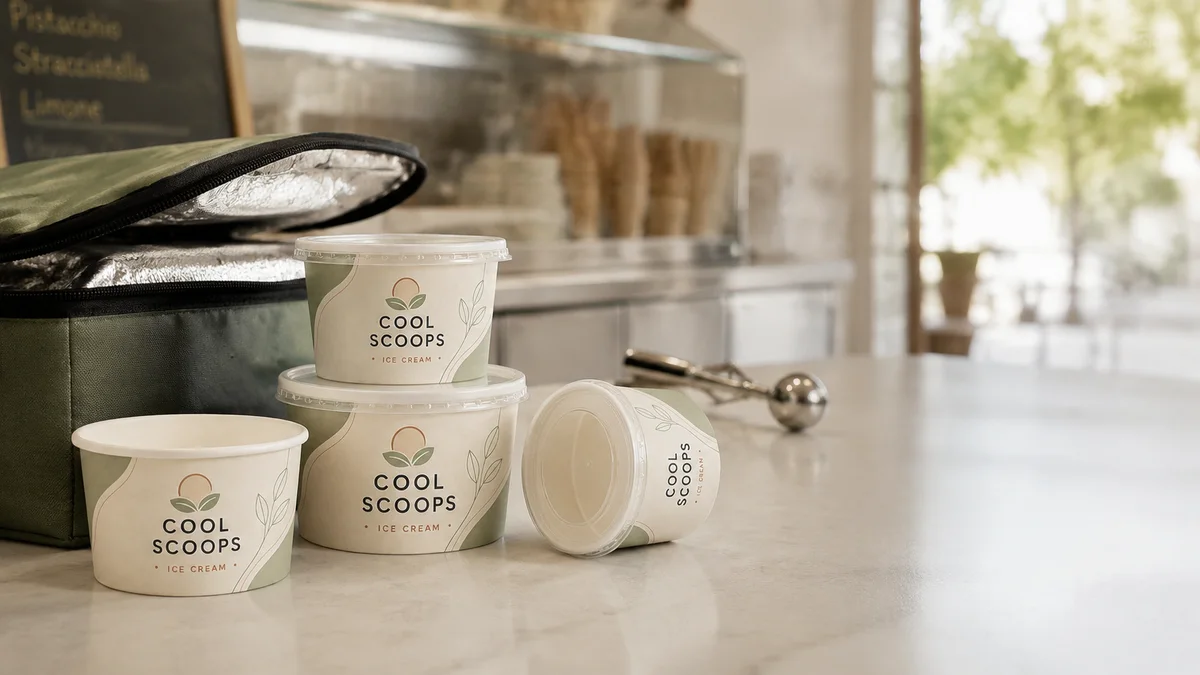
A gelato shop owner in Brighton posted on a hospitality forum last July. She had sold a £45 delivery order — six scoops, two sundaes, a family-size tiramisu tub — to a customer hosting a garden party. Everything was packed carefully, lids pressed down, cups nestled in a insulated bag. Forty minutes later the customer sent a photo that made her stomach drop: two cups had leaked through the bottom seam, the sundae lids had popped off, and the paper carrier bag had dissolved into a sticky puddle on the customer's patio table. "I refunded the whole order," she wrote. "Now I'm terrified to offer delivery at all." Seven other operators replied within hours, all with versions of the same story.
That's not a freak accident. It's a material failure that's entirely predictable — and entirely preventable — once you understand what's actually happening at the bottom of the cup. You don't need a different supplier. You need a different spec.
Key Takeaways
- Most ice cream cup leaks start at the base seam, not the lid. Board weight and coating type at the base matter far more than how hard you press the lid down.
- PE-lined cups hold up to melting better than PLA-lined cups during longer deliveries, but neither is truly compostable in UK council food waste collections.
- The difference between a cup that survives 30 minutes in a delivery bag and one that collapses is often as little as 50gsm of extra board weight at the base.
- Testing your cups under real delivery conditions — not counter service — is the only reliable way to know if they will hold.
Why your cups fail: it's not the lid
When an ice cream cup leaks, most operators reach for the obvious fix: press the lid harder, get a tighter lid, double-check the lid seal before the order goes out. That's almost never the real problem. Ice cream cups fail from the bottom up. The flat base disc of a paper cup is crimped and heat-sealed to the tapered sidewall at the factory. When ice cream at -18°C hits that paper base, the temperature difference creates condensation instantly — inside from the melting product, outside from ambient humidity. That moisture migrates to the weakest point in the cup's construction: the crimp joint where the base meets the wall. Once the paper fibres at that joint absorb enough moisture, they lose structural integrity. The joint softens, then separates, then weeps — and custard, melted gelato, or fruit syrup starts dripping from the bottom of a cup whose lid is still perfectly sealed.
A cup that sits on a counter for three minutes before being handed to a customer deals with very little of this. The ice cream is still largely frozen, the condensation hasn't had time to build, and the cup is upright and stationary. A cup that rides in a delivery bag for 35 minutes through a British July afternoon is in a completely different environment. It's tilted, jostled by scooter vibration, surrounded by warm air, and the product inside has been melting continuously since it left the freezer. The base seam is now submerged in a thin layer of liquid for the entire journey. This is why cups that have performed perfectly for counter service for years fail catastrophically the first week you add delivery.
There is a third factor that nobody in the packaging supply chain mentions: cup geometry. Tapered cups — the classic narrow-base ice cream cup shape — concentrate the weight of the product onto a smaller surface area. A 200ml tapered cup filled with dense Italian-style gelato exerts significantly more pressure per square centimetre on the bottom seam than a straight-walled tub holding exactly the same volume. Add the downward force of melting liquid, add the condensation softening the paper fibres, add the vibration from a delivery scooter or a car boot — and you have engineered a failure mode directly into the cup's shape. Straight-walled or minimally tapered tubs distribute weight more evenly and put less concentrated stress on the base joint. For delivery, shape matters as much as material.
What operators try first (and why it often doesn't work)
The instinctive fixes fail for interesting reasons. Double-cupping — putting one cup inside another — helps with insulation and hand comfort, but it does nothing for the inner cup's base seam. Worse, if gelato melts against the outer surface of the inner cup, it creates a thin liquid layer between the two cups that acts like a lubricant. The inner cup shifts and wobbles inside the outer cup, which actually increases mechanical stress on the inner cup's base joint. You have made the cup harder to hold and no more leak-resistant.
Switching to a thicker cup is the right instinct, but only if the extra thickness is in the base board. Many cups marketed as "heavy duty" or "premium" add grammage to the sidewall — for grip comfort and perceived quality — while leaving the base board at the same weight as the standard version. This is exactly backwards for delivery. The sidewall handles compressive force from your hand; the base handles the full weight of the product plus the hydraulic pressure of any melted liquid. If you are upgrading your cup spec for delivery, the only number that matters is the base board gsm. Ask for it specifically. If the supplier cannot tell you the base board weight separately from the wall weight, find a supplier who can.
Switching to plastic cups — PET or PP — eliminates the seam-absorption problem entirely. Plastic does not absorb moisture, so the base joint stays intact regardless of how long the delivery takes. This solves the leak issue, but creates a different set of problems. Plastic cups sweat condensation on the outside surface, making them slippery to handle — a real liability when a customer is opening a delivery bag on their kitchen counter. Plastic cups carry environmental baggage that your customers are increasingly aware of, especially in the UK where the Plastic Packaging Tax adds £217.85 per tonne to packaging with less than 30% recycled content. And plastic cups don't breathe, which means warm air trapped inside after sealing accelerates melting in a way that a paper cup's micro-porosity partially mitigates. The material choice is a genuine trade-off, not an obvious upgrade.
One operator on a UK foodservice forum described the cycle better than any supplier datasheet ever could: "We switched to the cheapest paper cups we could find to save 4p a unit. Six months later we'd spent more on refunds, replacement orders, and lost repeat customers than we ever saved. Now we spend 11p a cup and haven't had a single leak complaint in eight months." The maths she is describing is real: a £35 refunded order wipes out the savings from 875 cups at a 4p discount. If you sell 200 cups a week, that's over a month of cost-cutting erased by one bad delivery.
How to choose a cup that actually survives delivery
Here is a practical framework for evaluating ice cream cups for delivery. None of this depends on buying from any particular supplier — these are the material properties and testing methods that separate cups that work from cups that fail.
First, check the base board weight. Ask the supplier directly: what is the gsm of the base board, not just the sidewall? You want a minimum of 280gsm at the base for any cup that will travel more than 15 minutes. Below 250gsm, you are gambling — the cup might survive a short hop on a cool day, but it will fail on a warm Saturday evening when order volumes are highest and the consequences of failure are most expensive. The sidewall can be 230-260gsm — that is comfortable to hold and sufficiently rigid — but the base is where the physics happens. If you only upgrade one number, upgrade the base.
Second, choose your interior coating based on your real delivery window, not your sustainability ambitions. PE (polyethylene) lining is the industry workhorse for a reason. It is fully waterproof, it bonds well to paper at the crimp joint, and it holds up to 45-60 minutes of continuous melt contact without degrading. The trade-off is real: PE-coated cups are not compostable, not biodegradable, and will not be accepted in UK council food waste collections — they go to general waste, full stop. PLA (polylactic acid) lining is the compostable alternative made from corn starch, but it softens noticeably faster than PE when in contact with warm liquid. If your average delivery time is under 25 minutes and your delivery radius is tight, PLA is viable and carries the eco claim your customers may value. If you are doing 40-minute Deliveroo runs across town in August, PE is the safer engineering choice. Water-based barrier coatings are the newest option — they are recyclable with standard paper streams and avoid the microplastic concerns of PE — but they are less battle-tested in high-moisture freezer-to-delivery scenarios. Don't bet your summer delivery season on a coating you haven't tested yourself.
Third, match the cup size to the portion honestly. An aggressively tapered 200ml cup filled to the brim with dense gelato is less stable than a 150ml tapered cup filled to 120ml with a bit of headspace. The headspace does more than just prevent overflow when the lid goes on — it gives melted liquid somewhere to pool without immediately saturating the lid rim, and it reduces the hydraulic pressure on the base seam by lowering the liquid column height. For delivery, size down or leave headspace. If your counter-service cups are filled to the rim, your delivery cups should be one size larger or one scoop lighter.
Fourth, don't ignore the lid — but focus on the grip bead, not the branding. A lid that snaps onto a 90mm rim at room temperature may not grip the same rim when the cup is cold, the paper has contracted slightly from freezer exposure, and condensation has made the rim surface slick. Look for lids with an internal grip bead — a small ridge inside the rim channel that mechanically bites into the cup rim rather than relying on friction alone. Vent holes are a double-edged sword: they prevent the pressure build-up that can pop lids off during transit, but they also let warm ambient air into the cup, which accelerates melting. For most UK delivery scenarios with journey times under 45 minutes, vented lids paired with a properly specced cup are better than unvented lids — the extra melt rate is manageable, but a popped lid is an instant refund.
Fifth, test under delivery conditions. Not at the counter. Not after five minutes on the pass. Fill the cup with your actual best-selling product — not water, which has different thermal mass and viscosity — seal it with the exact lid you will use in production, place it in the delivery bag you actually send orders out in, and leave it for your maximum realistic delivery time at the warmest temperature you would deliver in. Then check the base. Press the bottom of the cup from underneath with your thumb. If there is any moisture beading on the outside of the base seam, the cup failed. If the base flexes or yields under gentle thumb pressure, the cup failed. If the lid comes off with one-handed pressure, the cup failed. A cup that passes this test — zero moisture, zero base flex, secure lid — will survive real-world delivery. Anything less is hope, not quality control.
One thing worth knowing about UK-specific regulation: if you are selling pre-packaged ice cream (sealed at your premises before the customer orders, rather than scooped to order), the cup and lid count as food contact materials under FSA guidance and must be traceable to a supplier with a Declaration of Compliance under EU Regulation 1935/2004, which the UK retained post-Brexit. This is not something most small operators think about, but it matters if you are scaling a delivery operation. Your packaging supplier should be able to provide this documentation on request. If they cannot, that is a red flag beyond the material performance concerns.
What to do tomorrow
Next time you are comparing ice cream cup samples, do not sort by price per unit and pick the cheapest one that looks decent. Ask the supplier for a pre-production sample in the exact board weight and coating specification you would be ordering. Ask for the base board gsm separately. Ask for the Declaration of Compliance. Then fill the sample with your best-selling gelato, put it in a delivery bag, and drive it around for your longest delivery radius. Check the base. Press the bottom. If it holds, order with confidence. If it does not, you have just saved yourself a summer of refunds, apologetic DMs, and lost repeat customers — for the cost of a single sample cup and an honest test.
If you are looking for a starting point, we stock PE-lined and PLA-lined ice cream cups from 4oz to 16oz in both tapered and straight-walled profiles, and we can send you samples of each coating type to test side by side with your own product. You can compare spec sheets and request samples on our ice cream cups page. There is no substitute for testing with your own gelato, in your own delivery bag, on your own delivery route — but starting with the right cup makes the test a formality rather than a gamble.