
Single Wall Cold Paper Cup vs PET Cold Cup: UK Cafe Guide
Compare single wall cold paper cups vs PET cold cups for your UK cafe. Real performance data, UK recycling rules, 2026 Plastic Packaging Tax impact, and which cup wins for iced lattes, smoothies, and delivery orders.
Filed under Operations.
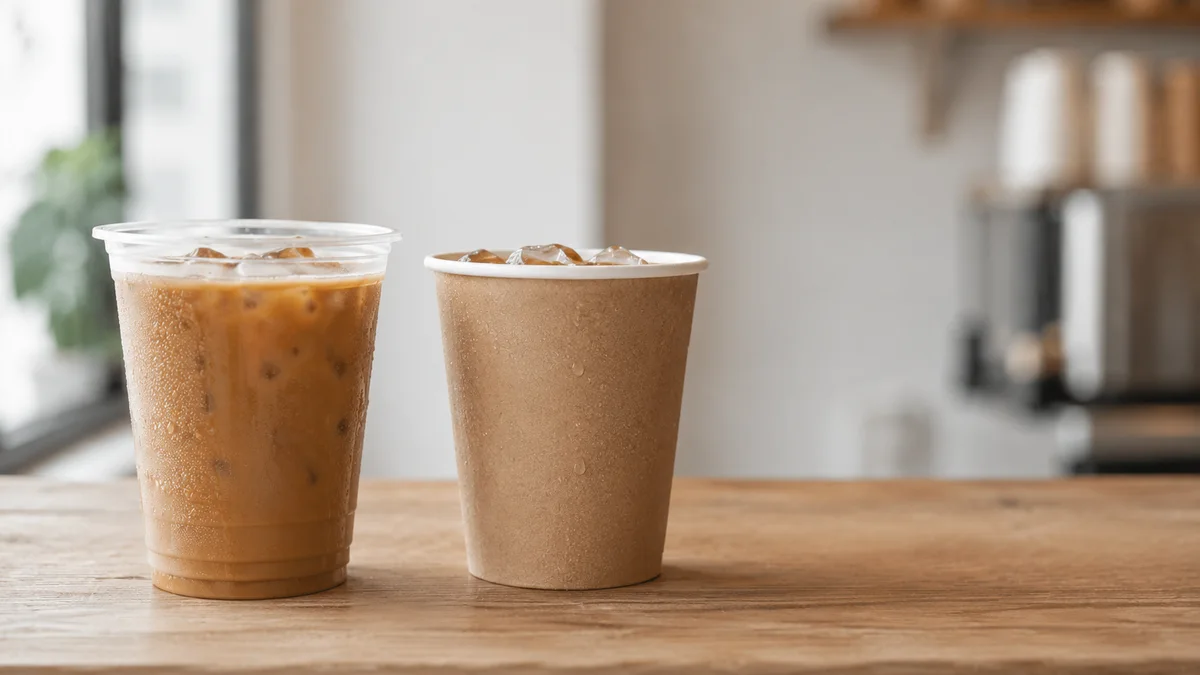
Single wall cold paper cups cost less and look more "eco," but PET cold cups win on genuine UK recyclability, structural durability, and drink presentation. If you serve iced lattes, smoothies, or bubble tea, PET (ideally rPET) is the practical pick. If you pour fountain soft drinks and water, single wall cold paper cups work fine for drinks consumed quickly — just do not expect them to survive a 30-minute walk to the office.
You are probably weighing this choice because a supplier pitched paper cups as the sustainable option, but you have watched a cup start to soften before the customer even left the counter. Or maybe you are opening a new site and need to settle on cold drink packaging that does not cause complaints, leaks, or regulatory headaches six months from now.
This article compares single wall cold paper cups and PET cold cups across the four things that actually matter in a UK cafe: real-world performance, genuine recyclability (not marketing claims), cost including the 2026 Plastic Packaging Tax, and which cup suits which drink. By the end, you will know when to stock each — and when the smartest move is to run both.
Key Takeaways
- PET cold cups recycle in UK kerbside collections; single wall cold paper cups do not — the plastic lining excludes them from the Simpler Recycling system.
- A single wall cold paper cup can start softening within 30 to 45 minutes on a warm day, especially with iced drinks that generate heavy condensation.
- The UK Plastic Packaging Tax (£228.82 per tonne, April 2026) applies to PET cups with less than 30% recycled content — rPET cups avoid the tax entirely.
- Paper cold cups cost 15 to 25% less per unit than standard PET, but the gap nearly closes when you account for lid failures, double-cupping, and waste.
- Most UK cafes that run both hot and cold menus stock paper for hot drinks and PET for cold drinks — it is rarely an either/or call.
How Single Wall Cold Paper Cups Actually Hold Up
Single wall cold paper cups are not the same product as the double-wall hot cups your customers know. For cold use, they carry a heavier PE (polyethylene) or wax coating on the inside to stop the paperboard from absorbing moisture and collapsing. Without that coating, the cup would be a soggy mess in under ten minutes.
But even with that coating, the performance window is short. Tom runs a coffee van in Brighton and switched his iced lattes to single wall cold paper cups in summer 2025. "By the time customers got to the beach, about half were coming back saying the cup had gone soft," he told us. "On a 22-degree day, condensation on the outside was soaking into the rim. People were pinching the cup and it was buckling."
The physics is straightforward. Cold liquid inside, warm humid air outside — condensation forms on the cup wall. A paper cup absorbs some of that moisture into its outer layer, even when the inner coating holds. Over 30 to 45 minutes, the structural integrity degrades.
The rim softens first, because that is where fingers apply pressure. Then the wall loses rigidity. If the cup is squeezed — picking it up from a car cup holder, for instance — the inner coating can crack. At that point, it leaks.
This matters more for delivery orders. A cold paper cup sitting inside a sealed delivery bag with other chilled items builds humidity fast. The cup arrives at the customer's door feeling damp and flimsy, which does not exactly say "premium."
Single wall cold paper cups are best for drinks consumed within 20 minutes, or for counter-service cold drinks that customers grab and drink quickly — soft drinks at a sandwich bar, water at a takeaway counter, iced tea that someone finishes at the table. If your customer walks more than five minutes from your door, you are taking a risk on cup integrity.
The coating weight matters too. Some manufacturers use a lighter PE coating to hit a lower price point, and those cups fail noticeably faster. When you order cold paper cups, ask the supplier to confirm the coating GSM (grams per square metre). A minimum of 15 GSM PE on the inner wall is standard for cold drinks. Anything lighter and you will see problems within the first case.
If you are comparing paper cup specs, we have a detailed product breakdown at okeypackaging.com/products/paper-cups.
How PET Cold Cups Perform in a Working Cafe
PET (polyethylene terephthalate) is the clear rigid plastic used for most cold drink cups in the UK. It is the same polymer as water bottles, which is exactly why it fits neatly into existing recycling streams. In a busy cafe, PET cold cups do three things paper cannot: they show the drink, they do not soften, and they stack securely without the bottom cup crushing the one below.
Showing the drink is not just about aesthetics — it drives revenue. Anna runs a bubble tea shop in Manchester and tested paper versus PET for six weeks in early 2026. "Our matcha latte sales went up 12% when we switched to clear PET cups," she said. "Customers were photographing the layers and posting them on Instagram. The paper cup hid everything and made the drink look flat and unappealing." The same dynamic applies to iced lattes, cold brew with oat milk, fruit smoothies with visible layers, and any drink where colour and texture sell the product.
Structurally, PET handles condensation differently. The outside of the cup still gets wet, but the material does not absorb moisture, so the rim stays firm and the wall does not weaken. For delivery orders, PET cups survive being bagged with other chilled items far better than paper. They also accept a domed lid more securely, which matters for whipped cream, ice cream floats, or bubble tea toppings that push upward.
The real weakness of standard PET is environmental. Virgin PET is made from fossil feedstocks, and while it is technically recyclable, UK collection rates are uneven. However, rPET (recycled PET) cups are now standard from most UK packaging importers. An rPET cup contains 30 to 100 percent post-consumer recycled plastic, which exempts it from the Plastic Packaging Tax and cuts the carbon footprint by 40 to 60 percent versus virgin PET, according to life cycle data from WRAP.
If you order PET cold cups today, specify rPET. The price difference versus virgin PET is negligible at current UK volumes — typically under half a penny per cup — and the tax and marketing advantages make it a straightforward decision.
The UK Recycling Reality: Paper vs PET
This is where most supplier marketing collapses under scrutiny.
Single wall cold paper cups are lined with polyethylene. That lining stops leaks. It also turns the cup into a mixed-material product that standard UK paper recycling cannot process. Under England's Simpler Recycling rules, effective from 31 March 2026, paper cups with plastic or compostable liners are explicitly out of scope for kerbside recycling. WRAP's July 2025 guidance confirms this directly: "Paper cups with a compostable, biodegradable inner waterproof plastic layer are also out of scope."
So what actually happens to a cold paper cup in the UK waste system? If the customer drops it in a recycling bin, it reaches a materials recovery facility where the plastic lining is detected during pulping. The cup is either rejected and sent to landfill or incineration, or it fragments and contaminates the paper stream. That contamination degrades the quality of the recycled fibre. If the customer puts it in general waste, it is incinerated or landfilled. Either path leads to the same outcome: the cup does not get recycled, despite the "please recycle" marking that many suppliers print on the side.
PET cold cups tell a different story. Clear PET is accepted by virtually every local authority in England, Scotland, and Wales. The polymer holds genuine secondary-market value, so MRFs have a commercial incentive to sort and bale it. rPET demand from packaging manufacturers is strong, which keeps the reprocessing loop economically viable. A PET cold cup dropped in a recycling bin in Manchester, Cardiff, or Edinburgh has a real chance of becoming another PET product within weeks.
One nuance: the lid complicates things. PET cups are often paired with PP (polypropylene) lids, which are also recyclable but must be separated. If the lid stays on, the whole item risks rejection at the sorting line. A simple instruction printed on the cup — "Lid off, both recycle" — can meaningfully improve end-of-life outcomes. Few cafes do this. It is a small detail that separates operators who take recycling seriously from those who just want the marketing badge.
The blunt summary: if recyclability in the real UK waste system is your sustainability criterion, PET — especially rPET — beats single wall cold paper cups by a wide margin. The "paper equals green" shortcut does not survive ten minutes of research into how UK recycling actually works.
Cost Per Cup: Paper vs PET, With UK Tax
Pricing varies by volume, print, and supplier. Here are representative UK market ranges for mid-2026 orders at 5,000-unit quantities:
Single wall cold paper cup, 12oz, plain white: £0.04 to £0.06 per cup. With a single-colour print: £0.06 to £0.09 per cup. Standard PET cold cup, 12oz, clear: £0.05 to £0.08 per cup. rPET cold cup, 12oz, clear: £0.06 to £0.10 per cup.
On unit price alone, paper looks cheaper. Three factors close the gap.
First, the Plastic Packaging Tax. From April 2026, the PPT rate is £228.82 per tonne on plastic packaging containing less than 30 percent recycled content. A cafe ordering 50,000 standard PET cups per year — roughly 500 kilograms of material — faces about £114 in PPT liability, or roughly £0.002 per cup. Not a budget-breaker, but it adds up across a full packaging order when you include lids, containers, and bags.
rPET cups with 30 percent or more recycled content are exempt. Most UK importers now default to rPET for cold cups specifically to keep their customers below the tax threshold.
Second, lid reliability. PET cups and their matching lids form a consistent seal. Paper cold cup lids sometimes use a different rim profile, and a poor fit means spills, remakes, and wasted product. A cafe making 200 cold drinks a day that loses just five to lid failures burns through an extra £5 to £15 daily in wasted ingredients, cup stock, and staff time. Over a year, that waste can exceed the entire difference in cup pricing.
Third, double-cupping. On warm days, cafes that use paper for cold drinks often resort to double-cupping because customers find a single wall cup feels cold and flimsy in the hand. That doubles the effective cup cost and erases any saving versus PET. Most baristas have done this without thinking about the cost implication — they are solving a customer comfort problem, not running a margin calculation.
For a medium-volume cafe pouring 200 cold drinks daily, the annual cup cost difference between paper and rPET typically falls under £300. That is small enough that performance, presentation, and recyclability should drive the decision, not the per-unit price.
Want specific pricing for your volumes with your artwork applied? Request a quote at okeypackaging.com/quote and we will send you side-by-side numbers for paper and rPET cold cups.
Which Cup Type Wins for Which Drink?
Rather than declare a single winner, match the cup to what goes inside it:
Iced lattes, iced cappuccinos, cold brew — PET or rPET. These drinks look beautiful with their layers, milk swirls, and ice. Paper hides all of that. Customers also sip iced coffees slowly; paper weakens noticeably after 30 minutes.
Smoothies, frappes, milkshakes — PET or rPET. Thick drinks need a rigid cup that does not flex when a wide straw goes in. The domed lid fit is also more reliable on PET, which matters when the drink is thick enough to push the lid up.
Bubble tea, fruit tea with toppings — PET or rPET. Visual appeal is central to bubble tea sales. The cup also needs to survive an hour or more of being carried around a shopping centre or high street.
Soft drinks from a dispenser, post-mix — Paper is fine. Fast consumption, no visual premium, and the cost saving adds up at volume across thousands of cups.
Water, iced tea, basic juice — Paper is fine. Same logic: quick drinking time, straightforward liquid, cost-sensitive.
Delivery and takeaway orders — PET is safer regardless of drink type. The cup spends 20 to 40 minutes in a bag, often jostled or tilted. Paper softens faster in the humid environment inside a sealed delivery bag.
If your menu spans multiple cold drink types, the practical answer is to stock both. Run paper for fountain drinks and water, PET for barista-made iced coffees and premium cold drinks. The supplier relationship is the same, the storage footprint is similar, and your customers get the right cup for their drink.
UK Regulations That Affect Your Cup Decision
The regulatory picture for disposable cups in the UK is evolving fast. Here is what matters for cafe operators as of mid-2026:
Plastic Packaging Tax. The rate from April 2026 is £228.82 per tonne, applied to plastic packaging with less than 30 percent recycled content. rPET cups above the 30 percent threshold avoid the tax. The registration threshold is 10 tonnes of plastic packaging handled per year, so most independent cafes fall below direct registration — but the tax still reaches you through supplier pricing.
Extended Producer Responsibility (EPR). Rolling out through 2026, EPR shifts packaging waste management costs from councils to producers. Cafes that import or fill packaging are classified as producers and must register with the Environment Agency (or SEPA in Scotland, NRW in Wales).
Large producers — turnover over £2 million and handling over 50 tonnes of packaging per year — face full fees. Most independent cafes fall into the small producer category with lighter obligations, but you still need to register and submit packaging data.
Simpler Recycling (England). From 31 March 2026, all businesses in England must separate recyclable waste streams from general waste. For a cafe, that means providing bins for dry recyclables (plastic, metal, glass, paper and card) and food waste, with separate general waste collection.
You need to be confident that the cups you hand customers can actually be recycled in your local authority area — otherwise your recycling bins are just expensive general waste containers with a green label.
Scotland's approach. Scotland's 2022 single-use plastics ban targeted polystyrene cups and containers, plastic cutlery, plates, and stirrers. PET cold cups were not included and remain legal. The Scottish Government has indicated further restrictions are under active review, but no ban on PET cold cups has been tabled as of mid-2026.
The EU signal. The EU Packaging and Packaging Waste Regulation (PPWR) bans single-use plastic cups for on-site consumption in HORECA premises from 2030. The UK is not bound by EU law, but UK trade bodies expect similar proposals in Westminster within the next two to three years. Preparing for tighter rules now is cheaper than scrambling later.
The regulatory bottom line: rPET positions you ahead of the curve. It avoids the Plastic Packaging Tax, it is accepted in UK kerbside recycling, and if single-use plastic restrictions tighten, a cup made from recycled content is harder to ban than one made from virgin fossil-derived polymer. Paper cold cups dodge the plastic tax but face a different vulnerability — they do not recycle in the standard system, and if the UK adopts mandatory recyclability standards, PE-lined cups could face restrictions of their own.
Cup coatings are also evolving. Several UK suppliers now offer cold paper cups with water-based dispersion coatings instead of PE, which improve repulpability. These are early-stage products with limited availability and higher pricing, but they are worth watching if paper is your preferred direction and recyclability matters. We track these developments at okeypackaging.com/products/plastic-cups.
Frequently Asked Questions
Do single wall cold paper cups actually leak? Not within the first 15 to 20 minutes under normal conditions. But on a warm day, condensation can soften the outer wall within 30 to 45 minutes, and if the cup is squeezed firmly, the inner PE coating can crack. For delivery orders or drinks consumed slowly, leaking is a genuine failure mode, not a theoretical one.
Are PET cold cups safe for cold drinks? Yes. PET is a food-grade plastic approved for cold beverage contact by the UK Food Standards Agency and EU food contact regulations. It does not leach at cold temperatures. PET is not suitable for hot drinks above roughly 60 degrees Celsius — at those temperatures it can warp and trace levels of antimony may migrate. For cold drinks only, it is safe and well-studied.
Why do paper cold cups feel like the greener option if they do not recycle? Because paper reads as natural to the consumer, and the marketing leans into that perception while the plastic lining stays invisible inside the cup. In reality, a PE-lined paper cup is mixed-material waste with no recycling pathway in standard UK collections. A 2023 YouGov survey for WRAP found that 73 percent of UK adults believe paper cups are widely recycled — a belief the actual infrastructure does not support.
What is the difference between single wall and double wall for cold drinks? Single wall is one layer of paperboard with an inner coating. Double wall adds a second, usually corrugated layer for insulation. For cold drinks, insulation is irrelevant — the drink is already cold. Double wall cold cups use more material and cost more without delivering performance gains. Single wall is the standard for cold.
Can I print my logo on PET cold cups? Yes. PET cups accept screen printing and shrink-sleeve labelling. Print quality is good, but small text and fine-line artwork can blur more on curved PET surfaces than on paper. If your logo is intricate, request a printed sample before committing to a production run.
Should I stock both paper and PET cold cups? If you only pour fountain soft drinks and tap water, paper alone is fine. If you serve any iced coffee, smoothie, bubble tea, or premium cold drink, adding PET for those items improves customer experience noticeably. The incremental cost of stocking both SKUs is small relative to the benefit of putting the right cup on the right drink.
Is the Decision Really That Straightforward?
The single wall cold paper cup versus PET cold cup question is not about finding a universal champion. It is about which cup matches which drink, which occasion, and which set of business priorities.
If your menu features iced lattes, cold brew, smoothies, or bubble tea, PET cold cups deliver stronger performance, genuine UK recyclability, and a presentation that helps sell the drink. Specify rPET to dodge the Plastic Packaging Tax and reduce your carbon footprint. If you pour fountain soft drinks and tap water, single wall cold paper cups cost less, feel more traditional, and perform adequately for drinks finished within 20 minutes.
Most importantly, do not let the "paper equals eco" shorthand make the decision for you. In the UK waste system as it actually operates in 2026, a PET cup has a far stronger chance of being recycled than a plastic-lined paper cup. The genuinely sustainable choice is not always the one that looks most natural sitting on the counter.
If you are placing an order and want to compare paper and rPET cold cup options at your volumes, get in touch at okeypackaging.com/quote. Our team can advise on what works best for your specific menu, volumes, and delivery setup.