
Why Customers Hate Your Wooden Cutlery — and How to Fix It
Wooden cutlery complaints hurting your reviews? Compare birch vs bamboo vs CPLA on cost, strength and mouthfeel, plus four quick pre-order checks.
Filed under Buying Guides.
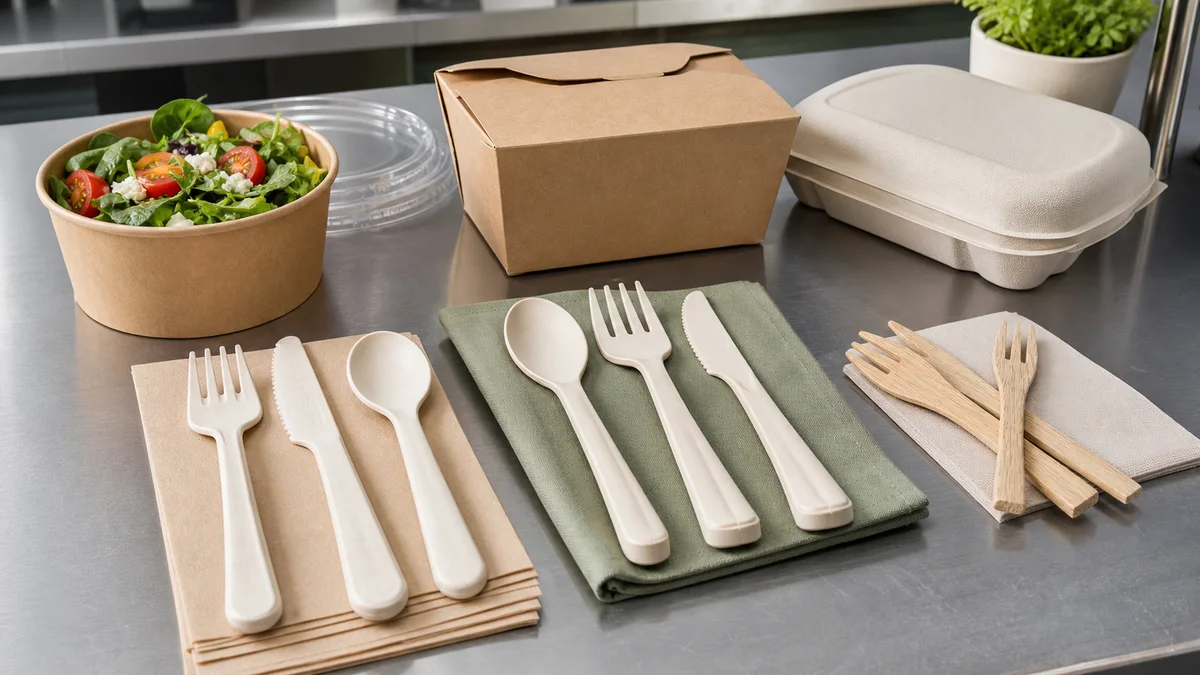
Why Customers Hate Your Wooden Cutlery — and How to Fix It
A cafe owner in Manchester posted on a hospitality forum in February. She'd switched to wooden cutlery the month before — the right thing to do after the October 2023 plastic ban. Within two weeks, her Google reviews had three separate complaints about "horrible wooden spoons that taste like lolly sticks." One customer wrote that the fork splintered mid-bite and she spent the rest of her lunch picking wood fibres out of her teeth.
She's not alone. Dozens of operators replied to that thread. Most had the same experience: they made the legally required switch, bought what seemed like a reasonable mid-range wooden cutlery option, and within days the complaints started rolling in. One operator on a UK foodservice forum put it bluntly: "We switched to comply with the law and now we're losing customers. Makes you wonder what the point was."
If you've been fielding complaints about splinters, woody aftertaste, or spoons that can't hold soup, you're not doing anything wrong — you're just buying the wrong spec. Here's what's actually happening and how to fix it tomorrow. And if you're still sourcing your disposable cutlery from whoever offered the cheapest box online, start with our cutlery range at okeypackaging.com/products/cutlery — at least you'll know the spec before you buy.
Key Takeaways:
- The UK single-use plastic cutlery ban has been in force since October 2023. Wooden cutlery is now the default — but not all wooden cutlery is fit for purpose.
- Cheap birch cutlery has three failure points: surface roughness (splinters and "furry" mouthfeel), shallow spoon bowls (can't hold soup), and thin stock that snaps under pressure.
- Operators who switched to mid-spec bamboo or compressed paperboard cutlery report a dramatic drop in complaints — and some say customers now compliment the cutlery.
- The material you choose matters less than the spec. GSM, edge finish, and spoon depth are the three numbers you need to check before ordering.
Why Most Wooden Cutlery Feels Awful — the Three Failure Points
When operators complain about wooden cutlery, they're usually describing one of three specific problems. Each one has a technical cause, and each one is fixable — but only if you know what to ask for.
Splinters and Rough Finish
The most common complaint. Cheap wooden cutlery is punched from thin birch sheets at high speed. The cutting die wears down over a production run, so the first 50,000 pieces come out smooth, and the next 200,000 come out with rough, frayed edges. If your supplier can't tell you their edge-finish tolerances, you're gambling.
Better manufacturers sand or compress the edges after punching. Some use a hot-press process that seals the wood fibres, creating a smooth surface that won't splinter even when wet. The spec to ask for is "smooth-edged" or "hot-pressed finish." If the product description doesn't mention edge finishing at all, assume it hasn't been done.
Shallow Spoons That Can't Hold Anything
Pret a Manger learned this one the hard way. In 2018 they switched to wooden spoons and faced what the Financial Times called a "major backlash" — the spoons were too shallow, couldn't hold soup, and customers were unimpressed. Pret switched again, this time to a deeper paperboard spoon from Belgian supplier Sabert.
The fix is simpler than Pret's two-attempt journey suggests. Wooden spoons are punched from flat stock, so the bowl depth is determined by how much material gets compressed in the mould. Cheap spoons use light compression — they look like a spoon but function like a paddle. Look for spoons with at least 5mm bowl depth. Ask the supplier for a sample and pour a tablespoon of water into the bowl. If it overflows, your customers' soup will too.
Snapping Under Load
Wooden forks and knives have a grain direction problem. Wood splits along the grain, and if the handle is cut parallel to the grain, it snaps clean when a customer applies pressure to cut something dense — a burger, a grilled halloumi slice, a thick-cut chip.
Bamboo doesn't have this problem to the same degree because bamboo fibres run in multiple directions. CPLA — crystallised corn-starch plastic — behaves almost identically to traditional plastic and won't snap at all. If you stick with wood, look for "cross-grain" or "compressed" construction, or step up to bamboo for the forks and knives while keeping wooden spoons for lighter dishes.
What the Alternatives Actually Cost — Per Piece and Per Complaint
Operators often compare cutlery on unit price alone. That's the wrong calculation. Here's what different materials cost per 1,000 pieces from UK wholesalers, alongside what they actually cost once complaint-driven remakes and refunds enter the picture.
Basic birchwood cutlery runs £25-35 per 1,000 pieces. It's the cheapest compliant option, and for cold, light foods — salad boxes, cake, sandwiches — it works fine. If you're pairing cutlery with takeaway boxes for those lighter meals, check that your packaging spec matches the quality of your cutlery at okeypackaging.com/products/takeaway-boxes — a premium box with a splintering fork sends mixed signals.
For hot food or anything requiring cutting, expect complaints. One operator on a UK hospitality forum calculated that every complaint cost him roughly £12 in staff time, refund, and goodwill discount. Three complaints a week wipes out every penny saved on cheaper cutlery.
Mid-grade birch with hot-pressed edges runs £40-50 per 1,000 pieces. The edge finishing eliminates the splinter complaint almost entirely. Spoon depth is still variable — check before committing.
Bamboo cutlery runs £55-75 per 1,000 pieces. It's stronger, splinters less, has no woody taste, and handles hot food without softening. Operators who switched from basic birch to bamboo reported that customer complaints about cutlery dropped to zero within a fortnight.
At £55 per thousand versus £30 per thousand, the bamboo is £25 more expensive — roughly the cost of one complaint-driven refund per 500 meals served. If your complaint rate on basic birch is higher than 0.2%, bamboo pays for itself.
CPLA (compostable plastic) runs £70-90 per 1,000 pieces. It looks and feels like the plastic your customers remember — no taste, no texture issues, no splinters. The catch: it needs industrial composting, which most UK councils don't offer. If it goes in general waste, it behaves like traditional plastic in landfill. For operators who want to make a genuine environmental claim, this is a problem.
Paperboard cutlery runs £50-65 per 1,000 pieces. Pret's current option. Smooth, no splinters, decent strength, recyclable with cardboard. It can soften if left in hot liquid for more than 15 minutes, so test with your specific menu before committing.
How to Test Cutlery Before You Commit to a Production Order
You wouldn't sign a lease on a kitchen you haven't walked through. Don't commit to 10,000 pieces of cutlery you haven't tested with your actual food. Here's a testing protocol that takes 15 minutes and costs nothing except the price of a sample pack.
First, the wet test. Submerge a spoon in hot water at 85°C — the temperature of fresh soup — for 10 minutes. Take it out and try to scoop with it. If the wood has swollen, softened, or started to fray, it fails.
Do this with three spoons from different positions in the sample pack. Inconsistent results are as bad as consistent failure — they mean the production run will be unpredictable.
Second, the cut test. Take a wooden fork and knife. Try to cut through a piece of grilled chicken, a halloumi fry, and a thick-cut chip — the three foods most likely to expose weak cutlery. If the fork tines snap, the knife splinters, or you feel the handle flexing, the cutlery isn't up to your menu.
Third, the taste test. This sounds obvious, but it's the one operators skip. Eat a full mouthful of your most popular dish using the cutlery you're testing. Pay attention to whether the wood taste transfers to the food.
Wood taste is most noticeable with hot, wet foods — soups, curries, pasta dishes. If you notice it, your customers will too.
Fourth, the splinter check. Run your tongue along the edge of a spoon and the inner tines of a fork. If you feel any roughness, any fibres catching, anything that isn't perfectly smooth — reject the sample. If you wouldn't put it in your own mouth, don't put it in your customers'.
One operator on a UK hospitality forum described testing six different wooden cutlery samples before finding one that passed all four tests. "Five out of six failed on at least one test," he wrote. "The one that passed costs 1.8p more per piece. Best 1.8p I've ever spent."
What About the Composting Question?
Here's the part most cutlery suppliers won't tell you upfront: "compostable" and "actually gets composted" are two completely different things in the UK right now.
Untreated birchwood and bamboo cutlery will break down in a home compost heap in 2-6 months. They'll also decompose in landfill — slowly, but without leaving microplastics. This is the most practical end-of-life outcome for the majority of UK operators, because most local councils do not accept compostable packaging or cutlery in food waste collections. If you're reviewing your entire packaging setup for environmental claims — from takeaway boxes to napkins — our full range at okeypackaging.com/products breaks down what's genuinely compostable and what isn't, by material.
CPLA and PLA cutlery are labelled "industrially compostable." This means they'll break down in a commercial composting facility that maintains specific temperature and humidity conditions. In the UK, access to these facilities is patchy. WRAP, the government's waste advisory body, has published guidance at wrap.ngo/resources/guide/compostable-plastic-packaging-guidance noting that compostable plastics should only be used where there is a clear, verified route to a compatible composting facility. If you don't have one — and most high-street cafes and independent takeaways don't — CPLA cutlery is functionally no different from traditional plastic at end-of-life.
If you're making environmental claims to your customers, untreated wood or bamboo cutlery is the safest ground. It degrades in any environment, leaves no microplastics, and doesn't require customers to have access to specialist facilities. The government's own impact assessment for the single-use plastic ban, published by DEFRA at gov.uk/government/publications/single-use-plastics-ban, identifies wood as the most practical and environmentally sound alternative for the majority of foodservice use cases.
What to Ask Your Supplier Before Ordering
When you're comparing cutlery suppliers, these six questions will separate the serious ones from the box-shifters.
One: what's the edge finish process? If they can't describe it — hot-pressing, sanding, compression sealing — they're selling unfinished cutlery.
Two: what's the spoon bowl depth? Anything under 5mm is a complaint waiting to happen.
Three: is it FSC-certified? This confirms the wood comes from responsibly managed forestry. Non-certified birch could come from anywhere.
Four: can you send a pre-production sample from the batch I'd actually receive? A showroom sample chosen by hand tells you nothing. You need a sample pulled randomly from a production run.
Five: what's your tolerance on thickness variation? If they can't quote a number (±0.2mm is reasonable for wooden cutlery), their quality control isn't real.
Six: do you offer mixed packs? Some suppliers will let you order forks in bamboo (for strength) and spoons in birch (for cost) in a single shipment. This hybrid approach lets you match the material to the use case without managing two separate supplier relationships.
One Small Change Tomorrow
If you do one thing after reading this, make it this: order sample packs from three different suppliers — a budget birch, a mid-grade hot-pressed birch, and a bamboo option. Run each through the four tests above with your actual food. Pick the cheapest one that passes all four.
The difference between the cutlery your customers complain about and the cutlery they don't notice is often less than 2p per piece. At typical foodservice volumes, that's £20 per thousand covers — roughly the cost of losing one customer who would have come back.
If you're looking for a starting point, we stock FSC-certified birchwood and bamboo cutlery in a range of pack sizes and can send a mixed sample pack so you can test different materials side by side with your menu. Request a sample at okeypackaging.com/quote.