
Salad Bowls for UK Takeaways — What to Check Before Ordering
Choosing salad bowls for a UK takeaway or deli? Compare rPET, kraft, bagasse, and PLA materials. Learn lid tests, EPR compliance, PPT costs, and the checks that prevent delivery leaks.
Filed under Buying Guides.
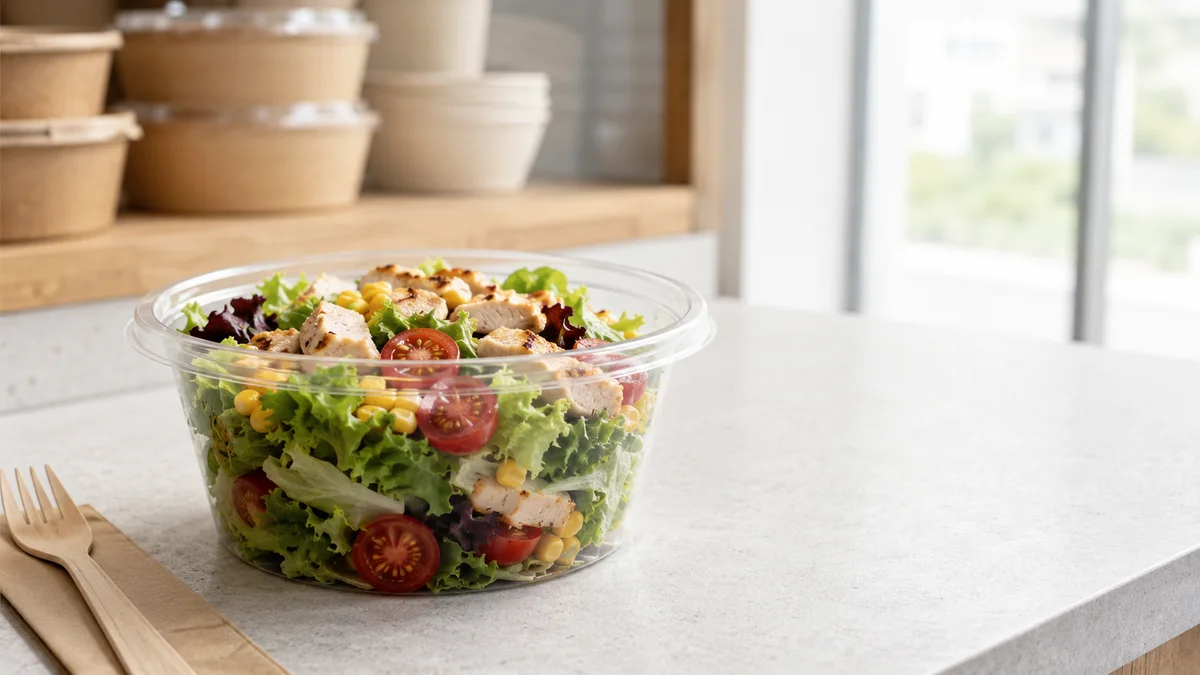
If you run a deli, cafe, meal-prep kitchen, or grab-and-go outlet in the UK, your salad bowl is doing two jobs at once. It needs to keep dressing inside the container during a 25-minute delivery run, and it needs to make the food look fresh enough that the customer orders again next week. Get either one wrong and you're paying for it twice — once in wasted stock and once in lost repeat business.
Most UK operators learn this the expensive way. They order a case of bowls that looked fine on the supplier website, only to find the lids pop open on the back of a moped, the kraft board goes soft within 15 minutes of dressing contact, or the "compostable" claim does not hold up when the council waste officer asks for a certificate. This guide walks through every check you should make before placing your next salad bowl order — materials, sizes, lids, leak-proofing, regulatory compliance, and the cost traps that catch first-time buyers.
Key Takeaways • Clear PET or rPET bowls let customers see the food and are the most leak-resistant option for delivery — but they attract Plastic Packaging Tax at £217.85 per tonne unless they contain at least 30% recycled content. • Kraft paperboard bowls with a water-based or PE lining give you the best printable surface for branding, are PPT-exempt, and cost roughly 20-30% less per unit than bagasse equivalents at comparable volumes. • Bagasse (sugarcane fibre) bowls are the only material that handles hot and cold food equally well, are fully EN 13432 compostable, and are completely exempt from Plastic Packaging Tax — but expect to pay a 15-25% premium over kraft. • Anti-fog lids are not optional if your salads sit in a chilled display cabinet — standard clear lids fog within 90 seconds of refrigeration and customers can't see what they're buying. • Always request a 24-hour dressing leak test from your supplier before committing to a bulk order. If the supplier can't or won't provide one, ask for a sample case and run the test yourself.
Why Most Salad Bowl Packaging Fails During Delivery
James runs a meal-prep business in Birmingham. He switched to a cheaper kraft bowl six months ago and saved £0.04 per unit. Within three weeks his repeat order rate dropped from 62% to 51%. The reason wasn't the food. Customers were receiving salads with dressing pooled in the bottom of the delivery bag because the lids on the new bowls did not seal properly against the rim when the container was tilted.
This is the pattern with salad packaging failures. The problem is rarely the bowl material itself. It is the combination of the bowl, the lid, and the real-world conditions of UK delivery — potholes, courier bags tipped sideways, and the 20-40 minutes it takes for vinaigrette to work its way through a fibre-based barrier coating.
There are three failure modes that show up again and again. First, rim-and-lid mismatch. A bowl from one supplier and a lid from another, or a lid that "fits" according to the spec sheet but was never tested with an oily dressing at a 45-degree tilt for half an hour. Second, coating breakdown. Kraft bowls with a thin PE lining resist moisture for about 15-20 minutes. After that, dressings with vinegar or citrus start breaking through at the side seams. Third, condensation softening. Cold salads in a refrigerated cabinet produce condensation on the inside of the lid, which drips back down onto the food and makes leaf greens wilt. A proper anti-fog lid stops this. A standard clear lid accelerates it.
The cost of a packaging failure isn't the refund on that one order. It's the customer who never comes back, the Deliveroo rating that drops from 4.7 to 4.2, and the 40 minutes you spend replying to complaint emails instead of doing anything else. For a typical independent UK takeaway doing 80-120 orders a day, a packaging failure rate of even 3% means 3-4 complaints daily. That's an operational problem, not a packaging cost problem.
The Four Materials That Dominate UK Salad Bowl Supply
Clear PET and rPET Bowls
Clear PET is still the default choice for most UK deli counters and salad-bar operations, and for good reason. Nothing sells a salad like being able to see the colours — the red peppers, the green leaves, the golden sweetcorn. PET bowls are rigid, they don't soften with moisture, and the snap-on lids create a reliable mechanical seal that survives delivery better than any fibre-based alternative.
The downside is regulatory. As of April 2026, plastic packaging that contains less than 30% recycled content attracts Plastic Packaging Tax at £217.85 per tonne. Standard virgin PET bowls fall squarely into this bracket. The fix is rPET — recycled PET — which typically contains 50-100% post-consumer recycled material and is exempt from the tax. rPET bowls cost roughly 8-12% more than virgin PET at current UK wholesale pricing, but the PPT saving often cancels out the premium at volumes above 50,000 units per year.
PET and rPET bowls are microwave-safe (check the spec — not all are), freezer-safe, and widely recyclable through UK kerbside collections. The clarity is slightly lower on rPET — a faint grey-blue tint compared to virgin PET's crystal transparency — but most customers won't notice the difference.
Kraft Paperboard Bowls
Kraft bowls are the branding play. The natural brown board takes printing well, which means your logo, your colours, and your social handle all go directly onto the packaging at a per-unit cost that is far lower than custom-printing plastic. They're lighter than PET, which reduces shipping weight, and they stack tighter, which matters when you have 40 square feet of dry storage and five different container SKUs.
The critical question with kraft bowls is the lining. Traditional PE (polyethylene) lining provides a reliable moisture barrier and is recyclable through mainstream UK paper streams — the PE separates during the pulping process. Water-based dispersion coatings are the newer alternative. They are PFAS-free, fully repulpable, and carry stronger environmental claims. But they aren't all equal. A low-quality water-based coating will let dressing seep through at the side-wall crease within 20 minutes. A high-quality one, applied at the correct coat weight, will hold for two hours or more. Ask the supplier for the coating specification and, if possible, the Cobb test value — a measure of water absorption. Lower is better. Anything above 30 g/m² over 60 seconds is likely to struggle with oily dressings.
Kraft bowls are exempt from Plastic Packaging Tax provided the PE lining is below 10% of the total packaging weight, which it almost always is. They aren't compostable in the UK sense — the PE lining means they need to go into paper recycling, not food waste.
Bagasse (Sugarcane Fibre) Bowls
Bagasse is the material most UK operators land on when they want to make a genuine sustainability claim without compromising on performance. Made from the dry fibrous residue left after sugarcane juice extraction, bagasse bowls are rigid, grease-resistant, microwave-safe, oven-safe to 200°C, and fully compostable to EN 13432 standard in industrial facilities.
The performance advantage over kraft is heat tolerance. Bagasse handles hot and cold food equally well, which makes it the only single-material option if your menu includes both salad bowls and hot grain bowls or curry boxes. It doesn't go soft with hot food the way kraft can, and it doesn't crack in the freezer the way PLA does.
The trade-off is cost. Bagasse bowls at UK wholesale volumes (500-1,000 units) typically run 15-25% more than equivalent kraft bowls, and 10-15% more than rPET. The surface is a natural off-white with visible fibre texture, which some brands love and others find limits their print options — crisp full-colour graphics are harder to achieve on bagasse than on kraft or plastic.
From a compliance perspective, bagasse is the cleanest option. It is fully exempt from Plastic Packaging Tax, contains no intentionally added PFAS (check the supplier spec to confirm), and qualifies for the lowest pEPR modulated fee band under the RAM green rating system rolling out through 2026-2027.
PLA Bioplastic Bowls
PLA (polylactic acid) bowls look like clear plastic but are made from fermented plant starch, usually corn. They offer the transparency of PET with a renewable-material story, and they are certified industrially compostable to EN 13432.
The catch is real-world UK disposal. PLA requires industrial composting conditions — 58°C sustained heat, controlled humidity, and specific microbial activity. Fewer than 50 UK councils currently accept PLA in food waste collections, and almost none accept it in kerbside recycling because it contaminates the PET stream. In practice, most PLA bowls used in the UK today end up in general waste, where they behave essentially like plastic in landfill.
PLA also has strict temperature limits. Standard PLA softens above 40°C, which rules out hot food, microwave reheating, and even being left in a warm car on a summer delivery run. Crystallised PLA (CPLA) raises the heat tolerance to about 85°C but costs more and is less widely available in bowl formats.
For cold-salad-only operations that serve customers in an area with access to industrial composting, PLA is a credible choice. For everyone else, rPET or bagasse will be more practical and no less environmentally responsible in real-world disposal terms.
Size Selection — Matching Bowl Capacity to What You Actually Serve
Salad bowl sizes in the UK market run from 350ml (12oz) up to 1,500ml (52oz), with the bulk of demand clustered in the 500ml to 1,000ml range. The size you need depends less on the volume of food and more on how the customer eats it.
A 500ml (17oz) bowl holds a standard single-portion salad with room to toss. This is the workhorse size for deli counters and meal-prep services serving lunch portions. It fits one full handful of mixed leaves, 80-120g of protein, and four to six topping elements without looking cramped.
A 750ml (26oz) bowl is the right size if your salads are main-meal portions — the kind someone orders for dinner, not a light lunch. It gives you room for a full grain base, generous protein, and layered toppings without the lid pressing down on the food. This is also the minimum size that works for a poke bowl with a rice base, which needs more vertical space than a leaf-based salad.
A 1,000ml (32oz) bowl handles meal-prep portions designed to be split across two sittings, large grain-and-protein bowls, and salad-plus-sides combos. Above this size you are in catering territory — 1,200ml to 1,500ml bowls for office lunch platters, buffet service, and family-sized takeaway portions.
Square bowls pack roughly 20% more units into the same shelf space compared to round bowls of equivalent capacity. If dry storage is tight in your kitchen, this matters. Round bowls, however, are easier to eat from and most customers find them more natural to hold — particularly for delivery orders where the customer is eating straight from the container on their sofa.
Check whether your supplier's bowls are truly stackable. Some kraft and bagasse bowls have a slight taper that allows nesting without jamming. Others have straight walls that bind when stacked, which means you lose 30% of your shelf capacity to air gaps. Test this with the actual product, not the catalogue photo.
Lid Selection — The Single Biggest Determinant of Delivery Success
The bowl holds the food. The lid determines whether the food arrives in the bowl or in the delivery bag. Lid selection is where most UK operators make the costliest mistake — they treat the lid as an afterthought, spec the bowl first, and then order whatever lid the supplier bundles with it.
Flat Snap-On Lids
Flat snap-on lids are the default for cold salad bowls. They are thin, cheap (typically £0.01-£0.03 per lid at wholesale volumes), and they work fine for counter service where the customer picks up and eats within the hour. For delivery, they are adequate only if three conditions are met: the rim profile on the bowl is deep and well-defined, the lid is from the same manufacturer as the bowl, and the dressing is packed separately in a portion pot.
If you dress the salad before it leaves the kitchen, a flat snap-on lid on a fibre bowl will leak roughly one time in ten. That is not a guess — it is what a dozen UK operators told us when they tracked packaging failures over a two-week period. The failure rate drops significantly with PET bowls because the plastic-on-plastic seal is more reliable, but the risk is still real if the container gets tilted past 45 degrees.
Dome Lids
Dome lids add 20-30mm of height above the bowl rim, which does two useful things. It stops the lid from pressing down on leafy garnishes and delicate toppings, and it creates an air pocket that reduces condensation buildup. Dome lids are essential if your salads are topped with anything that should not be squashed — microgreens, crispy onions, edible flowers, or a poached egg.
Dome lids cost roughly twice what flat lids cost (£0.04-£0.07 per lid), but the perceived value they add to a premium salad is easily worth it. A customer who lifts a dome lid and sees an intact, beautifully presented salad is far more likely to post a photo than one who peels back a flat lid with half the toppings stuck to the plastic.
Anti-Fog Lids
Anti-fog lids are treated with a hydrophilic coating that prevents water droplets from forming on the inside surface. Without this treatment, any salad bowl placed in a refrigerated display cabinet will fog within 60-90 seconds as the cold air outside hits the warm, moist air inside. The customer sees a misted-up lid and walks past.
We covered anti-fog lid selection in detail in our dedicated guide on the topic. The short version for salad bowl buyers is this: if your bowls sit in a chilled grab-and-go cabinet at any point, specify anti-fog lids. The cost premium is roughly £0.01-£0.02 per lid, and the sales uplift from visible food in a display cabinet recovers that ten times over.
Hinged Lids
Hinged-lid salad containers — where the lid is attached to the bowl along one edge — are common in supermarket meal deals and grab-and-go formats. They eliminate the separate-lid problem entirely, which means no inventory mismatch and no staff member hunting for the right lid during a lunch rush.
The trade-off is that hinged containers are typically shallower than bowl-and-lid combinations, so they don't work for layered salads or anything with significant height. They also cost more per unit than separate bowls and lids because the manufacturing process is more complex. For a standard deli-counter operation where speed of service matters more than premium presentation, hinged containers are worth testing. For a delivery-focused business where leak resistance is the priority, stick with separate bowls and snap-on lids from the same manufacturer.
Leak-Proof Testing — The Dressing Problem
Salad dressing is a packaging engineer's nightmare. It is acidic (vinegar, citrus), oily (olive oil, sesame oil), and almost always applied at the last second before the lid goes on, which means it is wet, mobile, and already in contact with the bowl walls when the delivery journey begins.
There is no UK industry standard for takeaway container leak resistance. Each supplier uses its own test methodology — or none at all. This means the burden is on you to verify that the bowl-and-lid combination you are buying survives the same journey your customers experience.
The simplest test is the one-hour tilt test. Fill a bowl with 50ml of your actual house dressing, seal the lid, place the bowl on its side in a plastic tray, and leave it for 60 minutes at room temperature. Any dressing that has seeped past the seal or through the bowl wall is a failure. Run this test on five bowls from the same batch. If more than one fails, the combination is not fit for delivery.
If you use a range of dressings — a thick Caesar, a thin balsamic vinaigrette, an oil-based chili dressing — test each one separately. A bowl that handles thick ranch perfectly may weep with a high-acid vinaigrette within 15 minutes.
A more thorough test is the 24-hour refrigerated test. Dress a full salad, seal the lid, place the bowl at a 30-degree tilt in a refrigerator, and check at 4 hours, 8 hours, and 24 hours. This simulates a meal-prep operation where salads are made in the morning and delivered throughout the day. Any visible seepage, softening of the bowl wall, or condensation pooling inside the lid is a fail.
If your supplier cannot provide test data — or if they seem confused by the request — treat that as a red flag. A supplier who has not tested their bowl-and-lid combination with real food and real dressings is selling you a product they do not fully understand.
EPR, Plastic Packaging Tax, and the Real Cost of Compliance
The UK packaging regulatory landscape changed significantly in 2025-2026, and salad bowl buyers need to understand two specific regimes that affect the per-unit cost of every container they purchase.
The Plastic Packaging Tax (PPT), introduced in April 2022 and increased to £217.85 per tonne in April 2025, applies to plastic packaging manufactured in or imported into the UK that contains less than 30% recycled content. For salad bowls, this means virgin PET bowls attract the tax. rPET bowls with 30% or more recycled content are exempt. Kraft, bagasse, and PLA bowls are exempt because they are not plastic, though PLA sits in a grey area — it is technically a bioplastic and the tax treatment depends on how HMRC classifies the specific product.
For a typical independent operator buying 20,000 salad bowls a year, the PPT difference between virgin PET and rPET works out to roughly £40-60 per year — not a line-item that should drive your decision. But for a chain or a wholesaler moving 500,000 units annually, the tax saving from switching to rPET can exceed £1,000 per year, which more than covers the higher unit cost of the recycled material.
The bigger regulatory story for 2026-2027 is pEPR — producer extended responsibility with modulated fees. Under pEPR, packaging is assigned a RAM (Recyclability Assessment Methodology) rating of red, amber, or green based on how readily it can be recycled in UK infrastructure. Green-rated packaging pays the lowest disposal fees. Red-rated packaging pays a 20% premium. For salad bowls, the material choice directly determines the RAM band. Clear PET and rPET are green-rated. Kraft with standard PE lining is green-rated because the PE separates in the pulping process. PLA is currently amber-to-red rated because it contaminates the PET recycling stream and is not accepted by most UK material recovery facilities. Bagasse is green-rated for industrial composting but the RAM framework is still evolving for compostable materials — confirm the current rating with your supplier before buying.
The practical implication is that a material choice made today — particularly switching to PLA or a non-standard composite — could lock you into higher disposal fees for years. When in doubt, default to a material with a clear, established recycling route in the UK: rPET or kraft paperboard.
Five Questions to Ask Any UK Salad Bowl Supplier
Before you place an order, send these five questions to your supplier and do not commit until you have answers you can verify.
First: "Can you send me a sample case of the exact bowl and lid combination I am ordering, not a similar product?" Suppliers sometimes send samples of their premium line when you have asked for a quote on their budget range. If the sample has a different coating weight, rim profile, or material composition than what you are buying, it tells you nothing.
Second: "What is the Cobb test value for this bowl, and can you provide the test certificate?" The Cobb test measures water absorption over a specified time period, typically 60 seconds or 1,800 seconds. A lower number means better moisture resistance. For a salad bowl that will hold dressing for 30 minutes or more, you want a Cobb 1800 value below 30 g/m².
Third: "Is the lining PE, water-based dispersion, or something else, and can you confirm in writing that the bowl contains no intentionally added PFAS?" PFAS phase-out is underway across the UK and EU food-contact packaging sector, and you want a written statement from your supplier confirming PFAS-free status for any bowls manufactured after January 2025.
Fourth: "What is the current RAM rating for this product under pEPR, and do you expect it to change in the next 12 months?" If the supplier does not know what RAM is, they are not keeping up with UK packaging regulation, and their products may create compliance problems for your business down the line.
Fifth: "If I order 5,000 units today, what is the lead time and what is the per-unit price including delivery to my postcode?" Do not accept a unit price without the delivery cost included. UK packaging wholesalers vary widely on delivery charges — some offer free next-day delivery on orders over £60, others add £12-18 for delivery regardless of order size. Get the all-in cost or you are comparing apples to oranges.
Frequently Asked Questions
What is the best material for salad bowls used for delivery in the UK? For delivery, clear rPET bowls with snap-on lids from the same manufacturer offer the most reliable leak resistance. If sustainability is the priority and your budget allows, bagasse bowls with tight-fitting separate lids are the best compostable option — but confirm the lid seal with a tilt test before committing to a bulk order.
Are kraft salad bowls actually recyclable in UK household collections? Yes — kraft bowls with a PE lining are recyclable through mainstream UK paper and card kerbside collections. The thin PE layer separates during the repulping process at the mill. Bowls with heavy food residue should be rinsed or wiped before recycling, but a light oil residue from salad dressing will not prevent recycling.
Do I need anti-fog lids if my salads go straight into delivery bags? Not necessarily. Anti-fog lids matter most when the bowl sits in a refrigerated display cabinet where customers need to see the food. For delivery-only operations where the customer opens the container immediately upon receipt, standard clear lids are adequate — the fogging dissipates quickly once the lid is removed.
How much do salad bowls cost per unit at typical UK wholesale volumes? At 1,000-unit quantities, expect roughly £0.08-£0.12 per kraft bowl, £0.10-£0.15 per rPET bowl, £0.12-£0.18 per bagasse bowl, and £0.15-£0.22 per PLA bowl, excluding lids. Lids add £0.01-£0.07 depending on type. Prices drop 20-30% at 5,000+ unit volumes.
Can I put hot food in salad bowls? It depends on the material. Bagasse bowls handle hot food up to 200°C without issue. Kraft bowls with PE lining can manage warm food up to roughly 90°C but may soften with sustained heat. PET and rPET bowls soften above 60-70°C and are not suitable for hot food. PLA bowls soften above 40°C. If you need bowls that work for both hot and cold, bagasse is the safest single-material choice.
What is the minimum order quantity for custom-branded salad bowls in the UK? Custom-printed salad bowls typically start at 5,000-10,000 units for flexographic printing on kraft, and 10,000-25,000 units for custom PET or rPET bowls. Some UK suppliers offer digital short-run printing from 1,000 units at a higher per-unit cost. Expect to pay a one-time plate or setup fee of £150-£400 for flexo printing, plus £0.03-£0.08 per unit for the print itself depending on colour count and coverage.
Conclusion
The salad bowl you choose is a marketing asset, a compliance obligation, and a delivery logistics problem all rolled into one piece of packaging. Getting the decision right means testing the specific bowl-and-lid combination with your actual food and your actual dressings, not trusting a catalogue description or a supplier's verbal reassurance.
Start with the material that matches your operational reality. If you are delivery-heavy with a chilled-display component, rPET with anti-fog snap-on lids is the lowest-risk option. If you're counter-service with a strong sustainability brand position, bagasse with separate flat lids gives you the strongest environmental story and full PPT exemption. If you're building a branded multi-location business and print quality matters more than anything else, kraft paperboard with a high-quality water-based coating is the platform to build on.
Whatever material you choose, verify the lid seal, confirm the RAM rating, and get the PFAS-free commitment in writing. A well-chosen salad bowl reduces complaints, increases repeat orders, and quietly pays for itself. A badly chosen one produces a slow drip of negative reviews and refunds that no amount of marketing budget can offset.
If you are sourcing salad bowls for a UK foodservice operation and want to compare material options with real pricing, get in touch with our team at Okey Packaging. We stock rPET, kraft, and bagasse salad bowls in sizes from 500ml to 1,200ml, with anti-fog and dome lid options across the range. Request a quote and we will send you a sample pack so you can run the dressing tilt test before you commit to a full order.