
Anti-Fog Salad Bowl Lids: What UK Grab-and-Go Operators Need to Know
Anti-fog coating technology for PET lids, dome height options, cold-chain seal integrity, PET vs PLA comparison, and MOQ for custom-printed salad bowl lids in the UK.
Filed under Operations.
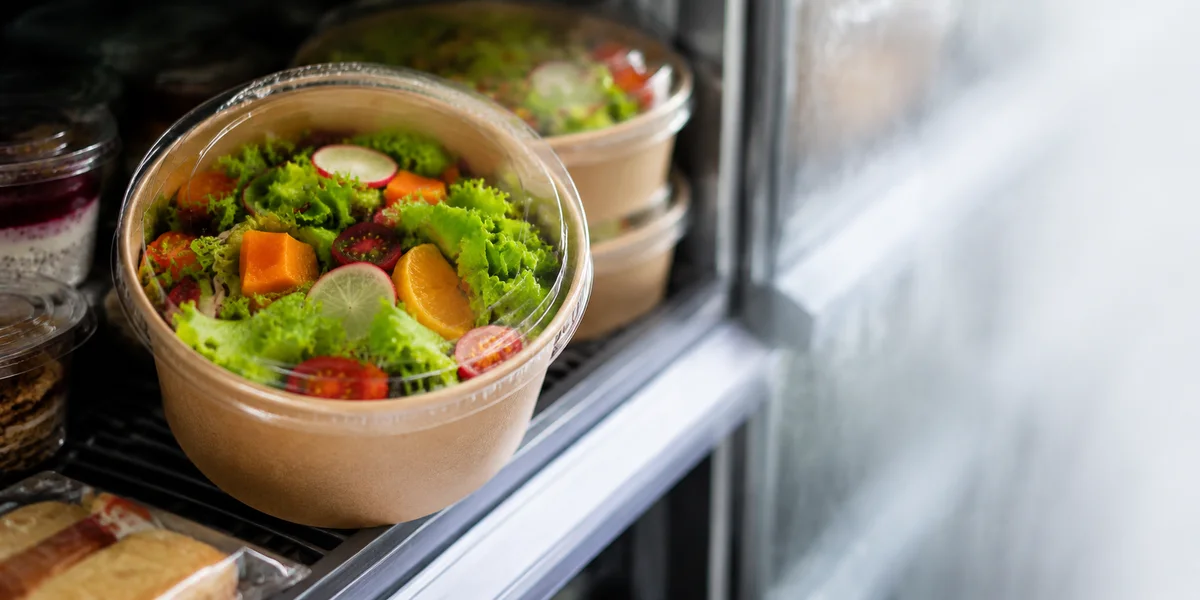
The UK grab-and-go market was valued at approximately 24 billion GBP in 2025, with fresh-prepared salads accounting for a growing share as health-conscious consumers choose convenience over fast food. Supermarket chillers, deli counters, and cafe displays now compete directly on visual presentation — and the lid is the shop window. A fogged-up lid costs you the sale because the customer cannot see the product. For UK operators running chilled salad displays, condensation on the lid interior is not a manufacturing defect; it is a physics problem caused by the temperature differential between the product and the ambient cabinet air. Anti-fog coating technology resolves this by altering the surface tension of the lid material, and it is becoming a baseline expectation in premium grab-and-go packaging.
Anti-fog coatings work by applying a thin hydrophilic surfactant layer to the interior surface of the lid. Instead of condensing into discrete droplets that scatter light and create a hazy appearance, moisture spreads into a continuous invisible film. The result is optical clarity that persists throughout the product shelf life. The coating is typically applied during the extrusion process or as a post-production spray, with extruded coatings offering more consistent coverage and longer dwell time — typically 24-72 hours of continuous clarity under refrigeration at 2-8C. Spray-applied coatings are cheaper but may degrade after 12-24 hours or under humidity cycling. For any product with a display life exceeding one day — such as meal-prep salads, deli pots, or pre-packed fruit — extruded anti-fog is the recommended specification.
Dome height is a material selection factor that directly affects both visual appeal and packaging cost. Low-dome lids, sitting flush to the bowl rim, are used for dense or compact salads with minimal headspace. Standard dome lids provide 15-25 mmof clearance for bulkier ingredients such as cucumber slices, cherry tomatoes, and croutons. High-dome lids offer 30-50 mmof clearance for layered salads, grain bowls, or protein-topped compositions. The dome height influences the air volume inside the container, which in turn affects condensation behaviour — higher domes create more headspace and require more effective anti-fog treatment to remain clear. In the UK market, standard-domePETlids for 300-500 mlcapacity bowls are the most popular format, representing roughly 60% of grab-and-go salad lid sales. High-dome lids account for 25%, primarily in premium supermarket meal-prep lines.
Seal integrity is critical for cold-chain delivery. A grab-and-go salad may travel from a central kitchen to a distribution hub, then to a retail outlet, and finally to the customer home — a journey of 24-72 hours under refrigeration. During this time, the lid seal must prevent moisture loss (which causes wilting), prevent contamination ingress, and maintain the anti-fog environment.PETlids with a rolled-edge seal design provide the most consistent closure onPETandrPETbowls, achieving a peel-force rating of 8-15 Newtons depending on the bowl rim finish. For comparison, flat-flangePETlids typically achieve 4-8 Newtons. The difference matters: a seal below 6 Newtons is vulnerable to popping open under the pressure changes that occur during refrigerated transport, especially when stacked multiple layers high.
The choice betweenPETandPLAlid materials involves trade-offs in clarity, temperature tolerance, cost, and environmental positioning.PET(polyethylene terephthalate) offers optical clarity of approximately 90-92% light transmission, a temperature range of -20C to 70C, and proven recyclability through UK kerbside collection schemes wherePETis widely accepted.rPET(recycledPET) lids typically contain 70-100% post-consumer recycled content with identical optical properties and cost roughly 5-10% more than virginPET.PLA(polylactic acid), derived from corn starch, offers a renewable material stream and compostable certification underEN 13432, but its optical clarity is lower at 82-88%, its temperature range is narrower (-10C to 40C), and it is not currently recyclable through standard UK kerbside systems — it requires industrial composting facilities that remain limited across the UK. For most UK grab-and-go operators,rPETrepresents the optimal balance of clarity, recyclability, and cold-chain performance.
Minimum order quantities for custom-printed salad bowl lids vary by print method and lid size. Flexographic print on standard-domePETlids typically requires a minimum of 1,000-2,000 units per design. Digital print, which eliminates plate costs, can reduce MOQ to 500 units per design but carries a higher per-unit cost — approximately 2-4p per lid premium overflexo at 1,000 units. Setup costs forflexographic plates run 40-80 GBP per colour, whiledigital setup is typically zero. For operators running multi-site grab-and-go programmes, ordering 5,000-10,000 custom lids per design reduces the unit print cost to within 1-2p of plain stock lids. Okeypackaging offers custom print onPETandrPETsalad bowl lids from 500 units per design, with a 5-7 working day lead time from artwork approval, and a free design service to adapt existing brand assets to the lid template.
UK food-contact regulations for chilled packaging require the same Declaration of Compliance framework as hot packaging.PETandrPETlids destined for chilled salad use must comply withRegulation (EC) 1935/2004and be tested against food simulant A (10% ethanol) at 40C for 10 days, representing aqueous and acidic foods — the relevant simulant for most salad dressings and marinated ingredients.PLAlids carry the additional requirement of compostability certification if marketed as biodegradable, under UK Competition and Markets Authority (CMA) green claims guidance. Operators making environmental claims on-pack must hold supporting evidence, includingEN 13432certification and confirmation that local industrial composting facilities acceptPLApackaging.
The financial case for anti-fog lids in the UK grab-and-go channel is straightforward. A standardPETlid with no anti-fog treatment costs approximately 3-5p at 1,000-unit volume. Adding extruded anti-fog coating raises the cost to 5-8p per lid — a 2-3p increase. If that lid prevents even one rejected salad per display shelf per day, the incremental cost is recovered at a retail price of 3.50-5.00 GBP per bowl. For a cafe or deli moving 50 grab-and-go salads daily, the lid upgrade costs approximately 1.00-1.50 GBP per day in additional packaging cost. Against a potential 4-6 lost sales from fogged-up lids at a typical 25% gross margin, the anti-fog upgrade delivers positive ROI within the first week of implementation.
UK grab-and-go operators should also consider lid colour options for brand differentiation. While clear anti-fog lids are the standard for salad visibility, tinted lids in green, black, or white are available and can be used to segment product lines — for example, clear lids for classic salads, green lids for plant-based options, and black lids for protein bowls. TintedPETlids carry the same anti-fog coating options and pricing structure as clear lids, with the same MOQ thresholds. Custom colour matching to your brand palette is available from 2,000-unit volumes, with a setup charge of 40-80 GBP per colour. Print on tinted lids typically requires an opaque ink layer for contrast, which adds approximately 1-2p per lid compared to printing on clear stock.
When selecting a salad bowl and lid system for UK grab-and-go, test the full assembly under real conditions. Fill a sample batch with your actual salad recipes, apply the lids, and place them in a 2-8C display chiller for 8 hours. Photograph the lids at 2-hour intervals to document fogging progression. Measure the internal moisture accumulation by weighing the bowl before and after the chill test. A quality anti-fogrPETlid paired with a compatible bowl should show no visible condensation and less than 0.5% moisture loss over 8 hours. Okeypackaging supplies anti-fogrPETandPET salad bowl lids in low-dome, standard-dome, and high-dome profiles, compatible with the salad bowls range. Browse the full product range for lids and bowls designed for the UK chilled supply chain, or request a quote for custom-printed volumes from 500 units.