
Soup Containers for UK Takeaways: What to Check Before Ordering
Compare soup container materials for UK takeaways — kraft PE, PLA, bagasse, and PP. Sizing guide, lid leak tests, and 2026 UK Simpler Recycling compliance checklist.
Filed under Buying Guides.
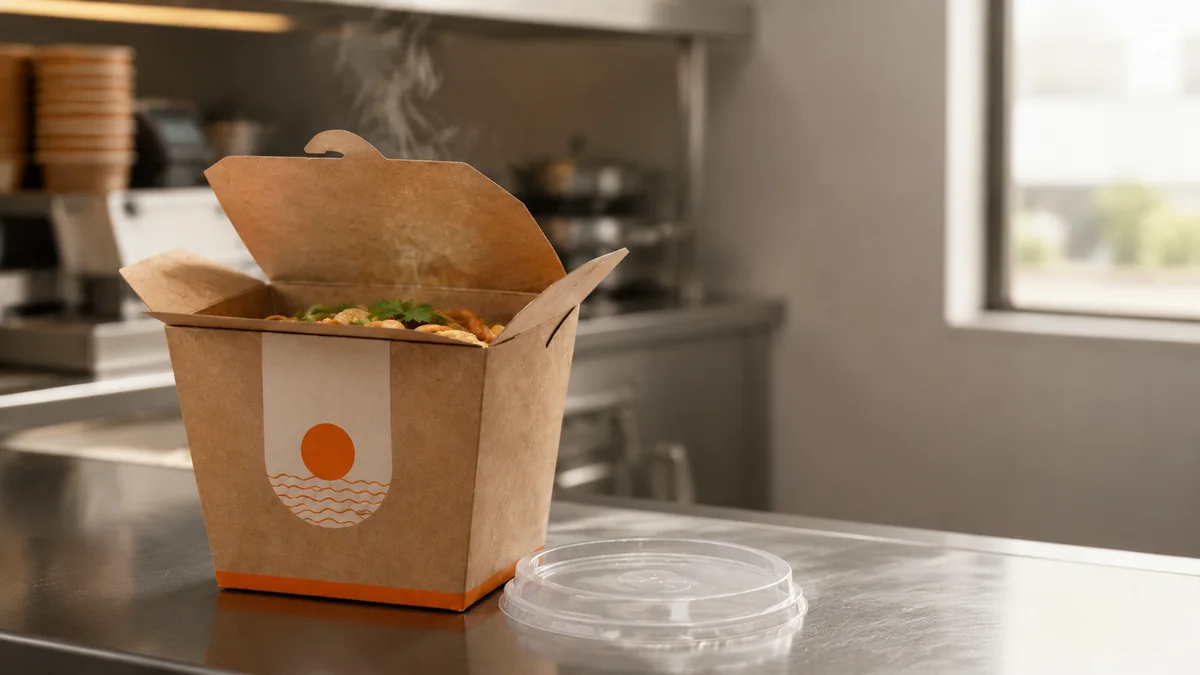
Soup Containers for UK Takeaways: What to Check Before Ordering
If you run a UK takeaway that sells soup, ramen, curry, or any broth-based dish, the container you pack it in matters more than almost any other packaging decision you make. A leaking soup pot turns a £12 order into a refund, a bad review, and a customer who orders from your competitor next time. Yet most operators order soup containers based on price alone, without checking the four or five things that determine whether the pot actually does its job.
That is what this guide covers. You will learn which materials hold up to hot liquids, what lid types actually seal, how to match container size to your portion, and what UK regulations mean for your choice. By the end, you will have a checklist you can take straight to your supplier.
Key Takeaways:
- Kraft paper with a PE or PLA lining is the most popular soup container material in the UK, balancing cost, leak resistance, and heat tolerance for delivery runs up to 30 minutes.
- PP plastic lids outperform pulp lids on leak-proofing for liquid-heavy dishes, especially when stacked during delivery — the difference is real and measurable.
- Bagasse containers read as "eco-friendly" to customers but absorb moisture over long delivery windows; they are best for dine-in or short-radius delivery, not cross-town runs.
- Under the UK's new Simpler Recycling rules (March 2026), compostable plastics including PLA-lined containers are not collected in food or recycling waste streams — they go to general waste.
- Always test soup containers with your actual hottest, thinnest broth before committing to a bulk order. A 5-minute pour test saves weeks of complaints.
Why Standard Takeaway Boxes Fail With Soups and Broths
Standard takeaway boxes, the kind you would use for chips or a burger and chips combo, are built for solid and semi-solid food. They rely on structural rigidity rather than seam integrity. That works fine when the contents stay in one place. It fails the moment a thin, hot liquid like tom yum broth or chicken soup sloshes against the corners during a delivery ride.
The failure points are predictable. Corner seams separate under heat and moisture. Lids pop off when stacked. Grease and water vapour soften the board from the inside, turning a sturdy box into a soggy mess within 15 minutes. Ali, who runs a small Indian takeaway in Leicester, learned this the hard way. He switched from his regular curry containers to a cheaper "multi-purpose" box for a soup promotion. By the end of the first week, he had processed 23 refunds for leaking orders. The £18 he saved on the cheaper boxes cost him over £300 in lost revenue and refunds.
Soup containers are designed differently. They have sealed sidewalls, reinforced bases, and lids that create a mechanical lock rather than a friction fit. The material is chosen specifically to resist hot liquid penetration for the expected delivery window. When you understand these design differences, you stop seeing soup containers as interchangeable with other takeaway boxes.
Soup Container Materials: What Is Available in the UK Market
UK suppliers now offer four main materials for soup containers. Each has genuine trade-offs, and none is the right answer for every operation. Your choice depends on your menu, your delivery radius, and what your local waste contractor actually accepts.
Kraft Paper with PE Lining
This is the workhorse of UK soup containers. A kraft paper outer gives the pot structure and a natural, premium look. A thin polyethylene lining on the inside creates the moisture barrier. These containers handle hot fill temperatures up to around 85 degrees Celsius and perform reliably for delivery windows of 30 to 40 minutes. They are microwave-safe, freezer-safe, and widely available from UK suppliers at competitive prices.
The PE lining means these containers are recyclable in the paper and card stream after rinsing, though in practice not every UK council accepts them. Packaging Environmental, one of the larger UK suppliers, sells a 26oz kraft brown soup bowl at around 11 pence per unit in case quantities of 360, with matching lids sold separately at similar pricing.
The main limitation is that these containers are not compostable. The PE layer, while thin enough to qualify for Plastic Packaging Tax exemption (under 10 percent of total pack weight), prevents them from breaking down in commercial composting facilities. If your customer base actively checks disposal claims, you may want a different option.
Kraft Paper with PLA Bioplastic Lining
PLA, or polylactic acid, is a plant-based polymer made from corn starch or sugarcane. When used as the inner lining of a kraft soup container, it replaces the PE layer with a compostable alternative. The container looks identical from the outside. The difference is at end of life: PLA-lined containers carry EN13432 certification for industrial compostability, meaning they break down within 12 weeks in a commercial composting facility.
The practical reality is more complicated. As of March 2026, the UK's Simpler Recycling legislation means compostable plastics including PLA are not collected in food waste or dry recycling streams by most councils. They go to general waste. The environmental benefit only materialises if your customer has access to a commercial composter that accepts packaging and if they actually put the container in the right bin. For most UK takeaway customers, a PLA-lined container and a PE-lined container end up in the same waste stream.
PLA-lined containers cost more per unit. A 32oz PLA kraft bowl runs around 15 pence per unit in bulk, compared to about 12 pence for the PE equivalent. The heat performance is similar, though PLA softens slightly earlier than PE at sustained high temperatures above 80 degrees Celsius. For most soup applications, the difference is negligible.
Bagasse (Sugarcane Fibre)
Bagasse is the dry fibrous residue left after sugarcane stalks are crushed for juice. Moulded into containers, it creates a sturdy, natural-looking pot with strong eco credentials. Bagasse is home and industrially compostable, PFAS-free by default, and handles temperatures up to 120 degrees Celsius. It goes from freezer to microwave without degrading.
The trade-off is moisture absorption. Bagasse is a fibre product. Over extended contact with hot liquid, it absorbs some moisture and softens slightly. For a dine-in soup served and eaten within 15 minutes, this is irrelevant. For a delivery order that spends 30 minutes in a driver's insulated bag followed by 10 minutes on the customer's doorstep, the softening can be enough to compromise structural integrity, especially if the container is stacked under other items.
Simon runs a pho kitchen in Manchester that delivers within a 2-mile radius. He uses bagasse containers because his orders rarely spend more than 15 minutes in transit and his customers actively choose his business for its sustainability positioning. For his operation, the material works. For a takeaway delivering 5 miles across town, it probably does not.
Polypropylene (PP) Plastic
PP containers are the most leak-proof option available. The material creates a complete moisture barrier, handles hot fill temperatures up to 90 degrees Celsius, and resists oil and grease penetration completely. Tamper-evident PP containers with snap-on lids are standard for higher-end soup and broth delivery because they virtually eliminate the risk of in-transit leakage.
The downsides are environmental perception and end-of-life handling. PP is widely recyclable in UK kerbside collections, and most UK councils accept PP pots, tubs, and trays. But it is not compostable, and some customers perceive plastic negatively regardless of recyclability. A clear PP container with recycling instructions printed on the lid can help bridge this gap.
Cater4You sells a 670ml tamper-proof PP container at around 45 pence per unit, though bulk pricing brings this down. The higher unit cost is partly offset by near-zero failure rate: you are not processing refunds for leaks.
Sizing Guide: Matching Container Volume to Your Menu
Soup container sizes in the UK are typically measured in fluid ounces or millilitres. The most common sizes and their typical uses are as follows.
8oz (227ml) containers are for starters, sides, children's portions, and sauce pots. They are too small for a main-course soup but useful as an add-on size. 12oz (350ml) works for small lunch portions, typically served with bread or a side. 16oz (475ml) is the standard individual soup portion for most UK takeaways and deli counters. This is your anchor size. 26oz (750ml) handles hearty main-meal soups, ramen bowls, and curry portions. It is the most popular size among full-menu takeaway operators. 32oz (1,000ml) suits large portions, sharing pots, and meal-prep containers. 42oz (1,300ml) is a catering and family-size format, less common for individual orders.
A practical approach is to stock three sizes: 12oz for smaller soups and sides, 16oz as your standard, and 26oz for large portions. This covers most menus without overcomplicating your inventory. Before committing to a size, fill the container with your actual soup portion and check the headspace. You need at least 10 millimetres of clearance below the lid to prevent spillage during transit and allow for expansion if the customer freezes the container.
Lid Types and Leak-Proof Performance
The container body gets most of the attention in buying decisions. The lid does most of the work in preventing leaks. There are three main lid types available for UK soup containers, and they perform very differently.
PP plastic lids with a snap-on rim are the most reliable. They create a mechanical seal that holds even when the container is tipped or stacked. For thin broths and high-liquid curries, PP lids are the safest choice. They also allow customers to see the contents when using a clear lid on a kraft container, which speeds up packing during busy service.
Pulp or bagasse lids match the eco positioning of fibre containers but do not seal as effectively. They rely on friction fit rather than mechanical lock, which means they can pop off if the container flexes during handling. They work adequately for thicker soups and stews served in dine-in settings. For delivery of thin liquids, they carry a higher failure risk.
PE-coated paper lids sit between the two. They seal better than pulp lids and cost less than PP, making them a reasonable middle-ground option for operators who want better leak resistance than pulp without switching to plastic.
Rachel runs a small ramen shop in Bristol. She tested all three lid types with her tonkotsu broth, which is thin and oily. The pulp lids failed within 10 minutes of simulated delivery movement. The paper lids held for about 20 minutes before showing seepage at the edges. The PP lids held with zero leakage after 45 minutes of agitation. She now uses PP lids exclusively for delivery orders and keeps paper lids for dine-in, where the container sits flat on a tray rather than bouncing around in a delivery bag.
Heat Retention: Keeping Soup Hot During UK Delivery Runs
A soup container has two jobs: contain the liquid and keep it hot. The second job matters as much as the first because cold soup gets sent back, regardless of how well the container held up.
Double-wall kraft construction provides the best heat retention among paper-based options. The air gap between the inner and outer walls slows heat transfer, keeping contents warmer for longer. Single-wall containers, even thick ones, lose heat faster and can become uncomfortable to hold with hot contents. If your delivery radius exceeds 3 miles, double-wall construction is worth the premium.
Insulated delivery bags are part of the equation. Even the best soup container loses heat quickly in an uninsulated bag, especially during UK winter months when ambient temperatures drop below 5 degrees Celsius. Operators who invest in quality soup containers but use worn-out delivery bags undermine their own spending.
There is a practical limit to what packaging can achieve. If your average delivery time exceeds 45 minutes, no disposable container will keep soup at serving temperature without active heating. For these longer runs, consider offering a reheat instruction on the container lid alongside a quality assurance message: "Delivered hot. If it has cooled, microwave for 90 seconds. Our containers are microwave-safe."
UK Regulations That Affect Your Soup Container Choice
Regulatory compliance for UK food packaging has changed significantly in the past two years. Four pieces of legislation now affect what soup containers you can buy and what claims you can make about them.
The Plastic Packaging Tax, introduced in April 2022 and now in its fourth year, applies a charge of approximately £217 per tonne to plastic packaging that contains less than 30 percent recycled content. For soup containers with a PE lining, the tax applies to the liner. Many UK suppliers have reformulated their PE linings to include recycled content or kept the liner thin enough to fall below the de minimis threshold. Ask your supplier for their Plastic Packaging Tax status before ordering.
The single-use plastic ban that took effect in England in October 2023 targets polystyrene and PVC containers. It does not directly ban PP soup containers or PE-lined paper containers, which remain permitted. However, some local authorities have introduced additional restrictions, and the regulatory direction is clearly toward further restriction of single-use plastics. Choosing containers that carry clear recyclability labelling positions your business ahead of future changes.
Simpler Recycling, the UK's new standardised waste collection framework, came into full effect on 31 March 2026. Under these rules, compostable and biodegradable plastics including PLA are not collected in food waste or dry recycling streams. This means PLA-lined soup containers, despite carrying EN13432 compostability certification, are classified as general waste for most UK households. The environmental claim you make on your menu or website should reflect this reality. Stating that a PLA-lined container is "compostable" without clarifying that it requires industrial composting and is not accepted in kerbside collections may expose your business to greenwashing complaints under CMA guidance.
Extended Producer Responsibility or EPR, which shifts the cost of packaging waste management from local authorities to producers, is being phased in. For takeaway operators buying packaging, the relevant point is that EPR fees are now embedded in supplier pricing for obligated packaging. Your supplier should be able to tell you what EPR band your containers fall into and what fee is included in the unit price.
What to Ask Your Supplier Before You Order
Most packaging suppliers will send you a sample box when you ask. Take them up on it, but do not just look at the samples. Test them. Here is a checklist to work through.
Pour your thinnest, hottest soup into the container, seal it, and tip it sideways over a sink. Hold it there for 30 seconds. If anything drips, the lid or seam has failed. This is a pass-or-fail test. Fill a container, seal it, and place it in a delivery bag with a 2-kilogram weight on top. Leave it for your average delivery time plus 10 minutes. Open it and check for deformation, softening, or leakage at the corners. This simulates real delivery conditions.
Ask the supplier for the full specification sheet, not just the marketing description. You want the material composition including liner type and percentage, the temperature rating for both hot fill and microwave use, the EN13432 or other compostability certification number if eco claims are made, the Plastic Packaging Tax status, and the EPR fee band.
If you plan to brand your soup containers, ask about minimum order quantities for custom print. Most UK suppliers require a minimum of 1,000 to 5,000 units for direct print, though branded stickers are usually available from 1,000 pieces and can be applied to plain stock at lower cost. Check the print area available on the container body. Some soup pots have limited printable surface due to their tapered shape.
Finally, ask about stock continuity. The supplier that quotes the lowest per-unit price today may not have the same product in stock next month if they source opportunistically from different manufacturers. A consistent container matters for your operation. If the lid fit changes between batches because the supplier switched factories, you will find out through customer complaints, not from the supplier.
Frequently Asked Questions
What is the best material for soup takeaway containers in the UK? Kraft paper with a PE lining offers the best balance of leak resistance, heat tolerance, and cost for most UK takeaways. If your delivery radius is short and your customers value sustainability, bagasse is a strong alternative. For maximum leak-proofing with thin broths, PP plastic containers are the safest choice.
Are paper soup containers recyclable in the UK? PE-lined paper soup containers are technically recyclable in the paper and card stream after rinsing, but acceptance varies by council. PLA-lined containers require industrial composting and are not accepted in kerbside recycling or food waste collections under the 2026 Simpler Recycling rules. Check your local council's website for specific guidance.
How do I stop soup containers from leaking during delivery? Use containers with a mechanical snap-on lid rather than a friction-fit lid. PP plastic lids provide the strongest seal. Ensure at least 10 millimetres of headspace between the soup surface and the lid. Pack soup containers upright in the delivery bag and avoid stacking heavy items on top of them.
What size soup container should a UK takeaway use? A 16oz (475ml) container is the standard individual soup portion size for most UK takeaways. Stock 12oz for smaller portions and sides, 16oz as your main size, and 26oz for large or main-meal portions.
Can I microwave paper soup containers? Yes, most kraft paper soup containers with PE or PLA linings are microwave-safe up to 100 degrees Celsius at 800 watts. Loosen the lid before microwaving. Bagasse and PP containers are also microwave-safe. Always check the supplier's specification sheet for the specific product you are buying.
Are compostable soup containers actually composted in the UK? In most cases, no. The UK has limited industrial composting infrastructure that accepts packaging, and under the 2026 Simpler Recycling rules, compostable plastics including PLA are routed to general waste rather than food or garden waste collections. A PLA-lined soup container placed in a customer's general waste bin will most likely be incinerated or landfilled, not composted.
How to Choose Soup Containers That Work for Your Takeaway
The right soup container for your operation depends on three things: what you serve, how far you deliver, and what your customers actually do with the empty pot. A thick lentil soup and a thin chicken broth place very different demands on packaging. A 1-mile delivery radius and a 5-mile radius are different engineering problems. A customer base that mostly eats at home versus one that eats on the go changes what disposal claims matter.
Start with the liquid test. If your thinnest soup leaks through your current container, upgrade to a PE-lined kraft or PP option with a snap-on lid. If it holds, move on to the delivery simulation: pack the container, stack weight on it, wait your average delivery time, and inspect for softening or deformation. If the container passes both tests, the spec is right for your operation.
Then check the cost per unit against your margin. Soup containers are a consumable, and their cost sits in your cost of goods sold. A 12-pence PE-lined kraft bowl might be all you need if your delivery radius is tight. A 45-pence tamper-proof PP container might be justified if one refunded order costs you more than the packaging upgrade for 20 orders.
Finally, align your disposal claims with reality. If you market your packaging as compostable, know whether it is home or industrial compostable and whether your customers can actually access a suitable facility. Under current UK regulations, "recyclable" with clear labelling is often more honest and more practical than "compostable" with caveats.
For help choosing soup containers that match your menu, your delivery setup, and your budget, request a quote from our packaging specialists. We stock kraft, bagasse, and PP soup containers in sizes from 8oz to 42oz with matching lids, and we can advise on the right spec for your specific operation.