
Branded Napkins for UK Cafes and Restaurants — Complete Buying Guide
Custom printed napkins for UK cafes, restaurants and takeaways. Compare 1-ply vs 2-ply vs 3-ply, print options, pricing from 1,000 to 25,000 units, and find UK suppliers. Full buying guide.
Filed under Buying Guides.
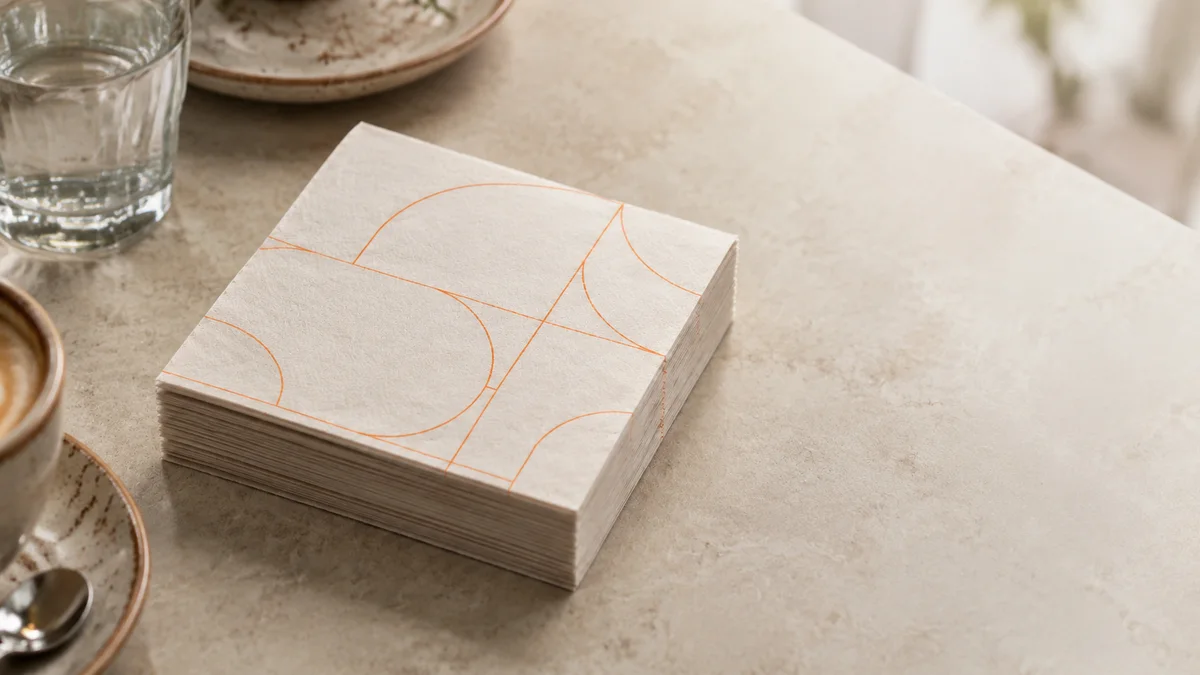
Custom napkins are the cheapest branding move a cafe, restaurant, or takeaway can make — and most operators overlook them completely. A branded napkin sits next to every plate, wraps every set of cutlery, and goes into every takeaway bag. For roughly a penny more per unit than a plain napkin, every customer who walks through your door leaves carrying your logo.
If you run an independent UK cafe, small restaurant, or takeaway, here's what you need to know: branded napkins cost between £0.02 and £0.45 per unit depending on quantity, ply, and print complexity. Minimum orders start at 1,000 units from UK printers like Navillus and Hound Promotions, or as low as 120 pieces from print24 if you're testing a design. The whole process — from sending your logo to holding a finished napkin — takes two to three weeks on standard turnaround.
But most operators get the spec wrong. They order the wrong ply for their service style, pick a print that bleeds or fades, or skip napkins entirely because they assume the minimums are too high. This guide walks through every decision: what ply actually means in a busy service, which print method lasts through a shift, what you'll pay at different volumes, and how to place an order that arrives on time and looks right.
Key Takeaways
- Branded paper napkins add 1-2p per unit over plain stock at volumes above 5,000 — making them one of the cheapest brand touchpoints in foodservice.
- 2-ply is the sweet spot for most UK cafes and restaurants: substantial enough to feel premium, cheap enough for daily use.
- Minimum orders start at 1,000 units from UK-based printers — or 120 from online platforms if you just want to test.
- 1-colour print on a standard white napkin is the most cost-effective spec; full-colour digital is best saved for 10,000+ unit runs.
- Most UK printers quote 2-3 weeks lead time from artwork approval; factor in another week for proofing if it's your first order.
Why Branded Napkins Work Harder Than You Think
Tom runs a small brunch spot in Bristol. He spent £900 on branded coffee cups and another £400 on stamped paper bags. Napkins were an afterthought — he grabbed whatever was cheapest from Booker. Then his wife pointed out that every table had a coffee cup with their logo and a napkin with someone else's. "That napkin is on the table longer than the cup," she said. "And it's in every photo."
She was right. A branded coffee cup leaves the cafe. A branded napkin stays on the table for 20, 30, sometimes 45 minutes. It sits in the frame when someone photographs their avocado toast. It gets tucked into a handbag as a keepsake at a wedding reception. It's the quietest, cheapest billboard in hospitality.
Napkins hit three branding moments that cups and bags miss. First, the table moment — every plate, every drink, every set of cutlery lands on or next to a napkin. Second, the photo moment — food photos on Instagram and Google Maps reviews almost always include the napkin. Third, the takeaway moment — a napkin tucked into a delivery bag travels to someone's home or office, where it sits on a desk for the rest of lunch.
Napkins also signal care. A plain white napkin says "I ordered the cheapest option available." A branded napkin says "I thought about every detail." In a market where most independent UK cafes use unbranded napkins, a printed one immediately separates you from the crowd.
Ply, Size, and Fold: The Three Specs That Actually Matter
When you order branded napkins, you're making three decisions that change the cost and the customer experience: ply, size, and fold. Get these right and the napkin feels intentional. Get them wrong and you've paid for branding on something that falls apart before the main course arrives.
Quick Spec Comparison
| Spec | Best For | Cost Impact | Notes |
|---|---|---|---|
| 1-ply | Cafes, bars, espresso counters | Cheapest (£0.01-0.02/unit plain) | Tears easily with wet hands; fine for quick service |
| 2-ply | Most cafes, casual restaurants, takeaways | Standard (£0.02-0.05/unit branded) | The sweet spot — substantial enough, cheap enough |
| 3-ply | Hotels, weddings, fine dining | Premium (£0.20-0.45/unit branded) | Cloth-like feel; worth it above £30 cover |
| Cocktail (20-25 cm) | Drinks, canapes, espresso | Smallest/cheapest | Fits under a glass; too small for food |
| Lunch (30-33 cm) | General table service | The standard size | Fits sandwich, cake, soup bowl |
| Dinner (40 cm) | Full meals, events | Largest/most expensive | Covers a lap; 3-course service |
| Quarter-fold | Table service | Standard | Square, neat next to cutlery |
| Eighth-fold | Dispensers, counters | Standard | Narrow shape reduces customer waste |
Ply: 1-Ply, 2-Ply, or 3-Ply
Ply is the number of tissue layers pressed together to form the napkin. More ply means more thickness, more absorbency, and more cost.
1-ply napkins are the cheapest option. They're thin, they tear easily with wet hands, and they feel disposable in exactly the wrong way. For a cafe serving espresso and pastries, 1-ply is fine — the napkin gets used once and binned. For a restaurant serving a three-course meal, 1-ply will disintegrate by the starter.
2-ply is the standard for most UK foodservice. It's thick enough to handle greasy fingers, absorb a spilled drink, and survive being tucked into a takeaway bag. Most operators choose 2-ply because it balances cost and quality. A 2-ply branded napkin at 33 x 33 cm costs roughly £0.02-0.05 per unit at 5,000+ quantity from UK printers — the sweet spot most independents should target.
3-ply napkins are the premium option. They're thick, soft, and cloth-like. Hotels, wedding venues, and fine-dining restaurants use 3-ply because the napkin is part of the experience. At lower quantities (1,000-2,000 units), 3-ply napkins cost £0.20-0.45 each. That drops fast as volume rises. If your average cover is above £30, 3-ply is worth the upgrade. If your average cover is below £12, 2-ply is plenty.
Size: Cocktail, Lunch, or Dinner
Napkin sizes follow a standard pattern across UK suppliers, though exact millimetres vary slightly between printers.
Cocktail napkins (20 x 20 cm to 25 x 25 cm) are the smallest standard size. They're designed for drinks service — under a gin and tonic, next to an espresso cup, or handed out with canapes. They're also the cheapest to print because you fit more per sheet. For cafes and bars, cocktail napkins are usually the right choice.
Lunch napkins (30 x 30 cm to 33 x 33 cm) are the workhorse of UK foodservice. They're large enough for a sandwich and crisps, a slice of cake, or a bowl of soup. Most cafes, casual restaurants, and takeaways use lunch napkins as their standard. If you only order one size, make it this one.
Dinner napkins (40 x 40 cm) are for proper meals — three courses, wine, and a tablecloth. They unfold to cover a lap and have enough surface area to handle a full meal's worth of wiping. They're more expensive and take up more storage space, so they're usually reserved for evening service or special events.
Fold: Quarter, Eighth, or Custom
The fold determines how the napkin sits on the table and how it comes out of the dispenser.
Quarter-fold napkins are folded in half twice, creating a square roughly the size of a coaster. They're the most common fold for table service — easy to pick up, easy to stack, and they look neat next to cutlery. Most UK restaurants use quarter-fold napkins.
Eighth-fold napkins are folded three times, creating a narrow rectangle. They're designed for dispenser use — the narrow shape lets you pull one napkin at a time without grabbing three. High-volume cafes and quick-service counters prefer eighth-fold because it reduces waste: customers take one napkin instead of a handful.
Custom folds exist — tri-fold, pocket fold, even fan folds for events — but they add cost and lead time. For the vast majority of operators, quarter-fold or eighth-fold covers every need.
Print Options: 1-Colour Flexo, Full-Colour, or Foil
Once you've picked the napkin spec, you choose how your logo appears on it. The print method determines the look, the cost, and the minimum order quantity.
1-Colour Flexographic Print
This is the most common option for branded napkins and usually the most cost-effective. Your logo is printed in a single Pantone colour — black, navy, red, or your brand colour — typically in the corner of the napkin. Some printers offer edge-to-edge repeating patterns in 1 colour, but corner placement is standard.
1-colour flexo works best for simple logos and wordmarks. If your brand is "Bean & Brew" in a bold sans-serif, 1-colour print will look sharp and clean. If your logo has gradients, photographs, or more than one colour, you'll need to step up.
The cost difference is significant. At 5,000 units, a 1-colour branded napkin might cost £0.03 per unit. The same napkin in full-colour could be £0.06-0.08. Over a year of orders, that adds up to hundreds of pounds.
Full-Colour (CMYK) Print
Full-colour napkin printing uses digital or offset presses to reproduce photographs, gradients, and multi-colour artwork. The result is vibrant and detailed — your latte art photo, your illustrated logo, your patterned design all print cleanly.
The catch: full-colour printing typically has a much higher minimum order — often 10,000 units and up. Some online platforms now offer full-colour from 500-1,000 units at a premium per-unit price. For large events, product launches, or brands with complex visual identities, full-colour is the way to go. For everyday service, 1-colour is usually enough.
Foil and Specialty Finishes
Gold, silver, or rose-gold foil stamping on napkins creates a premium, tactile finish. It's popular for weddings, luxury hotels, and high-end patisseries where the napkin is part of the presentation. Foil adds roughly 30-50% to the per-unit cost and typically requires a minimum order of 5,000 units. Expect a longer lead time — foil stamping adds an extra week to production.
What Branded Napkins Actually Cost at Different Volumes
Napkin pricing follows steep volume breaks. The difference between 1,000 and 5,000 units can cut your per-unit cost in half. These prices are based on a 2-ply, 33 x 33 cm, quarter-fold white napkin with 1-colour corner print, as quoted by UK printers in mid-2026.
At 1,000 units, expect to pay £0.20-0.30 per napkin (£200-300 total). The setup cost — creating the printing plate and mixing your ink colour — is amortised over a small run, so the per-unit price is highest here. Some printers won't even quote below 1,000 units for flexo print.
At 5,000 units, the price drops to £0.03-0.06 per napkin (£150-300 total). This is the volume where branded napkins start making obvious financial sense. The setup cost is spread thinner, and the printing runs more efficiently. For a busy cafe going through 500 napkins a day, 5,000 units is about 10 days of stock.
At 10,000 units, you're paying £0.02-0.04 per napkin (£200-400 total). At this volume, the premium over plain unprinted napkins shrinks to roughly a penny per unit. A cafe spending £12 on a case of 1,000 plain napkins is now spending about £20-30 for branded — an £8-18 difference for 1,000 brand impressions.
At 25,000+ units, per-unit costs reach their floor — roughly £0.01-0.03 for standard 2-ply. Orders at this scale usually come from multi-site operators, caterers serving large events, or chains.
Important: these prices assume a standard white napkin with 1-colour print. Coloured base paper (black, kraft, any Pantone shade) adds roughly 15-25% to the unit cost. 3-ply roughly doubles the ply cost. Full-colour print roughly doubles the print cost. If your spec is a 3-ply black napkin with full-colour digital print, you're looking at the top end of every range.
Lead Times and the Ordering Process
The typical timeline from "I should order branded napkins" to holding them in your hand is three to four weeks for a first order, and two to three weeks for reorders.
Week 1: Get quotes from two or three suppliers. You'll need your logo file (vector format — AI, EPS, or PDF — is best; high-res PNG or JPG at 300 dpi also works), your preferred napkin spec, and your quantity. Most UK printers quote within 24 hours.
Week 1-2: Artwork proofing. The printer sends a digital mockup showing how your logo will look on the napkin — placement, size, colour. Review it carefully. Check that the logo is centred, the colour looks right, and there are no typos. One common mistake: logos designed in RGB (screen colours) can shift when printed in CMYK or Pantone. If colour accuracy matters — and it should — ask the printer to confirm the Pantone reference they'll use.
Week 2-4: Production. Once you approve the proof, the printer makes the plates and runs the job. Production typically takes 10-15 working days for standard orders, less for express service. Larger orders or foil finishes add time.
Week 4+: Delivery. Most UK printers ship via courier (DPD, DHL, or pallet delivery for large orders). Factor in 2-3 working days for delivery. Always order before you're critically low — running out of branded napkins and having to use plain ones from the cash-and-carry undercuts the whole exercise.
Storing Your Napkins
Branded napkins arrive in boxes — usually 500 or 1,000 per box. If you've ordered 10,000 napkins, that's 10-20 boxes. They need a dry, cool storage area away from direct sunlight (UV can fade the print over time) and away from kitchen grease and moisture. For cafes with limited storage, 5,000 napkins in quarter-fold take up roughly two archive-box-sized cartons. Factor this in before ordering — there's no point saving money on a 25,000-unit order if you have to store them in the customer toilet.
Eco Options: What "Compostable" and "Recycled" Actually Mean for Napkins
The sustainability story for napkins is simpler than for most packaging because paper napkins are inherently compostable — they're made from wood pulp with no plastic lining. But there are choices that matter.
FSC-Certified Paper: Look for FSC (Forest Stewardship Council) certification on your napkin order. It means the wood pulp came from responsibly managed forests, not illegal logging or deforestation. Most UK printers offer FSC-certified stock as standard now — it's worth confirming.
Recycled Content: Some napkins use post-consumer waste (PCW) paper — recycled office paper, cardboard, and other paper waste. Recycled-content napkins are typically slightly greyer than virgin pulp napkins and may be marginally less soft, but the environmental benefit is real. Bunzl's TableSMART range switched to 100% recycled material in 2026, saving a claimed 359 tonnes of virgin material annually.
Chlorine-Free Bleaching: Standard white napkins are bleached with chlorine compounds. Chlorine-free bleaching (TCF or ECF) uses oxygen or hydrogen peroxide instead, reducing dioxin pollution. If your brand markets itself as eco-conscious, chlorine-free napkins are a meaningful differentiator.
Home Compostable vs. Industrially Compostable: All uncoated paper napkins are home compostable — they'll break down in a garden compost heap within weeks. This is a genuine advantage over coated packaging like PE-lined cups. You can (and should) tell your customers this directly — a small sign on the table or a note on your menu: "Our napkins are home compostable. Pop them in your food waste bin."
UK Suppliers Worth Calling
Navillus (print-gifts.com) is a UK-based printer with a solid range of branded napkin options. They offer 24 colour choices, 1-colour or full-colour print, and a clear pricing structure with setup charges quoted upfront. Their MOQ for paper napkins is around 1,000-5,000 units depending on the spec.
Hound Promotions is another British manufacturer, producing branded napkins from 1,000 units with up to 4-colour print. They're worth contacting for mid-volume orders where you want a UK-made product with reliable lead times.
Green Box (ecobiopack.co.uk) focuses on eco-friendly packaging and offers FSC-certified, chlorine-free printed napkins. Their MOQ starts around 1,200 units for 33 x 33 cm 2-ply. If sustainability is central to your brand, they're the natural starting point.
Print24 (print24.com) offers the lowest online MOQ — 120 pieces of 3-ply, 33 x 33 cm from around £54. It's a good option for testing a design before committing to a larger run, though the per-unit price is high at this volume.
BioPak (biopak.com/uk) supplies compostable napkins alongside their wider eco-packaging range. Their napkins are available in black and white, 2-ply, with a free design service included. They're a good fit if you're already ordering BioPak cups or containers and want one supplier.
Frequently Asked Questions
Do I need to supply print-ready artwork or can the printer design something for me? Most UK napkin printers include a basic design service — send your logo and they'll position it on a template and send a proof. If you have a specific layout in mind, provide a rough sketch or reference image. Full custom illustration or logo design is usually charged separately if you need it.
How long do branded napkins take from order to delivery? Budget three to four weeks for a first order, including artwork proofing. Reorders with the same artwork typically take two to three weeks. Express services can cut this to one to two weeks for an additional fee, usually 20-30% on top of the standard price.
Can I mix sizes or colours in one order to reach a volume discount? Most printers allow you to split an order across sizes — for example, 3,000 cocktail and 2,000 lunch napkins to hit a 5,000-unit price break — as long as the artwork is the same. Colour variations usually count as separate print runs. Ask your printer about their mixing policy when you quote.
Will the ink come off on my customers' hands? No — foodservice napkin inks are water-based and bonded to the tissue fibre. They're food-contact safe (compliant with EU Regulation 1935/2004) and do not transfer with normal use. If a customer wipes their mouth with the printed area, there's no health risk and no colour transfer.
What's better for a small cafe: 1-ply branded or 2-ply plain? 2-ply branded, every time. The branding cost is incremental once you're above 5,000 units, and the customer experience difference between 1-ply and 2-ply is immediately noticeable. A 2-ply branded napkin feels intentional. A 1-ply plain napkin feels like you're cutting corners.
If You Skip Everything Else
Order 2-ply, 33 x 33 cm, quarter-fold, white, with a 1-colour corner print of your logo. Start at 5,000 units. Expect to pay £150-300 total, wait three weeks, and receive roughly five cartons of napkins that will make every table in your cafe look more professional than it did the day before.
Branded napkins won't single-handedly transform your business. But they're the cheapest and most consistent brand impression you can make — and almost none of your competitors are doing it. That's the opportunity.
If you're ready to order or want to compare napkin specs alongside your other packaging, send us your logo and we'll quote printed napkins, cups, bags, and boxes in one go. Same artwork across every item, one point of contact, one delivery.