
Low MOQ Custom Packaging Guide: How UK Small Businesses Can Order Branded Packaging
Low MOQ custom packaging is real. This guide covers minimum order quantities per product category, real pricing examples, artwork tips, and how UK small businesses can get branded packaging from 250 units.
Filed under Buying Guides.
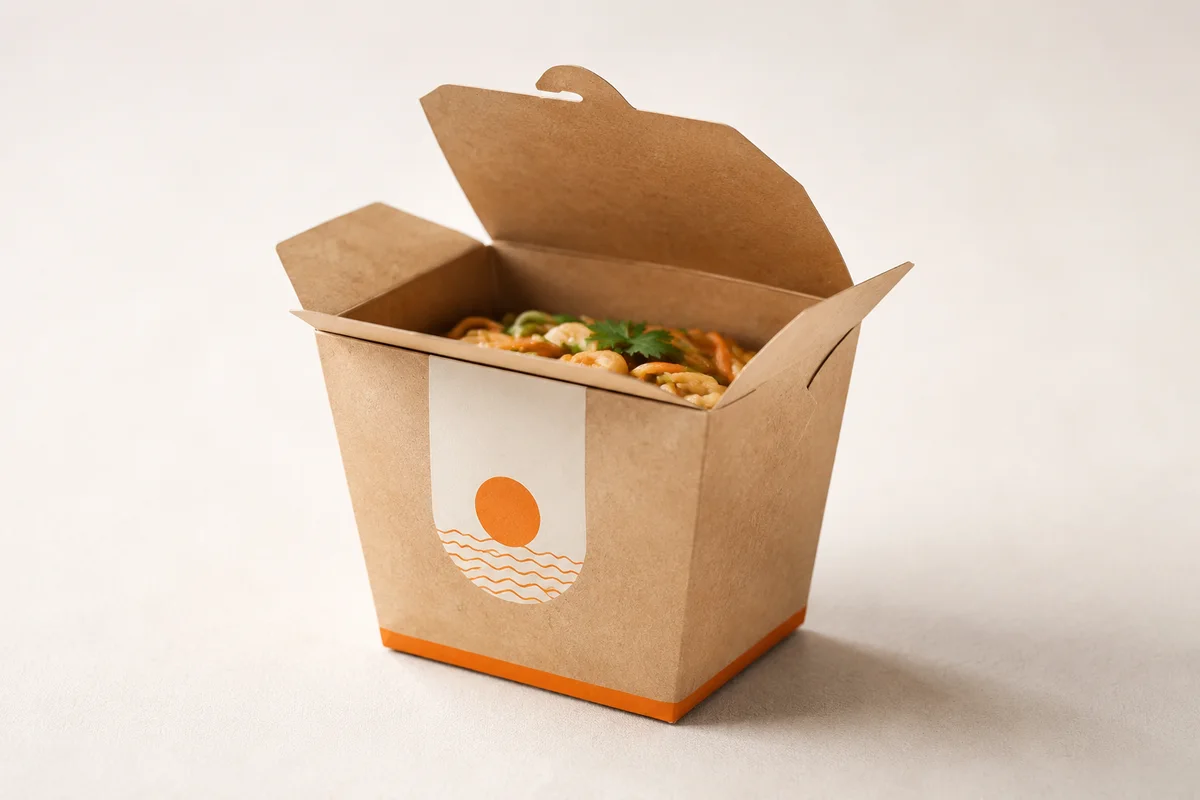
Key takeaways- OkeyPackaging's low MOQs start at 250 units for printed boxes, 500 for paper bags, and 1,000 for paper cups -- well below the industry standard of 5,000--10,000.
- We keep minimums low throughdigital printing(no expensive plates), shared production batching, and UK-based manufacturing that cuts logistics overhead.
- The per-unit cost difference between a low MOQ and a bulk order is often 2--4p per item, not the 10--20p many small business owners expect.
- Free artwork setup and no-charge design checks mean you do not need a graphic designer to get started.
- Sample orders are available before you commit to production, so you can check print quality, material, and fit in your own hands.
If you run an independent cafe, a street food trailer, a small bakery, or any food business that serves fewer than a few hundred customers a day, you have almost certainly hit the MOQ wall. A supplier tells you their minimum order is 10,000 printed cups. They need 5,000 boxes before they can set up the print run. You think about the storage space you do not have, the cash you cannot tie up, and you walk away from custom packaging entirely.
That is the norm in packaging manufacturing. It is not a law of physics, and it does not have to be your reality.
This guide explains why most suppliers demand high minimums, how OkeyPackaging structures its business to work at lower volumes, and exactly what MOQ you can expect for each product category. By the end, you will know whether custom packaging is viable for your business right now -- and how to get started without overcommitting.
Why Most Suppliers Demand High MOQs
To understand why low MOQ is unusual, you need to see the cost structure behind a packaging order. A supplier who quotes you a minimum of 10,000 units is not being difficult for the sake of it. They are working within a production model built for scale.Plate and tooling costs.Flexographic printing (the standard for most packaging) uses a metal or polymer printing plate for each colour in your design. A four-colour print run needs four plates, and each plate costs 40--80 GBP to produce. On a run of 10,000 cups, that setup cost is pennies per unit. On a run of 500 cups, it would be 20--30p extra per cup -- and the supplier knows most customers will not pay that.Die cutting and tooling.If your packaging needs a specific shape -- a takeaway box with a locking tab, a pizza box with a ventilation slit, a cake box with a viewing window -- the supplier needs a custom die. A steel rule die can cost 200--500 GBP. That cost gets amortised across the print run. For a supplier who runs 50,000 units at a time, the die cost is negligible. For a smaller run, it represents a significant chunk of the total order value.Press setup and changeover time.Every time a production line switches from one product to another, it stops producing. The line needs cleaning, the plates need changing, the registration needs adjusting. A 30-minute changeover costs the supplier real money in lost production time. They would rather run one 50,000-unit job than five 10,000-unit jobs, because the changeover cost hits them five times.Material minimums.Paper mills and film extruders sell to packaging converters in full pallets or tonnes. A mill might require a minimum order of two tonnes of a specific paper weight. For a small supplier, that two tonnes becomes 200,000 cups or more. For a converter that only works at that scale, there is no way to offer low MOQ -- they have to use the material somewhere, and passing the material minimum down the chain is how they make the numbers work.
These four costs -- plates, dies, changeover, and materials -- are the real reasons high MOQ exists. They are not arbitrary. But they are also not inevitable, provided you structure production differently.
How Low MOQ Is Possible at OkeyPackaging
We set up our production model specifically to serve small and medium-sized businesses. That meant making different choices about equipment, workflow, and supply chain. Here is how we keep MOQs low without passing excessive costs to the customer.
Digital printing instead offlexoplates
The single biggest cost in short-run custom packaging is the printing plate. By usingdigital (HP Indigo and similar) presses for short runs, we eliminate plates entirely. The design file goes straight from your artwork to the press. No plates to make, no plate costs to amortise, no minimum quantity needed to justify the setup.
Digital print quality on packaging-grade materials is excellent -- comparable toflexo for most solid-colour and photographic designs. The only trade-off is on very large runs (50,000+), whereflexo becomes cheaper per unit because the plate cost is spread thin. For the volumes our customers need,digital is the right choice.
Shared tooling and standard dies
Where a custom die is needed, we use standardised tooling wherever possible. Our takeaway boxes, cake boxes, and pizza boxes use industry-standard sizes and lock patterns, which means the dies are already made and paid for. You only pay for the material and print, not for new tooling.
When a genuinely custom shape is required, we keep the die cost transparent -- typically 200--400 GBP -- and spread it across your actual order quantity. No hidden minimum to absorb the tooling.
UK-based manufacturing and warehousing
Keeping production in the UK eliminates several cost layers that force higher MOQs. We do not need to factor in container shipping minimums (typically 15--20 pallets per container from Asia). We do not need to hold 12 weeks of safety stock to cover transit time. We can run smaller batches because the supply chain is hours away, not weeks away.
Our warehouse holds a broad range of blank stock -- unprinted cups, boxes, bags, and containers -- which we print on demand. This means the material is already bought and paid for at full mill volumes, but you only pay for the portion you use.
Smart production batching
We batch multiple small orders onto the same press run where the substrate and size match. If you order 500 printed paper bags and another customer orders 800 printed bags on the same paper stock, they might run on the same press sheet. Batching like this shares the setup cost across multiple orders without anyone knowing or paying a premium.
This is not possible with every product (cup sizes and box dimensions vary too much), but it makes a real difference for bags, napkins, and sheets where the substrate is standard.
What "Low MOQ" Actually Means: Real Numbers by Category
Low MOQ is a relative term. To a multinational coffee chain, 50,000 cups is a Tuesday. To an independent cafe opening a second location, 50,000 cups is a year's supply and 3,000 GBP tied up in cardboard. Here are the actual minimum order quantities we work to, per product category.
| Product Category | Standard MOQ | Low MOQ (Custom Print) | Notes |
|---|---|---|---|
| Paper Cups | 5,000 | 1,000 | 1,000 is one case; go lower for sample qty |
| Plastic Cups | 5,000 | 1,000 | Clear cups; printed minimum 2,000 |
| Ice Cream Cups | 5,000 | 1,000 | Paper or plastic, printed minimum 1,000 |
| Paper Bags | 2,000 | 500 | SOS bags; printed minimum 500 |
| Greaseproof Paper | 5,000 sheets | 1,000 sheets | Interleaved sheets or roll; printed 2,000 |
| Salad Bowls | 5,000 | 1,000 | Bagasse or paper; printed 2,000 |
| Takeaway Boxes | 3,000 | 500 | Kraft or white card; printed 500 |
| Napkins | 10,000 | 2,000 | Dinner or beverage napkins; printed 2,000 |
| Coffee Sleeves | 5,000 | 1,000 | 12 oz/16 ozstandard; printed 1,000 |
| Pizza Boxes | 5,000 | 500 | Standard corrugated; printed 500 |
| Cake Boxes | 3,000 | 250 | Various sizes; printed 250 |
| Burger Boxes | 3,000 | 500 | Hinged containers; printed 500 |
| Cutlery | 10,000 | 3,000 | Wood,PLA, or CPLA; printed 5,000 |
| Straws | 10,000 | 3,000 | Paper orPLA; printed 5,000 |
| Stickers and Labels | 5,000 | 500 | Roll or sheet; custom shape minimum 1,000 |
| Tissue Paper | 5,000 sheets | 1,000 sheets | Printed tissue 2,000 sheets |
| Accessories (carriers, boxes, etc.) | 2,000 | 500 | Category varies; printed 500 |
These numbers assume one-colour to four-colour print on one surface. If you need full inside-and-outside print, foil stamping, or embossing, the minimum may be higher because of the additional setup. If you are unsure, ask. We will give you the real minimum for your exact spec, not a generic quote.
Cost Per Unit: Low MOQ vs Bulk Order
The most common concern small business owners raise is price. "Won't a low MOQ mean I pay double or triple per unit?" The short answer is: sometimes, but usually much less than you think.
Here are worked examples based on real pricing from our 2025 price list.Custom printed paper cups (12 oz, one-colour print)- 1,000 cups: 180 GBP (0.18 GBP per cup)
- 5,000 cups: 700 GBP (0.14 GBP per cup)
- 10,000 cups: 1,200 GBP (0.12 GBP per cup)
The difference between 1,000 and 5,000 is 4p per cup. Between 1,000 and 10,000, it is 6p per cup. For a coffee shop selling 100 hot drinks a day, 1,000 cups lasts about two weeks. At 180 GBP, that order is affordable. The per-cup cost difference versus buying 10,000 is 6p -- less than the price of a 2p sugar sachet.Custom printed paper bags (medium, one-colour print)- 500 bags: 115 GBP (0.23 GBP per bag)
- 2,000 bags: 370 GBP (0.185 GBP per bag)
- 5,000 bags: 790 GBP (0.158 GBP per bag)
At 500 bags, you pay 115 GBP to get your brand on every bag that leaves your shop. That is a billboard that walks down the high street, and it costs less than a single round of flyer printing. The per-bag premium for starting at 500 instead of 5,000 is 7.2p.Custom printed takeaway boxes (hinged kraft, one-colour)- 500 boxes: 140 GBP (0.28 GBP per box)
- 2,000 boxes: 450 GBP (0.225 GBP per box)
- 5,000 boxes: 925 GBP (0.185 GBP per box)
The formula is consistent across categories: starting at a low MOQ adds roughly 25--30% to the per-unit cost compared to the highest volume tier. That is a small price to pay for access to custom packaging that your competitors (who are waiting to hit 10,000 units) do not have.
And critically: you are not locked in. Once you prove the product works, you can reorder at higher volumes and capture the savings on your next batch. Every order is an opportunity to move up the volume curve.
Design and Artwork for Small Orders
One advantage of low MOQdigital printingis that artwork setup is simpler and cheaper than traditional print methods. Here is what you need to know.
File requirements
We accept the same standard print-ready files that any packaging printer uses: PDF, AI, EPS, or CDR files with3 mmbleed, text converted to outlines, and minimum 300 DPI at actual size. Full artwork specs are available on our design page, but the essentials are simple.
If you do not have a professional design file, you have options:
-Free template downloads.Every product category has downloadable templates with the correct dimensions, bleed, and safe zone marked. You or a freelance designer can place your artwork directly onto the template. -Free design review.We check every artwork submission before it goes to press. If your bleed is short or your logo is too close to the edge, we flag it and suggest fixes. No charge, no friction. -Paid design assistance.If you need a design from scratch -- logo placement, colour matching, copy -- we offer a flat-fee design service starting at 75 GBP per product. You get a print-ready file and your first order proof free.
Keeping costs down
For a low MOQ order, you can reduce printing costs by following two principles. First, limit your colour count. A one-colour design (one ink colour, usually your brand colour) costs significantly less than four-colour process because it uses one plate equivalent of setup. Second, keep your print area modest. A small logo on the front of a cup or bag uses less press space and ink than a full-surface wrap, and on a small order the saving is visible.
Sample Orders Before Bulk Production
We strongly recommend ordering samples before committing to a full production run. This is especially important for first-time custom packaging buyers, because what looks right on screen can read differently on a printed cup.
What samples cost
Samples are priced at cost plus shipping. Typically:
- Printed paper cup sample (one design): 5--10 GBP depending on size
- Paper bag sample (printed): 3--7 GBP
- Takeaway box sample (printed): 4--8 GBP
- Unprinted stock sample (any product): free with paid shipping
Sample quantities are typically 5--10 units, enough to test in real use. We can rush samples within 2--3 working days if you are on a tight timeline.
What to check on a sample
Run through these checks before approving:
1.Print colour.Does the logo match your brand guide? Digital print can render colours differently on coated vs uncoated stock. If precision matters, request aPantonereference match (additional charge on low MOQ, but available). 2.Material feel.Is the paper weight right for your product? A250 gsmcup that feels too thin for your12 ozlatte will not improve in the bulk run. 3.Fit and function.Does the lid snap on properly? Does the bag handle hold the weight of your typical order? Does the box lock tab hold closed during delivery? 4.Ink adhesion.Rub a slightly damp finger across the printed area. If the colour transfers or smudges, the ink cure is wrong and the production batch needs adjustment.
Sample feedback goes directly to our production team. If anything is off, we adjust the file or the press settings before your main order runs. Sampling is not a box-ticking exercise -- it is a genuine quality gate.
Case Studies: Small Businesses Using Low MOQ Packaging
The Spoke and Bean, Manchester -- bike shop cafe
A combined bike workshop and espresso bar in Manchester's Northern Quarter. They wanted custom8 ozcups with a simple one-colour logo: a bicycle chain ring forming the rim of a cup. Estimated first-order volume: 800 cups.
Most packaging suppliers quoted minimums of 5,000--10,000. At 1,000 cups with us, they paid 180 GBP for a two-week supply. The cups now appear in Instagram posts from customers, and the owner estimates the branding value at roughly 15--20 organic impressions per day -- people who photograph the cup and tag the shop. At 180 GBP, that is roughly 0.3p per impression for the life of the cup.
Peckham Batch, London -- sourdough bakery
A micro-bakery selling at three London farmers' markets and through a small weekly subscription. They needed printed paper bags (medium, one-colour) in batches of 500 every 6--8 weeks. Standard supplier MOQ was 5,000, which would have meant a year's supply on a single payment.
At 500 bags per order at 115 GBP, they ran through three reorders in their first year. Total annual spend: 345 GBP. The branded bags became a recognised sight at their market stalls, and regulars began collecting them. The owner estimates that 60% of new customers first noticed the stall because of the branded bag they saw another customer carrying.
Katiwok, Bristol -- Ghanaian street food
A street food trailer operating at Bristol's weekly markets and festival bookings. They wanted branded takeaway boxes with a two-colour print (green and gold) for their jollof rice and waakye. First order: 500 boxes at 140 GBP.
The boxes did double duty as serving containers and marketing. Festival-goers carried the branded boxes around the site, effectively advertising Katiwok to everyone who passed. After their first summer season, the owner reported that wholesale accounts (catering companies and event organisers) began approaching them directly, citing the professional packaging as a reason they felt confident booking Katiwok for corporate events.
Frequently Asked QuestionsQ: What if I need fewer units than your published MOQ?A: We can sometimes accommodate smaller quantities as a sample order or trial run. The per-unit cost will be higher, and we cannot do custom print below certain thresholds. Contact us with your specific quantity and product, and we will tell you what is possible rather than giving you a flat no.Q: How long does a low MOQ order take from artwork approval to delivery?A: Typical lead time is 10--15 working days for printed orders. Unprinted stock ships in 2--5 working days. Rush production (5--7 working days) is available at a 15--20% premium, depending on the product.Q: Can I order multiple products together to spread the setup cost?A: Yes. Combining cups, bags, and napkins on the same order saves on shipping and can sometimes share a production batch if the print method and substrate align. Each product still has its own MOQ, but there is no penalty for mixing products on one order.Q: Do you offer storage for bulk orders if I order more than I can store?A: We offer short-term warehousing (up to 30 days free) on orders above 500 GBP. This is useful if you want to hit a better per-unit price but cannot physically hold 10 pallets in your high street shop. Speak to your account contact about storage terms.Q: Is the print quality the same at low MOQ as it is at high volume?A: Yes. Digital print quality is consistent from unit 1 to unit 10,000. There is no degradation in registration, colour density, or material quality at lower volumes. The only difference is the per-unit price, driven by setup amortisation.Q: What if my design changes after I receive the first batch?
A: Artwork changes are free on reorders as long as the print area and colour count remain the same. If you add colours, change the print position, or switch to a different product size, we treat it as a new artwork setup (free, unless it requires new die tooling).
The Bottom Line on Low MOQ Custom Packaging
Low MOQ custom packaging exists because the production model was designed for it. It is not a compromise or a loss leader -- it is a deliberate way of manufacturing that serves businesses that do not need 10,000 units of anything.
If you run a small food business in the UK and you have held off on custom packaging because you assumed it was out of reach, the numbers above show otherwise. You can get your brand on a paper cup for 180 GBP. You can put your logo on a paper bag for 115 GBP. You can have a takeaway box that says your name for 140 GBP.
Those are not trivial amounts of money, but they are accessible -- and they pay for themselves in brand visibility, customer perception, and the quiet marketing that happens every time someone carries your packaging out of your shop.
The next step is simple. Decide which product you want to start with, check the MOQ for that category, and request a quote with your quantity, size, and print requirements. We will come back with a firm price, a lead time, and a sample option so you can see the quality before you commit to the full run.
Your brand is worth packaging for. And you do not need to wait until you are big enough to afford it.