
UK Takeaway Allergen Labelling: What Your Packaging Must Show in 2026
UK takeaway allergen labelling requirements explained: what your packaging must show in 2026, PPDS vs made-to-order rules, label formats for different containers, and EHO inspection checklist.
Filed under Regulations.
UK Takeaway Allergen Labelling: What Your Packaging Must Show in 2026
If you sell pre-packed sandwiches, salad bowls, or wrapped pastries from your cafe or takeaway counter, your packaging needs a full ingredients list with allergens in bold. If you sell made-to-order food through delivery apps, you still need to provide allergen information before the customer orders and again when the food arrives. As of 2026, the Food Standards Agency expects written allergen information for all food, not just pre-packed items. Getting the labelling wrong on your packaging can trigger unlimited fines, a failed EHO inspection, or worse.
You probably know about Natasha's Law. It came into force in October 2021 and required full ingredient labelling on all Pre-Packed for Direct Sale food. What you might not know is how much the enforcement landscape has shifted since then. It's changed faster than most operators realise. The FSA now strongly encourages a "written-first" approach to allergen information for all food. Environmental Health Officers across the UK are checking packaging labels more closely than ever. Yet 24% of food businesses still admit they aren't fully compliant, and allergen labelling errors now account for 35% of all FSA food alerts, up from 23% just one year earlier. That isn't a seasonal spike. It's a trend.
This guide explains exactly what your takeaway packaging needs to show, how to label different container types without overspending, and what EHO inspectors will look for when they walk through your door this year. It covers the rules, the practical labelling setups that work for small kitchens, and the mistakes most operators only discover after a failed inspection.
Key Takeaways
- PPDS food (pre-packed before the customer orders) needs a full ingredients list with the 14 major allergens emphasised in bold on the packaging itself.
- Made-to-order takeaway and delivery food does not need full PPDS labels, but you must provide written allergen information at two points: before the customer buys and when the food is delivered.
- The FSA now expects written allergen information from all food businesses as of its March 2025 best practice guidance. Relying on a sign that says "ask staff" no longer meets the expected standard.
- Allergen labelling failures caused 35% of FSA food alerts in 2025. Enforcement is tightening, and EHO officers now include PPDS label checks in 95% of routine hygiene inspections.
- Small food businesses have a lower compliance rate (73%) than large operators (86%), per FSA retail surveillance data. The gap is mostly about access to clear, practical guidance and affordable labelling tools, not willingness to comply.
What UK Law Requires on Your Takeaway Packaging
The legal framework splits takeaway food into two categories. Which one your food falls into determines what your packaging must show.
PPDS vs Made-to-Order: The Split That Matters
Pre-Packed for Direct Sale, or PPDS, is food that meets three conditions at the same time. The food is inside packaging before any customer selects it. The customer cannot alter the contents without opening that packaging. And the food is packed on the same premises where it is sold. Think of the sandwich wedges in your display fridge, the salad bowls stacked on your grab-and-go counter, the muffins wrapped in cellophane, or the sushi boxes sitting in a chilled cabinet. All of these are PPDS.
For PPDS food, your packaging must carry a label with three specific pieces of information: the name of the food, a full ingredients list in descending order by weight, and every one of the 14 major allergens emphasised within that list, almost always in bold type. The label must be physically attached to the packaging. A QR code on its own doesn't count. The information must be visible without the customer needing to scan or search for anything.
Made-to-order food follows different rules. If a customer orders a burger and you cook it, wrap it, and hand it over, that is not PPDS. If someone orders a curry through Deliveroo and you prepare it after the order comes in, that is not PPDS either. These items do not need a full ingredients label stuck to the container. But you still have legal obligations. Under the Food Information Regulations 2014, any food sold at a distance, including through delivery apps, by phone, or via your website, must have allergen information provided at two points: before the purchase is completed, and again at the moment of delivery. In practical terms, your delivery bags or containers should include a sticker, a printed slip, or a label telling the customer which of the 14 allergens are present in their meal.
The 14 Allergens Your Labels Must Declare
Every PPDS label and every delivery allergen slip must highlight these 14 allergens wherever they appear in the food. The list is fixed in law. There are no exceptions.
The 14 are: celery including celeriac; cereals containing gluten such as wheat, rye, barley, oats, spelt, and khorasan; crustaceans including prawns, crab, and lobster; eggs; fish; lupin, which sometimes appears in flour and baked goods; milk including lactose and all dairy derivatives; molluscs such as mussels, oysters, squid, and clams; mustard; tree nuts including almonds, hazelnuts, walnuts, cashews, pecans, Brazil nuts, pistachios, and macadamia nuts; peanuts; sesame seeds; soybeans; and sulphur dioxide or sulphites at levels above 10mg per kg.
These allergens must be emphasised every single time they appear in the ingredients list, including inside compound ingredients and sub-ingredients. If your ingredient declaration reads "Sausage Roll (Pork, Wheat Flour, Milk Powder, Egg, Mustard, Salt)", then wheat flour, milk powder, egg, and mustard must all appear in bold. Listing allergens in a separate "Contains:" box without providing the full ingredients list isn't compliant, no matter how clear it looks. The law requires the allergens to sit within the full ingredients list, emphasised, every time they occur.
What a Compliant Label Looks Like
A correct PPDS label isn't complicated, but small formatting mistakes catch out a surprising number of businesses. Here's a compliant label for a pre-packed chicken and bacon sandwich, written exactly as it would appear on the pack:
Chicken & Bacon Sandwich
Ingredients: White bread (Wheat Flour (contains Calcium Carbonate, Iron, Niacin, Thiamin), Water, Yeast, Salt, Soya Flour, Emulsifier (Mono- and Diacetyl Tartaric Acid Esters of Mono- and Diglycerides of Fatty Acids)), Cooked chicken breast (Chicken, Salt), Smoked bacon (Pork Belly, Salt, Sugar, Preservatives (Sodium Nitrite, Potassium Nitrate)), Mayonnaise (Rapeseed Oil, Water, Pasteurised Egg Yolk, Spirit Vinegar, Sugar, Salt, Mustard Flour), Lettuce.
For allergens, see ingredients in bold.
The food name is clear and accurate. Ingredients run in descending weight order. Compound ingredients like bread and mayonnaise are fully broken down into their sub-ingredients. Allergens appear in bold each time they show up, including within sub-ingredients. The allergen reference statement sits at the bottom. That's a legally compliant label.
Font Size, Placement, and Format Rules
The minimum x-height for allergen text is 1.2mm. If the largest surface area of your packaging is less than 80 square centimetres, the minimum drops to 0.9mm. For most takeaway containers, this translates to using at least 8-point or 9-point type. Anything smaller risks failing an EHO inspection on legibility grounds.
The label must be fixed to the packaging. A loose slip tucked inside the bag doesn't satisfy PPDS requirements, though it can work for made-to-order delivery food. The label must remain legible for the entire shelf life of the product. If condensation from a chilled sandwich fogs your label, or the ink smudges against damp cardboard, the label is technically non-compliant even if the information was correct when you applied it.
Placement matters for practical reasons. Put the label where the customer can read it before opening the pack. The front-facing panel of a sandwich wedge or the top lid of a salad bowl are good spots. Tucking the label under the base where nobody sees it until they have already eaten the food defeats the purpose of the regulation entirely.
Common Labelling Mistakes EHO Officers Flag
Emma runs a small bakery in Leeds. She makes six types of sausage rolls, wraps each one individually, and puts them in a display case by the till. When her EHO visited last year, the officer flagged three problems. First, Emma was listing allergens in a separate "Contains: milk, wheat, egg" box rather than embedding them in the full ingredients list. Second, she had not updated her labels when she switched mustard suppliers, and the new supplier's mustard contained wheat flour as a filler, which was not on the old label. Third, her handwritten labels had smudged from handling, making three of the allergen names completely illegible.
Emma's experience is common. The most frequent labelling errors EHO officers report include: listing allergens separately from the full ingredients list; failing to update labels when recipes or suppliers change; using handwritten labels that degrade over time; applying blanket "may contain all 14 allergens" warnings instead of conducting a proper risk assessment; and printing labels with font sizes below the 1.2mm minimum. Each of these issues can result in a failed inspection, even when the food itself is perfectly safe.
How to Label Different Types of Takeaway Packaging
Different container types present different labelling challenges. What works on a flat sandwich wedge doesn't necessarily work on a domed salad bowl lid or a hot curry container. Here is what works in practice.
Sandwich Wedges, Salad Bowls, and Wrap Sleeves
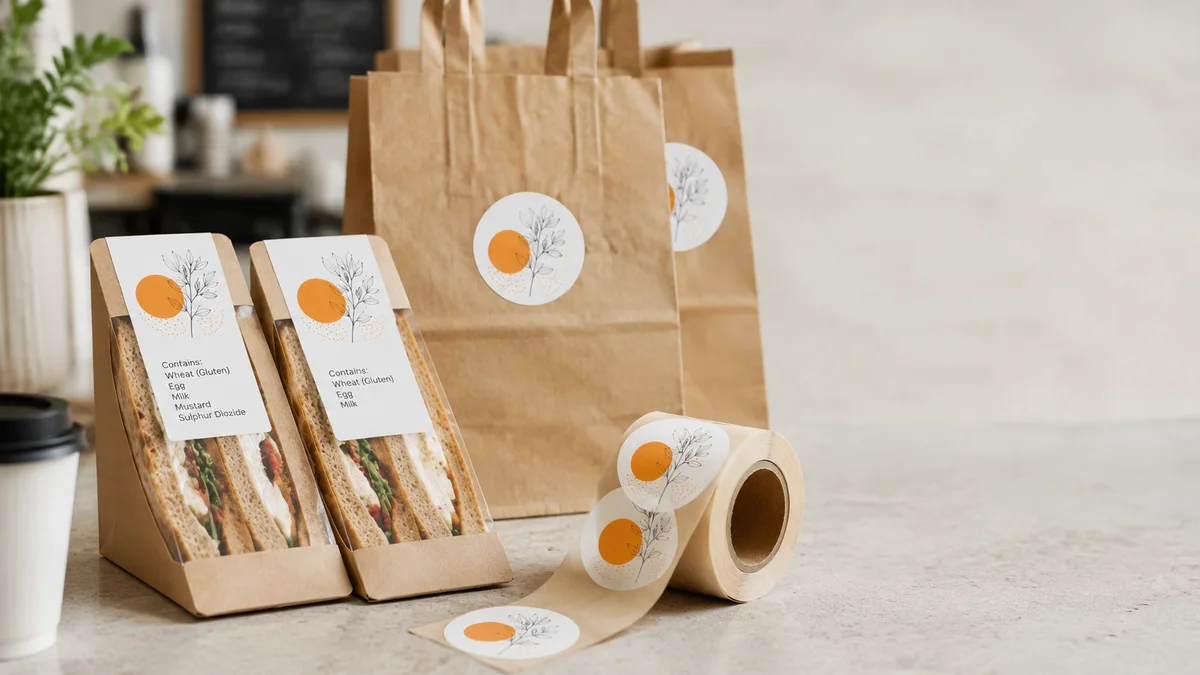
These are the highest-volume PPDS items in most UK cafes. Sandwich wedges and wrap sleeves have a flat surface that accepts a sticker easily. A 50mm by 30mm label on the front or top panel gives enough space for a full ingredients list in 8-point type. Salad bowls with domed lids work best with a sticker on the lid itself. If your bowls use flat lids, place the label there rather than on the curved side of the bowl, where it will wrinkle and peel.
The real challenge with chilled items is label durability. Standard paper labels fail quickly in a cold, damp refrigerated environment. Moisture creeps under the adhesive edge, the paper absorbs condensation, and by the end of the day the label looks like a receipt left in a wet pocket. Use polypropylene or polyethylene label stock for anything that goes in a fridge. These synthetic materials don't absorb moisture and their adhesive holds on cold, damp surfaces. The per-label cost is about 0.5p to 1p more than paper. That's trivial compared to the cost of a failed inspection.
Hot Food Containers and Delivery Boxes
Hot food sold pre-packed, such as curries, rice boxes, or noodle pots that are prepared before the lunch rush and kept under heat lamps, is still PPDS. These containers need the same full ingredients label as a cold sandwich. But the label stock must handle heat without the adhesive failing. Standard paper labels curl and peel when the container surface exceeds about 60 degrees Celsius. Use thermal-transfer printed labels on synthetic stock for hot-hold items. These stay flat and legible even at temperature.
For made-to-order hot food going out for delivery, you don't need a full PPDS label, but you must provide allergen information at the point of delivery. A simple allergen slip or sticker on the outer delivery bag handles this requirement. Most established takeaways use pre-printed sticker sheets that list all 14 allergens with tick boxes next to each one. The kitchen staff mark which allergens are present per order before sealing the bag. This takes a few seconds and satisfies the distance-selling delivery obligation without requiring a full ingredients breakdown on every container.
Bakery Boxes, Cake Boxes, and Loose Pastries
Bakery items create a labelling grey area that causes persistent confusion among operators. A cake box containing a whole cake that the customer selected from a display cabinet is PPDS and needs a full label. Individually wrapped muffins, brownies, and cookies sold from the counter are PPDS too. Loose pastries and bread rolls that the customer selects and you place into a bag are not PPDS; they are non-prepacked food. For these loose items, the FSA's 2025 written-first guidance applies. A clear allergen information sheet displayed at the counter or printed on the menu meets the requirement, but EHO officers increasingly expect it in writing rather than delivered verbally on request.
For cakes and multi-component baked goods, break down every layer in the ingredients list. If your carrot cake includes cake sponge, cream cheese frosting, and a walnut topping, each component needs its sub-ingredients listed separately. This is tedious. There is no shortcut around it. Missing a component, such as the butter in the frosting or the egg in the sponge, makes the entire label inaccurate and the product non-compliant.
Delivery App Orders: The Double Allergen Rule
Selling through Deliveroo, Just Eat, or Uber Eats adds obligations beyond what applies to in-store sales. Under distance selling rules, allergen information must be provided at two distinct points: before the customer completes their purchase on the app, and when the food physically arrives at their door.
The first obligation means your menu listing on the delivery platform must include clear allergen information for each dish. A generic "may contain allergens" note in the footer of your page does not meet this requirement. Each menu item needs its own allergen declaration. If your butter chicken contains milk, that needs to be visible on the listing before the customer adds it to their basket. Just Eat, Deliveroo, and Uber Eats all provide allergen information fields per menu item. A striking number of small takeaways leave these fields blank. Some don't know they need to fill them in. Others find updating the listings across three platforms a hassle and put it off. The legal risk is the same either way. Leaving them blank puts you at legal risk.
The second obligation means the food that arrives at the customer's address must carry allergen information. The simplest approach is a printed sticker or slip attached to the outer delivery bag or the main container. Digital-only allergen information, such as a QR code linking to a webpage, does not satisfy this delivery obligation on its own. The information must be visible on or inside the package without the customer needing to scan anything or visit a website. A sticker takes seconds to apply. It also protects you if a customer later claims they were not told about an allergen.
Low-Cost Labelling Setups for Small Cafes and Market Stalls
The biggest complaint about Natasha's Law from small food businesses is the cost of compliance. A market stall selling six varieties of samosa or a home baker selling cakes at a weekend farmers' market doesn't have the budget for thermal label printers and digital allergen management software. The FSA's own PPDS evaluation found that 51% of food businesses reported increased costs from the new labelling requirements, with micro-businesses feeling the impact hardest. Some 17% of businesses stopped selling PPDS items altogether to avoid the labelling burden.
There are affordable ways to get it right without spending hundreds of pounds on equipment.
The simplest option is pre-printed label sheets ordered from a packaging supplier. Design one label template per product with the full ingredients list correctly formatted. Order a batch. Stick them on your packaging. This works well for businesses with a small, stable product range. A set of 500 pre-printed 50mm by 30mm labels costs significantly less than a printer setup and lasts a small operator three to four months. If you make the same five sandwiches and three salad bowls every day, pre-printed labels are the lowest-friction path to compliance.
If your menu changes frequently, or you run daily specials, a basic thermal label printer with a roll of synthetic label stock costs less than a single failed EHO inspection. Entry-level thermal printers start around £80 to £120. A roll of 1,000 synthetic labels costs roughly £15 to £25. Connect the printer to a laptop or tablet. Type up your ingredient lists once. Print labels on demand. When a recipe changes, update the file and reprint. This gives you flexibility without the recurring cost of ordering new pre-printed sheets every time you switch a supplier or tweak a recipe.
For the very smallest operators, a home cake baker selling four products at a monthly market say, handwritten labels remain legally acceptable provided they are legible, durable, and include the full ingredients list with allergens emphasised. Use a fine-tip permanent marker on sturdy adhesive labels. Don't use ballpoint pen on paper that will smudge in damp conditions. Check your labels at the end of every market day and replace any that have become illegible. EHO officers will accept handwritten labels if they are clear, accurate, and consistently applied across every item. What they will not accept is a smudged, unreadable scrap of paper that clearly took ten seconds to produce.
What Happens If You Get It Wrong
The enforcement picture has sharpened considerably since 2021. In the first two years after Natasha's Law came into force, most local authorities took an advisory approach, providing guidance rather than issuing formal enforcement notices. That phase is over.
In 2025, allergen labelling failures accounted for 35% of all FSA food alerts, up from 23% in 2024. The FSA's retail surveillance programme tested 822 food samples and found that 4% contained undeclared allergens. A further 21% of all products tested had labelling irregularities of some kind. Small food businesses showed a 73% compliance rate, compared to 86% for large operators. Bread and bakery products had the lowest compliance rate of any category at just 26%, driven largely by undeclared milk and labelling errors in bakery items.
EHO officers now include PPDS label checks in routine hygiene inspections. According to FSA data, 95% of local authorities have integrated PPDS compliance into their inspection protocols. Officers expect to see documented allergen matrices, up-to-date supplier specifications, staff training records, and labels that match the food in the pack. They will ask staff to name the 14 allergens and explain the process for handling an allergen-specific order from a customer.
The consequences of serious non-compliance are severe. Under the Food Safety Act 1990, courts can impose unlimited fines for food safety offences. Where a labelling failure leads to harm, prosecution can result in prison sentences. Where a death occurs from an undeclared allergen, the charge can be manslaughter by gross negligence, which carries a maximum sentence of life imprisonment. Multiple prosecutions have already concluded under these powers. A takeaway owner in Yorkshire received a three-year sentence in 2023 after a customer with a peanut allergy died from eating food that carried no peanut warning on the packaging. These cases set a precedent that the courts are willing to enforce.
Frequently Asked Questions
Do I need full allergen labels on takeaway coffee cups? No. Made-to-order hot drinks are non-prepacked food. You do not need a PPDS label on a coffee cup. However, if you sell pre-bottled drinks or pre-filled smoothie cups from a chilled cabinet, those are PPDS. Under the FSA's 2025 written-first guidance, having written allergen information for your drinks available at the counter remains best practice, even for made-to-order items. If someone orders a latte with oat milk instead of dairy, make sure oat milk is what goes into the cup. Milk is one of the most common undeclared allergens found in FSA test purchases.
Can I use a QR code instead of a printed label on the packaging? Not for PPDS food. The label must be physically attached to the packaging with the information visible without any device. QR codes can supplement the on-pack label but cannot replace it. For made-to-order delivery food, a QR code on its own also doesn't satisfy the delivery obligation. The allergen information must be visible on or in the package without the customer needing to scan anything.
What if my packaging is too small to fit a full ingredients list? The minimum font x-height drops to 0.9mm when the largest packaging surface area is under 80 square centimetres. If even that does not fit, consider attaching a fold-out label or a two-layer sticker where the top layer lifts to reveal the full ingredients underneath. If your product genuinely cannot accommodate a label at the minimum font size, contact your local EHO for guidance before you start selling. They would rather advise you in advance than find a problem during an inspection.
How often should I review my allergen labels? Every time you change a supplier, a recipe, or an ingredient. If your new batch of curry powder contains mustard flour and the old one did not, your label becomes wrong the moment you start using it. Even without supplier changes, review all labels at least every three months. Set a recurring calendar reminder. An out-of-date label caused by an unrecorded recipe change is one of the most common reasons for a failed PPDS inspection.
Do catering orders for offices and events need allergen labels? Yes, if the food is PPDS. If you pre-pack individual sandwich platters, salad boxes, or buffet portions before the customer orders them, each item needs a PPDS label. For a platter made to order, provide a written allergen sheet with the delivery instead. Catering for events where guests cannot step into a kitchen and ask about allergens makes written allergen information especially important.
Do free samples need allergen labels? Yes. A free sample of cake, a taster pot of curry, or a pre-wrapped biscuit handed to customers at a market stall is still PPDS if it was packaged before being offered. The fact that no money changes hands doesn't exempt you from the labelling requirement. If wrapping individual samples is impractical, serve samples loose from a platter with a written allergen card displayed next to them. The card should list all allergens present in each sample item.
What Your Takeaway Packaging Needs to Show Next
Food allergen labelling law in the UK is not standing still, and the direction of travel is unambiguous. More written information, more consistent formatting, and more enforcement. Owen's Law, which would require written allergen information on menus at the point of ordering, is under active government evaluation with findings expected in late 2026. If voluntary uptake proves insufficient, legislation is likely in 2027 or 2028. Benedict's Law, focused on mandatory allergy policies and staff training in schools, becomes law in September 2026. Separately, the EU is moving to harmonise precautionary allergen labelling rules from late 2027, and the FSA is running a parallel consultation on UK standards. The reforms share a common thread: allergens must be communicated clearly, in writing, at every stage where a customer makes a decision about food.
For a small cafe or takeaway, the smartest approach is to build good labelling habits now, before the next wave of regulation arrives. Audit every pre-packed item you sell. Write down the full ingredient list for each one, with allergens in bold. Choose a label format and stock that works for your specific packaging type and storage conditions. Train every staff member to name the 14 allergens. And if you're unsure whether a product counts as PPDS, the FSA has a free online decision tool that walks you through the classification question by question.
The packaging you put your food in does more than keep it hot or stop it leaking during delivery. It is the document your customer reads before they take their first bite. Getting the label right is not just about passing an inspection. It is about making sure that customer trusts what you have put in the box. If you need help with labelling solutions for your takeaway packaging, whether that means pre-printed allergen stickers, compatible label stock for your containers, or packaging formats that work well with standard label sizes, contact our team or request a quote.