
Why Your Cake Boxes Collapse During UK Delivery — and How to Fix It Before the Next Refund
Standard cake boxes lose 40% of their crush strength from moisture within 90 minutes. Learn the five spec numbers that prevent delivery damage and cut refunds by over 90%.
Filed under Operations.
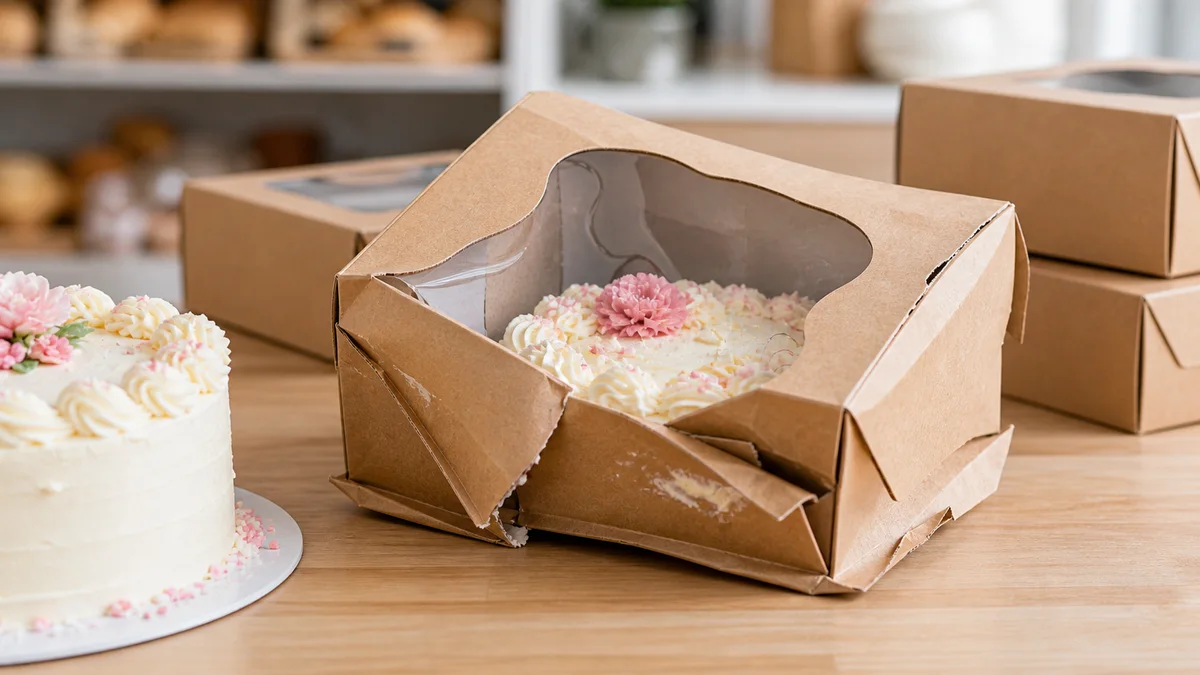
A bakery owner in Manchester posted on a hospitality forum last month: her celebration cakes were leaving the shop looking immaculate, but by the time the courier dropped them at customers' doors, the boxes had caved in at the corners. Three orders in one week arrived with crushed decorations and smeared buttercream. She'd refunded £240 and lost two regular customers before she worked out what was actually going wrong. The thread drew 87 replies. Most of them were from other bakers who'd been through the same thing — and nearly all of them were fixing the wrong problem.
Most cake box collapses are not caused by rough courier handling. They are caused by the box being the wrong board weight for the job. Standard 300gsm cake boxes lose up to 40% of their crush strength within 90 minutes of a buttercream-filled cake going in, because moisture from the filling softens the cardboard fibres from the inside. Upgrading to the right board specification typically adds 8p to 12p per box but can cut delivery damage by over 90%. And UK couriers — DPD, Evri, Royal Mail — all publish minimum packaging standards that most off-the-shelf cake boxes simply do not meet.
When a cake box arrives crushed, the instinct is to blame the courier. And yes, parcel networks are hard on boxes. Automated sorting belts drop parcels from waist height into collection cages. A box at the bottom of a cage stack can carry the weight of fifteen other parcels on its lid. These are real forces.
But in most cases, the damage has already started before the courier even scans the parcel. Packaging engineers call it moisture creep. A freshly filled and iced cake releases water vapour for the first two to four hours after boxing. That vapour soaks into uncoated cardboard fibres, softening them from the inside. A standard cake box — the kind most bakeries pick up in packs of 50 from the cash-and-carry, typically 250gsm to 300gsm single-wall board — loses roughly 40% of its crush resistance within an hour and a half of a moist-filled cake going in.
Once the board has softened, it doesn't take a dramatic drop to finish the job. The steady weight of a single other parcel resting on top of it in the back of a van is enough. The corners buckle inward. The lid caves along the score lines. The cake underneath is finished. And the customer opens the box expecting a £45 celebration centrepiece and finds something that looks like it lost a fight with a pothole.
This isn't a delivery problem. It's a specification problem. And the fix is less complicated than most bakery owners assume.
One operator on a UK hospitality forum described the cycle with painful accuracy: "We were buying the same white cake boxes for three years. Never had a problem with counter sales. The minute we started posting them, it all fell apart — literally. We tried taping the corners, double-boxing, even switching couriers twice. Nothing worked until someone told us to check the GSM on the box. I didn't even know what GSM meant before this."
When boxes start collapsing, most bakeries reach for one of three fixes. Each one makes sense on the surface. Each one comes with a hidden trade-off that costs either time or money — and sometimes both.
Double-boxing. Putting the cake box inside a larger corrugated outer carton. This does reduce damage in many cases. The outer box absorbs the stacking pressure and the impact forces, while the inner box stays clean for presentation. But it doubles your packaging cost per order, adds weight that pushes you into the next Royal Mail pricing band, and makes the unboxing experience feel like a Russian doll. Your customer pays £45 for a celebration cake, not an Amazon logistics puzzle. Double-boxing is a bandage, not a solution, and it does nothing to stop the inner box from softening if moisture is the underlying problem.
Switching couriers. One operator on a baking forum wrote: "DPD crushed three of my orders last month so I switched to Royal Mail Special Delivery." This can help for a week or two, because you get lucky with a different depot or a different driver. But every UK courier network uses automated sorting belts, stacked cages, and multi-drop vans. None of them sort cake boxes differently from any other parcel. None of them promise crush-free handling for standard cardboard containers. Switching couriers without fixing the box specification just moves the same problem to a different postcode. The box is still too weak. The courier isn't the variable that matters most.
Taping everything. Reinforcing corners with packing tape, taping lids down on all four sides, wrapping the entire box in layer after layer until it looks like it's heading into a war zone. This adds two to three minutes of labour per order and uses about 40p worth of tape each time. More importantly, it does nothing to stop the cardboard itself from softening. The tape holds the external shape. But the softened board underneath still compresses under stacking weight, and the cake inside gets crushed just the same — now inside what amounts to a neatly taped coffin.
The pattern across all three fixes is the same: they treat the symptom, not the cause. The box itself isn't strong enough for what you're asking it to do. Everything else is just making peace with a specification that was never designed for courier delivery in the first place.
Here is a framework any bakery can use regardless of which supplier they order from. It comes down to five numbers on the spec sheet. Get these right, and the problem goes away.
One: Know your board weight. Standard cake boxes at retail are typically 250gsm to 300gsm single-wall board. That's adequate for counter display, where the box sits on a shelf supporting nothing heavier than its own lid. For courier delivery, the minimum you want is 350gsm — and 400gsm if your cakes weigh more than 1.5 kilograms or travel further than 30 miles from your kitchen.
A Birmingham-based online bakery tracked their damage rate across six months of deliveries. With standard 300gsm boxes, 7.2% of orders arrived with visible crush damage — collapsed corners, smeared decoration, or cracked icing. They switched to 350gsm duplex board with a PE lining on the inside face. The damage rate dropped to 0.4%. The upgraded boxes cost 11p more per unit. The refunds they stopped issuing saved them over £1,800 in the following quarter. That's not a marginal improvement. That's a completely different business.
Two: Demand a moisture barrier. If your cakes contain buttercream, cream cheese, fresh cream, mousse, fruit compote, or any filling with moisture content above about 15%, uncoated kraft board will absorb that water and weaken. PE (polyethylene) or PP (polypropylene) lamination on the inside face of the board creates a vapour barrier that keeps the fibres dry and rigid throughout the delivery window. The coating adds roughly 3p to 5p per box. It pays for itself the first time it prevents a single refund.
A baker in Glasgow put it bluntly on a forum: "I didn't believe the coating made a difference until I did a side-by-side test. Same cake recipe, same courier, same delivery route, same day. The coated box arrived perfect. The standard uncoated one looked like it had spent the morning sitting in a puddle. I've never ordered uncoated since."
Three: Match the base structure to the cake weight. Most cake boxes use an auto-bottom design — the base folds itself into shape when you open the box. This is quick, but the locking mechanism relies on small tabs that can pop out under sustained pressure. For cakes over two kilograms, or any multi-tier cake, specify a lock-bottom base instead. The interlocking flaps distribute the load across four contact points rather than two. Assembly takes an extra five seconds. For a box carrying sixty quid's worth of wedding cake, that's five seconds well spent.
Four: Understand the window box trade-off. Window boxes sell more cake — customers can see the product, the presentation looks premium, and they perform measurably better at markets and in shop displays. But every window cut into a cake box removes roughly 15% of its crush resistance. The PET film that fills the window restores some of the lost structure, but not all of it. If you're delivering rather than displaying, either use a solid lid for delivery boxes, or confirm with your supplier that their windowed boxes have been crush-tested to courier-network standards and ask to see the test data. A box that looks beautiful on your Instagram won't save you from a one-star review when it arrives flattened.
Five: Right-size, don't oversize. A box that's too big lets the cake slide around during transit. A box that's too small crushes the decoration against the lid or sides. The sweet spot for courier delivery is 3cm to 5cm of clearance on each side of the cake board, and 2cm to 3cm above the highest point of decoration. Anything more than that, and you're paying postage to ship empty air — and giving the box more internal volume to crumple into under stacking pressure. Use a cake board that fits snugly inside the box base with no more than 5mm of play in any direction. If the board can shift, the cake can shift. And if the cake can shift, it will.
When you're comparing quotes from packaging suppliers, ask for five specific numbers on every spec sheet: the GSM, whether the board is coated, the base closure type, the crush test result in kilopascals, and the exact internal dimensions. If a supplier can't provide all five, move on. These aren't premium extras. They're the difference between a cake that arrives looking like the photo on your website and one that generates a refund request and a lost customer.
It's worth knowing what the couriers themselves require. DPD's published packaging guidelines state that parcels must withstand a drop from waist height onto a solid surface and must survive the compression weight of other parcels stacked on top during transit. Their guidance explicitly recommends double-walled corrugated board for any item over two kilograms and warns against reusing boxes, because "strength is significantly reduced" after a single journey through the network.
Evri's terms are similar: items must be packed to survive automated sorting equipment, and the company reserves the right to reject damage claims if the packaging is deemed insufficient for the contents. Royal Mail Special Delivery covers contents up to a declared value, but their compensation terms exclude damage caused by "inadequate packaging."
In plain English: if your cake box collapses during delivery and the courier decides the box was too weak for the job, the refund comes out of your pocket — not theirs. This isn't a theoretical risk. It's written into the terms and conditions of every major UK parcel carrier.
Next time you're ordering cake boxes, pull one out of your current stock and check the board weight. If it's 300gsm or below, and you're sending cakes through any UK courier network, you're running a known risk that has already cost you money — even if you haven't added up the refunds, the remakes, and the lost repeat orders yet.
Run a small test. Order five boxes in a higher GSM — 350gsm minimum, with a moisture barrier and a lock-bottom base if your cakes are heavy. Send them to friends or family through your usual courier. Open them yourself at the other end. If they arrive intact, the unit economics on the upgrade will do the rest of the convincing for you. If you want a starting point for comparing specifications side by side, request a sample pack with the board weights and coatings discussed here. A box that survives the journey is cheaper at any price than a box that does not.