
Why Your Cake Boxes Collapse During UK Delivery (And How to Prevent It)
Cake boxes fail during UK delivery from moisture-weakened board, not weight. Learn which GSM ratings, coatings, and corner construction actually prevent collapse before you order.
Filed under Buying Guides.
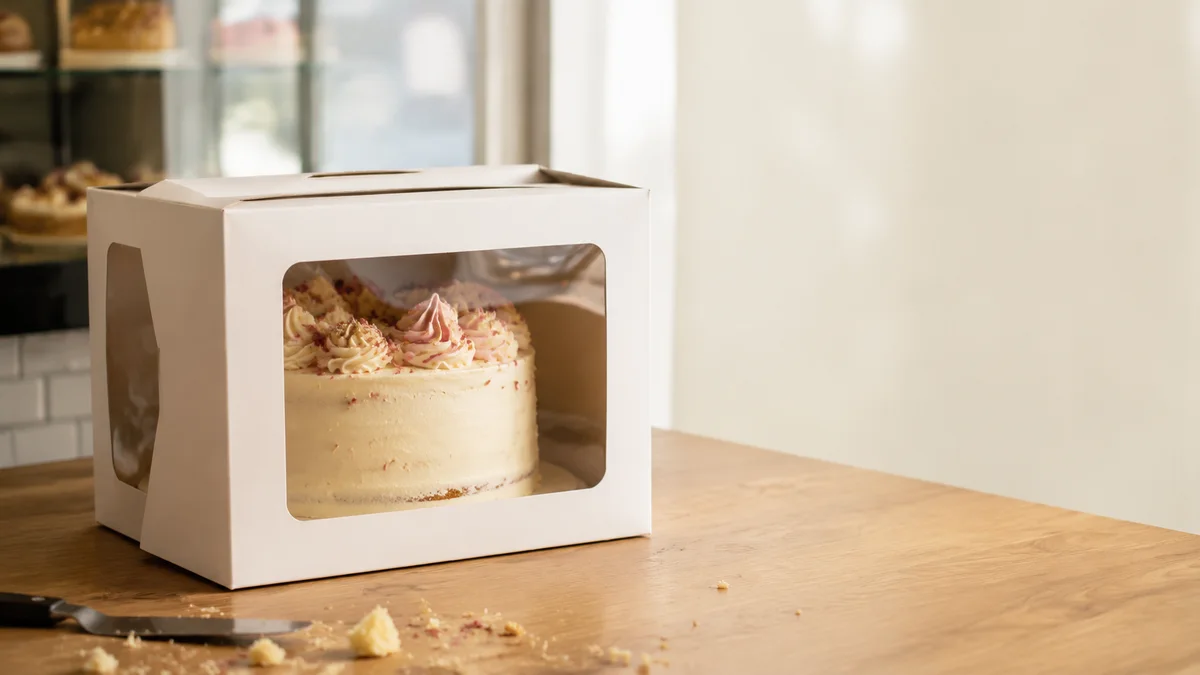
A home baker in Manchester posted in a trade group last December: she had delivered a three-tier wedding cake to a venue 25 minutes away, only to find the top tier had shifted during transit and the buttercream finish was smeared across the inside of the box lid. The box hadn't ripped. It hadn't got wet. It had simply given way at the corners under the weight of a cake that was well within its stated size capacity. Fifty-seven other bakers replied to that thread. Most had a version of the same story.
This is the hidden problem with cake boxes that nobody in the supply chain talks about openly: a box can be the right size, the right shape, and even the right price — and still fail you when it matters. The failure isn't always dramatic. Sometimes it's a corner that softens just enough to let the cake shift. Sometimes it's a lid that bows under condensation and touches the frosting. Sometimes it's a window that fogs up so completely the customer can't see the £85 cake inside. None of these are freak accidents. They are structural outcomes of specific design choices that most bakers don't know to ask about.
Key Takeaways
- Most cake box collapses are not caused by the cake being too heavy — they are caused by the board losing rigidity from moisture absorption, particularly during UK autumn and winter deliveries.
- A box rated for the right dimensions on the spec sheet can still fail if the board weight is under 350gsm for standard cakes or under 400gsm for tiered and fondant-heavy work.
- Greaseproof coatings and ventilation holes are not the same thing — a box can have one without the other, and choosing wrong for your cake type creates either sogginess or structural failure.
- The cheapest box per unit often costs more in replacements, refunds, and reputational damage than the mid-range option — especially if you deliver rather than sell over a counter.
Why Cake Boxes Actually Collapse
Ask most bakers why a box failed and they will point to the cake being too heavy. That is rarely the root cause. The real mechanism is more boring and more useful to understand.
Cake boxes are made from paperboard — a compressed fibre material that gets its rigidity from the bonding between fibres and from engineered fluting or lamination layers. When the board absorbs moisture, those fibre bonds loosen. The board loses stiffness incrementally, starting at the points of highest stress: the corners where the side walls meet, the base where the cake board sits, the lid edges where the closure tabs lock in. Once enough moisture has been absorbed, the box doesn't need to be overloaded to deform. It just needs time plus humidity.
In the UK, this is an especially persistent problem because our climate does half the work for you. A cake box that holds up perfectly during a dry June delivery can soften noticeably during a damp November run — even without rain — simply because ambient humidity in the vehicle or the rider's bag is higher. Add a cake that is still releasing residual heat from baking or a chilled cake that causes condensation as it warms up, and you have created a microclimate inside the box that is actively degrading the board from the inside out.
One operator on a UK baking forum described discovering this the hard way: "I tested my boxes in the kitchen and they were absolutely fine. First wet Saturday in October, four out of twelve deliveries arrived with the boxes soft at the base corners. The cakes hadn't moved but the boxes looked like they'd been in a sauna. I realised I'd been testing in the wrong conditions."
This is the gap between how boxes are spec'd and how they actually perform. Most suppliers list external dimensions and sometimes a brief description like "sturdy white card." What they rarely disclose is the GSM rating of the board, whether the internal surface has a moisture barrier coating, and whether the corner construction is reinforced or simply glued. These three specifications determine whether your box survives a 30-minute delivery in British weather, regardless of what dimensions are printed on the label.
What Bakers Try First — And Why It Usually Fails
When boxes start failing, most bakers reach for one of three fixes. None of them solve the underlying problem, and some make it worse.
The first fix is buying a larger box. The logic is that if the cake is pressing against the sides or the lid, more headroom will solve it. What happens instead is that the cake now has room to shift during transit, which introduces impact forces that a snug box would have absorbed. A cake that slides into the side of a box at a roundabout or speed bump exerts more force than one that was gently touching the sides from the start. You have traded structural compression for impact damage.
The second fix is switching to a cheaper box to save money on what now feels like a disposable item. This almost always backfires. Cheaper boxes use lighter board weights — often 250-280gsm — and thin, brittle corner gluing. They degrade faster in humidity and fail sooner. One operator on a UK hospitality forum described the cycle perfectly: "We switched to a cheaper box to save 4p a unit. Two months later we had lost more in refunds and replacement cakes than we saved in a year of packaging costs."
The third fix is taping the box — running clear tape around the base or adding a second layer of tape to the lid. This can work as a short-term emergency measure, but it makes your packaging look like it has been repaired, which undercuts the premium presentation that bakeries depend on. It also adds time per order: 30 seconds of taping multiplied by 40 orders on a Saturday morning is 20 minutes of labour you cannot recover.
What Actually Works: A Spec-Based Approach to Choosing Cake Boxes
The solution is not a different box brand or a single magic product. It is knowing which specifications to check before you order, regardless of which supplier you end up using. Here is the framework that separates boxes that survive delivery from boxes that look fine on the shelf but fail on the road.
Start with board weight. For standard single-tier cakes up to 8 inches, look for a minimum of 350gsm. For anything larger, tiered, or decorated with heavy fondant, 400gsm or higher is worth the extra cost. The difference between a 300gsm box and a 400gsm box is roughly 1.5-2p per unit at wholesale quantities. Over a year of deliveries, that premium buys you a failure rate closer to zero. If your supplier cannot tell you the GSM rating — not the "thickness in microns," not the "heavy duty" marketing label, but the actual grams per square metre — treat that as a red flag. A supplier that does not know the spec cannot guarantee the performance.
Next, check the internal coating. A box described as "greaseproof" has an internal barrier that stops buttercream and oil from bleeding through the board, but it does nothing to stop moisture in the air from softening the board fibres from the inside. What you want for UK delivery conditions is a box with either a PE lining or an aqueous coating on the internal faces — including the lid underside. This creates a vapour barrier that stops the cake's residual heat and moisture from humidifying the inside of the box. Without it, every warm cake you box turns the lid into a condensation trap, and the board absorbs that moisture while the delivery rider is still finding your customer's address.
Then, look at the corner construction. Most budget boxes use a simple glued side seam — the side wall is one strip of board with a single glued overlap. Under load and humidity, that seam is the first point of failure. Better options include reinforced corner folds, double-wall bases, or crash-lock bases that distribute weight across multiple contact points rather than relying on a single glue line. If you can unfold a sample box and see where the stress concentrates, you know where it will fail. Ask the supplier for a pre-production sample and deliberately test the weak points: load a box with a weight-equivalent dummy cake, leave it in a steamy kitchen for 30 minutes, then carry it around the block. If it survives that test, it will survive a delivery run.
For boxes with windows, the window material matters as much as the board. Cheap acetate windows fog instantly and stay cloudy. PET windows stay clearer longer but are not kerbside recyclable in most UK council collections. PLA windows are compostable and reasonably clear, but they can soften in high humidity — the same conditions that challenge the board. There is no perfect window material, only the right trade-off for your business. If your cakes are collected from a counter or market stall, a PLA window is a solid eco-forward choice. If you deliver by courier or rider in all weather, PET or a no-window design eliminates an entire category of failure.
One more point that catches bakers off guard: size tolerances. A box described as "10 inch" might measure 10 inches externally — making the internal dimension closer to 9.75 inches. That quarter inch matters when your cake board is exactly 10 inches and needs to sit flat on the base. Always confirm that the stated size is the internal dimension, not external. If the listing does not specify, assume it is external and subtract half an inch when working out what will fit.
How to Test Before You Commit
Before placing a production order of 500 or 1,000 boxes, order a sample pack and run these three tests. They take 30 minutes and will tell you more than any product description.
Test one is the loaded humidity test. Place a cake dummy or a sealed bag of flour equal to your heaviest typical cake weight inside the box. Close it fully. Put it in your kitchen during a busy service period — near the oven or dishwasher if possible — for 30 minutes. Then pick it up from the base only, carry it to another room and back, and check for corner softening, lid bowing, or base sag. If any of these appear, the board weight or internal coating is not adequate for your use case.
Test two is the condensation check. Box a warm cake dummy — microwave a damp sponge for 30 seconds, or use a hot water bottle wrapped in a tea towel — and close the lid. Wait 15 minutes. Open the box and check the lid underside for moisture droplets. A small amount of condensation on the lid is normal. Moisture that has started to soak into the board fibres at the corners or along the base edges is not. If you see fibre swelling or softening, the internal vapour barrier is insufficient.
Test three is the stack test. If you stack boxes for storage or transport — most bakeries do — take three filled boxes, stack them, and carry the stack 20 metres. The bottom box should not show corner compression or lid deformation from the weight above it. If it does, the board weight or structural design is not suitable for stacking, and you will discover this on a busy weekend morning when you least need the surprise.
Next time you are comparing cake box suppliers, ask your current one for the GSM rating, the internal coating type, and the corner construction method for the boxes you are using now. If they cannot provide all three answers in a single email, you are buying on faith. Start getting samples from suppliers who can. If you want to compare spec sheets side by side across the most common UK bakery box sizes, we have put together a comparison tool that lays out board weights, coatings, window materials, and per-unit pricing. You can also request a sample pack of the board weights discussed above to test with your actual products before committing to a full production order.