
Cake Boxes for UK Bakeries: What to Check Before Ordering
Wrong box size, weak board, or a lid that crushes your decorations — here's how to spec cake boxes that protect your bakes from counter to customer door.
Filed under Operations.
Cake Boxes for UK Bakeries: What to Check Before Ordering
Most UK bakeries order cake boxes the same way they order flour - reordering the same SKU every month without a second thought. Then a customer sends back a photo of a birthday cake that shifted in transit and smeared buttercream across the lid. Or a batch of boxes arrives that takes 45 seconds each to assemble during the Saturday morning rush. Or a wedding cake delivery goes wrong because the box was rated for counter display, not a 40-minute drive to a venue in the Cotswolds.
A cake box does three jobs. It protects the cake during transport. It keeps the cake fresh from collection to consumption. And it sets the customer's expectations before they lift the lid. Get any of those three wrong, and the customer blames your baking - not your packaging. This guide walks through the five decisions that determine whether your boxes work as hard as you do.
Key Takeaways
- Always size up by at least 2 inches beyond your cake board, not your cake. A 8-inch cake on a 10-inch board needs a 10-inch box, not an 8-inch one.
- Flat-packed boxes cost 20–30% less per unit than auto-popup boxes but take 3–4 times longer to assemble. For a bakery doing 50 orders a day, that is 30–40 minutes of extra labour.
- Window boxes sell more cakes on retail display but cost 15–25% more and have a structural weak point where the film meets the board. For delivery orders, plain boxes are safer.
- UK food contact regulations require any box that touches unwrapped food to be made from food-grade board. This isn't the same as FSC-certified - ask for both.
- Always test your box with your heaviest cake in a real delivery scenario before committing to a bulk order. A 20-minute drive with a few speed bumps reveals more than any spec sheet.
Why Cake Box Specifications Matter More Than Price
Rachel runs a home baking business in Leeds that grew from six orders a week to forty. For her first two years she bought whatever white cake boxes were cheapest on Amazon. They arrived flat, took forever to fold, and roughly one in every fifteen orders generated a complaint about squashed decorations or a lid that had popped open in transit. She was losing about £60 a month in refunds and replacement bakes.
The turning point came when she landed a wedding cake order for a venue 45 minutes away. She tested three different box types with a dummy cake - a standard flat-packed white box, a corrugated kraft box with a separate lid, and a tall window box. The standard box failed within 15 minutes of driving. The lid flexed, the cake board slid, and the buttercream decorations on top kissed the inside of the lid. The corrugated box held perfectly. She switched her entire range to corrugated kraft boxes, raised her prices by 50p per order to cover the difference, and her complaint rate dropped to near zero.
The lesson isn't that Rachel was cheap. It is that most bakers treat cake boxes as an afterthought - something you grab from the shelf without reading the specification. In reality, the box is the last thing your customer sees before the cake, and the first thing they judge when they collect it.
The UK bakery sector produced roughly £4.4 billion in retail sales in 2024 according to the Craft Bakers Association. Independents and home bakers make up an increasing share of that market, driven by delivery platforms and social media. Yet most of them can't tell you the board grade, assembly type, or food contact certification of the boxes they use. That's a gap worth closing.
Sizing: Why the 2-Inch Rule Is Only the Starting Point
The standard advice - choose a box 1 to 2 inches larger than your cake - is correct but incomplete. Cake boxes are sized to the cake board, not the cake. If you bake an 8-inch round but mount it on a 10-inch drum, you need a 10-inch box. The board must sit snugly inside the box base. Any lateral movement during transport turns the cake into a sliding weight that will hit the sidewall and damage your decoration work.
Standard UK cake box sizes follow the inch-based system inherited from the American market, with most suppliers stocking these dimensions:
6-inch box - for 4-inch cakes, small gift cakes, and individual celebration portions. 8-inch box - for 6-inch cakes. This is the most popular size among home bakers and covers roughly 40% of celebration cake orders in the UK. 10-inch box - for 8-inch cakes. The workhorse size for independent bakeries doing birthday and occasion cakes. 12-inch box - for 10-inch cakes. Used for larger celebration cakes and dessert table centrepieces. 14-inch box - for 12-inch cakes. Typically special order rather than stocked. 16-inch and above - for wedding cakes and multi-tier deliveries. Usually corrugated.
Height matters as much as width and is the dimension bakers most often overlook. Standard cake boxes are 5 inches deep. That works for a single-tier cake with modest decoration - a smooth buttercream finish, a drip edge, some piped rosettes. It fails for tall cakes, cakes with fresh flower toppers, cakes with macaron stacks, and anything with a cake topper that sticks up more than 2 inches above the icing.
Tall or extra-deep boxes add roughly 2 to 4 inches of height. A standard 10-inch box in extra-deep format might be 9 inches tall instead of 5. These cost about 30–50% more than standard depth but eliminate the most common cause of decoration damage - lid contact. For wedding cakes and tiered celebration cakes, the extra depth is not a luxury. It's the difference between a clean delivery and a remake.
One size detail that catches out first-time buyers: box dimensions on UK supplier websites are sometimes listed as internal and sometimes as external. A box listed as 10 x 10 x 5 external might only give you 9.5 x 9.5 x 4.75 internal, and that half-inch difference matters when your cake board is exactly 10 inches. Always ask whether the listed dimensions are internal or external before placing a first order.
Window vs Plain: When Visibility Matters and When It Does Not
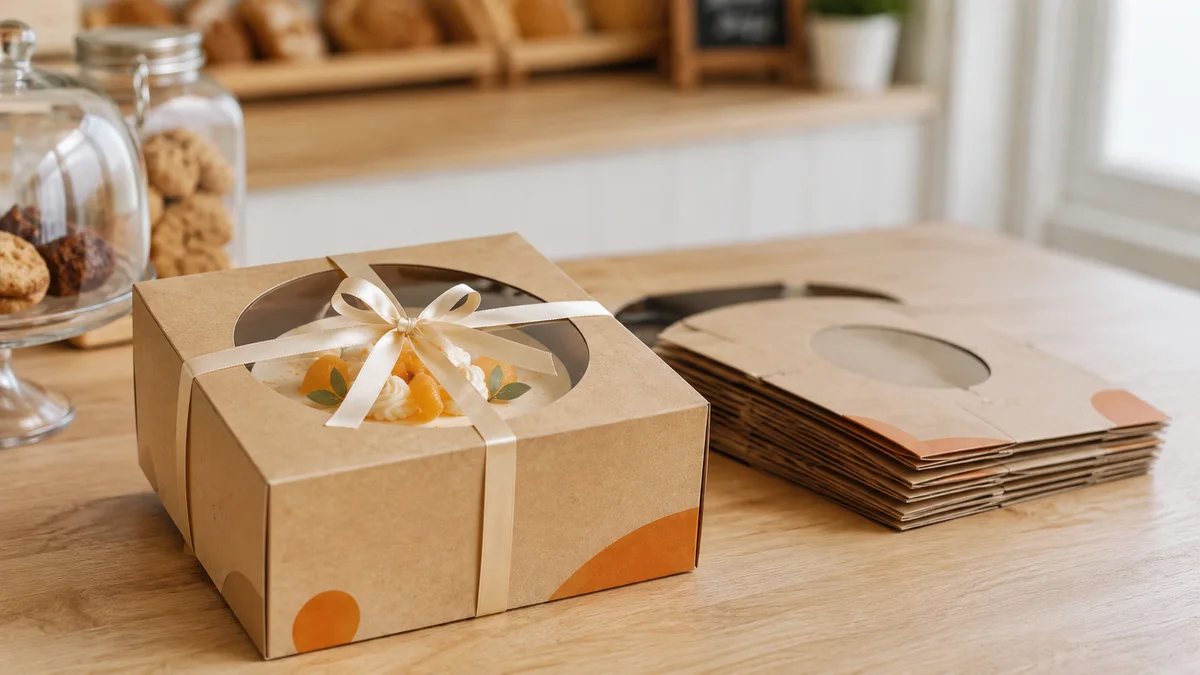
Window boxes are the default choice for bakeries with a retail counter. The customer can see the cake without opening the box, which means fewer fingerprints on the icing and more impulse purchases. A cake visible through a clear window on a counter display sells itself in a way that a closed white box never will.
The trade-offs are real. The window cutout weakens the structural integrity of the lid. A box that stacks perfectly without a window can bow or collapse under the same load with one. The window film - typically PET plastic or compostable PLA - adds roughly 15–25% to the per-unit cost. And window boxes are more vulnerable to crush damage in delivery because the window has no compression strength.
For counter sales and click-and-collect orders where the customer carries the box by hand, window boxes are worth the premium. The visual presentation drives sales and the structural demands are modest. The box travels from counter to car to kitchen, not through a delivery network.
For delivery orders - Just Eat, Deliveroo, Uber Eats, or courier-shipped celebration cakes - plain boxes are the safer choice. Delivery involves stacking, vibration, temperature changes, and handling by people who didn't bake the cake and have no emotional investment in its survival. A plain corrugated box with a snug-fitting separate lid will outperform a window box in delivery conditions every time.
For home bakers who sell through Instagram and arrange customer collection, a hybrid approach works well. Use a window box for the handover (the customer sees the cake, the moment is Instagram-worthy) and provide a plain corrugated outer box if the customer is driving more than 20 minutes. The outer box costs about £0.80–1.50 and eliminates the single most common complaint source for home bakers - damage during the customer's own journey home.
Material Grades: Cardboard, Corrugated, and Kraft Explained
Cake boxes come in three broad material categories, and each suits a different job.
Standard cardboard cake boxes are made from 250–400gsm coated board, usually white on the outside with a grey or white interior. These are the boxes you see on bakery counters - clean, printable, and rigid enough for counter display and short hand-carried journeys. They are not designed for stacking, long-distance transport, or heavy cakes. A standard cardboard box holding a 6-inch sponge cake is perfectly adequate. The same box holding a 10-inch fruitcake will buckle at the base within 20 minutes of carrying.
Corrugated cake boxes use a fluted middle layer between two flat liners, the same construction as a shipping carton but in thinner, food-grade board. They are significantly stronger than solid cardboard of the same weight and handle stacking, vibration, and long-distance transport without deforming. The trade-off is appearance - corrugated boxes look industrial compared to smooth white cardboard. For bakeries that wrap their boxes in ribbon or tissue, the box itself is not customer-facing and the strength advantage wins. For counter display, the utilitarian look can undermine the premium positioning of your cakes.
Kraft brown boxes sit between the two. They are typically made from unbleached solid board (not corrugated) and have a rustic, artisanal look that suits sourdough bakeries, farm shops, and eco-conscious brands. Kraft boxes photograph well and perform well on social media. The material is naturally grease-resistant to a point, though heavily buttercreamed cakes will still show oil marks after a few hours of contact. Kraft boxes with a greaseproof lining solve this but add cost and complexity.
The practical guide is straightforward. For counter display and hand-carry, standard cardboard is fine. For delivery and transport, use corrugated. For brand-driven bakeries where the box is part of the product experience, kraft or custom-printed cardboard is worth the investment. For wedding and tiered cake deliveries, corrugated is non-negotiable - the structural demands of a multi-tier cake in transit exceed what any solid board box can reliably handle.
Assembly Type: Flat-Packed vs Auto-Popup and Why Speed Matters
This is the specification that separates professional bakeries from home operations, and it rarely appears in buying guides. Cake boxes come in two assembly formats: flat-packed sheets that you fold into shape, and auto-popup boxes that spring open with a single motion.
Flat-packed boxes arrive as die-cut sheets. You fold along the crease lines, tuck the side tabs, and form the base and lid. The process takes 30–45 seconds per box for an experienced pair of hands and closer to 60 seconds for someone new. For a bakery doing 20 orders a day, that is 15–20 minutes of folding. For 50 orders a day, it is 30–40 minutes - roughly the time it takes to bake and decorate an additional cake.
Auto-popup boxes come pre-glued and folded flat with a spring mechanism. You pull the sides apart and the box snaps into shape. Assembly takes 5–8 seconds per box. The per-unit cost is 20–30% higher than flat-packed, but the labour saving is substantial. A bakery doing 50 orders a day saves roughly 25–35 minutes of staff time with popup boxes. At a staff cost of £12 per hour, that is £5–7 saved per day, which over a working month covers the box premium and then some.
The decision isn't purely about speed. Flat-packed boxes store more compactly - 100 flat-packed boxes take up roughly the same space as 60–70 popup boxes. If storage is tight (and in most small bakeries it is), flat-packed wins on space efficiency. Flat-packed boxes also give you more flexibility on sizing because suppliers stock a wider range of dimensions in flat format than in popup.
Most growing bakeries eventually settle on popup boxes for their core sizes (8-inch and 10-inch cover the majority of orders) and keep a small stock of flat-packed boxes in less common sizes for special orders. This gives you speed where volume lives and flexibility where it counts.
Custom Printing: When to Brand Your Boxes and When to Wait
Custom-printed cake boxes are the most powerful branding tool most bakeries never use. A box with your logo, colours, and social handle turns every customer into a walking advertisement. It signals professionalism before the lid comes off. And it makes your cakes instantly identifiable in an office fridge or a party buffet spread.
The economics have shifted in favour of small bakeries over the past three years. Digital printing technology means short runs are now practical and affordable in a way that traditional flexographic printing never was. A typical UK packaging printer will run 100–500 custom cake boxes with a one or two-colour design for roughly £0.80–1.50 per box depending on size, board grade, and whether you need a new printing plate made. At 500 boxes, that is a £400–750 investment.
The minimum order quantity is the key number to check. Some printers quote as low as 50 boxes but the per-unit cost at that quantity is uneconomic (£2.50–4.00 per box). The sweet spot for independent bakeries is 250–500 boxes, where the per-unit cost drops to a level that adds £0.50–1.00 to your cost per cake. For a cake that sells at £35–50, that packaging premium is easily absorbed and pays for itself through repeat orders and word of mouth.
Design considerations worth knowing before you brief a designer or approve a proof:
- Keep the design to one or two colours. Each additional colour adds a setup charge and increases the per-unit cost.
- Your logo and social handle should print on the lid (the face the customer sees) and ideally on one side panel (visible in a stack or on a shelf).
- Avoid full-coverage ink on the interior. The inside of the box touches food directly or indirectly through the cake board, and heavy ink coverage can transfer odour or colour to the cake.
- If you use window boxes, position the window so it frames the cake centre. Offset windows that show a corner of the cake are less effective for display.
- Order a printed sample before the full run. Colours on screen and colours on coated board are not the same thing, and the only way to confirm is to hold the physical box in your hand.
For bakeries that can't meet the minimum for custom printing, a branded sticker on a plain box is a practical and effective alternative. A roll of 500 custom stickers costs £30–60 and turns any plain box into branded packaging in two seconds. The look is more handmade than fully printed, but for artisan and home bakeries that works in the brand's favour.
UK Regulations and Food Safety: What Your Boxes Must Comply With
Cake boxes may look like simple cardboard, but they are food contact materials under UK law. Three regulatory requirements apply to every box you buy.
First, the box must be made from food-grade board. This means the paper and any coatings or adhesives used in manufacturing are safe for direct and indirect food contact. The relevant UK standard is the Materials and Articles in Contact with Food Regulations 2012, which implemented EU Regulation 1935/2004 into UK law post-Brexit. A supplier should be able to provide a Declaration of Compliance (DoC) confirming their boxes meet this standard. If they cannot, find a different supplier.
Second, the box must be traceable. Under UK food contact materials law, every business in the supply chain must be able to identify who supplied their materials and who they supplied them to, one step forward and one step back. This matters for bakeries because if a packaging defect causes a food safety issue, you need to be able to trace the box batch back to your supplier.
Third, if you make any environmental claims about your packaging - compostable, biodegradable, recyclable - those claims must be substantiated under the UK Green Claims Code, enforced by the Competition and Markets Authority. A box described as compostable must meet EN 13432 certification for industrial composting. A box described as recyclable must be recyclable in practice through UK kerbside collections, not just recyclable in theory.
FSC certification is separate from food safety. FSC (Forest Stewardship Council) confirms the paper came from responsibly managed forests. It tells you nothing about whether the box is safe for food contact. You need both certifications - FSC for sustainability credentials, food-grade certification for legal compliance.
The UK Plastic Packaging Tax, currently £228.82 per tonne from April 2026, applies to plastic packaging with less than 30% recycled content. Most cake boxes are paper-based and fall outside this tax. The exception is boxes with plastic windows. If the window film is virgin PET (not recycled), and the window makes up more than a minimal proportion of the total packaging weight, the box could attract the tax. PLA (compostable bioplastic) windows are exempt. Ask your supplier whether the window film in their boxes is recycled PET, virgin PET, or PLA.
How to Test Cake Boxes Before You Commit to a Bulk Order
Suppliers will send you samples. Most bakers glance at them, fold one, and decide. That is not a test. Four simple checks will tell you more in an hour than any product description.
The assembly test. Time yourself folding five boxes from flat. If each one takes more than 45 seconds, and you do more than 30 orders a week, you should be looking at popup boxes or a different flat-packed design. Also check whether the tabs align smoothly or whether you are fighting the crease lines. Boxes with poorly scored fold lines will slow you down every single time.
The cake test. Bake or buy a cake at the weight and height of your heaviest product. Place it on your standard board. Box it. Pick the box up by the lid (not the base - customers do this) and walk 100 metres. Open it and inspect. If the board has shifted, the box is too large for your board size. If the lid shows any residue, the box is too shallow for your decoration height.
The stack test. Box three cakes and stack them the way a delivery driver would - heaviest at the bottom, lightest on top. Leave them for 30 minutes. Unstack and inspect the bottom box. If the lid shows any bowing, creasing, or collapse, the board grade is too light for stacking. Corrugated boxes should withstand this test with no visible deformation.
The temperature test. Put a boxed cake in your fridge for two hours, then take it out into a warm kitchen for 30 minutes. This simulates the transition from cold storage to customer collection on a summer day. If condensation forms on the inside of the lid and drips onto the cake, the box lacks adequate ventilation or anti-condensation properties. This is more common with window boxes than plain boxes because the window film creates a vapour barrier.
Ask your supplier three questions before placing your first order. Is the board food-grade certified? Are the listed dimensions internal or external? What is the board weight in gsm or the flute grade for corrugated? A supplier who can't answer all three has either never been asked before (unlikely for a reputable manufacturer) or is reselling imported stock with no meaningful quality specification. Either way, find a different supplier.
Frequently Asked Questions
What is the difference between a cake box and a cupcake box? Cake boxes are sized for whole cakes and have a flat interior base. Cupcake boxes have a die-cut insert with individual cavities that hold each cupcake in place and prevent them from sliding into each other during transport. Do not use a cake box for cupcakes - without an insert, the cupcakes will tip over and ruin each other's frosting.
How many cake boxes should I keep in stock? For a bakery doing 30 orders per week, keep a minimum of two weeks of stock for your core sizes (roughly 60 boxes each for your two most-used sizes) plus a smaller buffer of less common sizes. Factor in two weeks of lead time for reorders. Flat-packed boxes store in less space, so you can hold more buffer stock without sacrificing worktop space.
Can I reuse cake boxes? No. Cake boxes are single-use food contact packaging. Once a box has held a cake, the interior has been exposed to fats, moisture, and potential allergens. Reusing a box creates a food safety risk and breaches food hygiene regulations for commercial bakeries.
Which box material is best for a wedding cake delivery? Corrugated board with a separate lid, without windows. Wedding cakes are heavy, tall, and typically transported long distances. The structural demands exceed what any solid board box can handle. A corrugated box with a snug-fitting separate lid provides the crush resistance, stacking strength, and lid security that wedding cake deliveries require.
Do I need different boxes for summer vs winter? Not different boxes, but different handling. In summer, condensation is the main risk - warm air hitting a cold cake creates moisture inside the box. Use boxes with small ventilation holes or add a moisture-absorbing pad under the cake board. In winter, the main risk is cold board becoming brittle. Standard cardboard boxes stored in a cold van or unheated bakery overnight can crack when folded. Bring boxes to room temperature before assembly in cold weather.
Is a window box worth the extra cost for a small bakery? If you have a retail counter where customers see the cakes before buying, yes. The visual presentation drives impulse purchases that offset the 15–25% cost premium. If you sell entirely through pre-orders and deliveries where the customer never sees the box before purchase, plain boxes are the more cost-effective choice.
Conclusion
A cake box is the cheapest part of your product and the most visible to your customer. A box that collapses, smears buttercream on the lid, or lets the cake slide in transit tells the customer you don't care about details. A box that holds its shape, presents your work cleanly, and carries your brand tells them you are a professional who takes pride in every part of the customer experience.
The five decisions that matter are size (match to your board, not your cake), window vs plain (retail display vs delivery), material grade (cardboard for counter, corrugated for transport), assembly type (popup saves labour at scale), and food contact certification (non-negotiable for any commercial bakery).
Write down the specifications of the boxes you currently use. If you cannot find the internal dimensions, board grade, or food contact certification, call your supplier and ask. If your supplier can't tell you, call a different supplier. Then test the box against your heaviest, tallest cake in a real delivery scenario. Most bakeries discover they have been using boxes that are too shallow, too weak, or both - and the fix costs less per cake than the refunds and remakes it prevents.
Browse our full range of cake boxes in standard, tall, window, and corrugated options at okeypackaging.com. Request a sample pack to test with your own cakes, or contact us for a custom quote on printed boxes with your branding.